


The Agni-6 missile has become the global talk after a query raised by a Pakistani female journalist against US Secretary of Defence Pete Hegseth about the purported testing of the Indian Agni-6 missile in the Shangri-La Dialogue held in Singapore. It is important to note that even raising the question caused controversy since India has yet to announce any Agni-6 missile test flight. For years now, Agni-6 has been regarded as one of the projects that has received immense attention without much disclosure from Indian security experts and authorities. In fact, Agni-6 is often described as the weapon that can help transform India from being a regional nuclear state to being a global nuclear deterrent. Agni-6 missile can be seen as an arsenal that will help India extend its strategic capabilities well into the future due to increasing geopolitical conflicts in Asia and elsewhere.
ALSO READ- India’s Insolvency Law Gets Speedy and Clearer
Latest Updates of Agni-6 Missile-
- The Agni-6 issue has gained prominence again in May 2026. Though this missile is yet to be fully tested, indications from various recent international conversations indicate that India’s most ambitious ballistic missile program may see some fruition in the coming years.
- As reported by Defence Today on 14 May 2026, the chairman of DRDO, Dr Samir V. Kamat, stated in his press interaction that the Defence Research & Development Organisation (DRDO) was prepared to make maximum input into the technological development required for Agni-6, but was waiting for clearance from the Government of India before proceeding with the development programme.
- Agni-VI came into the world’s attention only weeks later, at the 22nd edition of the Shangri-La Dialogue held in Singapore from May 30 to June 1, 2026. At a press conference, a Pakistani female reporter questioned US Secretary of Defence Pete Hegseth regarding news reports of a clandestine test of the Agni-6 ICBM by India. Immediately, the controversy arose since there have been no official statements from India on conducting an Agni-6 test flight to date. Secretary Hegseth refused to make a statement on the alleged test flight.
- On the other hand, the successful Indian testing of Divyastra Mission on 11th March, 2024, still remains relevant when it comes to discussions regarding Agni-6.
- According to the defence analysts, the majority of technologies tested during the Divyastra Mission, including the advanced launchers for autonomous warheads, sophisticated guidance systems, and re-entry vehicles, among others, will serve as the building blocks of technology for the future Agni-6 missiles. Therefore, experts have described the Agni-6 missile as the future of the Indian strategic deterrence programme.
What is Agni-6 Exactly?
Agni-VI is the crucial missile project in the history of India’s Agni series missile program. India’s next-generation ICBM, to serve the purpose of Indian security, is being developed by the DRDO for induction into the Strategic Forces Command (SFC) of the Indian Armed Forces. The Agni-VI is the most sophisticated missile ever built by India and the most sophisticated in the family of Agni series ballistic missiles. It marks a significant milestone in India’s ballistic missile technology and enhances the features of its predecessor, the Agni-V.
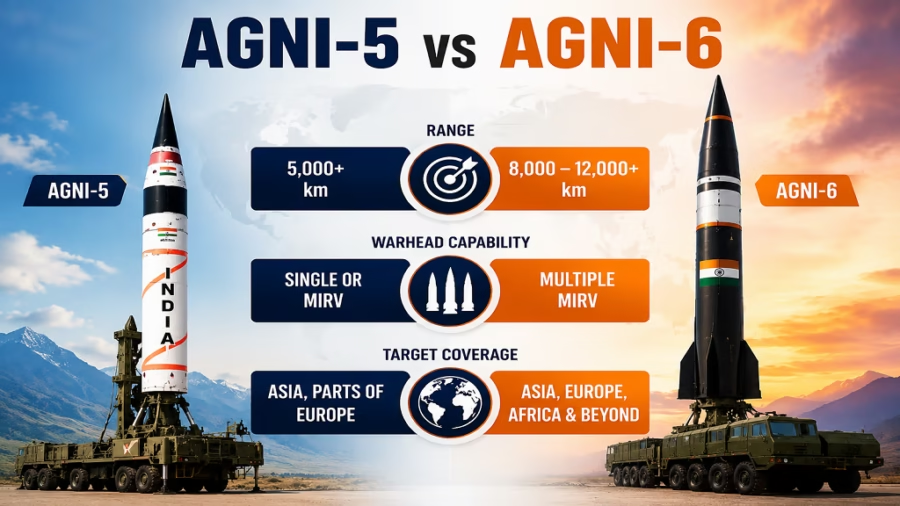
As per sources, including information from previous DRDO employees, the design process has already been completed, and all they are waiting for is final clearance from the government. Unlike the earlier versions of the Agni series that had a regional deterrent, the new Agni-6 missile system strikes the targets at intercontinental ranges. It is estimated that the Multiple Independently Targetable Reentry Vehicle (MIRV) missile technology has a range capability between 8,000 and 12,000 km, and a single missile carrying multiple warheads striking different targets.
Specifications of Agni-6 Missile-
| Basis | Specifications of Agni-VI |
| Range of Strike | 8,000-12,000 km (projections made); others claim over 10,000 km |
| Payload Capacity | Has the capacity to manage 1,000 kg of nuclear or conventional warheads |
| Number of Stages | Agni-VI consist of a four-stage solid-propellant ballistic missile |
| Number of Warheads | Can carry up to 10 MIRV warheads |
| Propulsion Type | Solid propellant (four stages) |
| Launching Platform | Land-based canister launchers; submarine-based launcher expected |
| Guidance System | Features sophisticated guidance with ring laser gyroscope INS and micro navigation |
| Missile Accuracy | Achieves high accuracy with circular error probable (CEP) measured in meters |
| Weight of Missile | Weigher and massive, and then the previous Agni-V (weighs approx. 50 tn(s) ) |
| Deployment Status | Pending or Awaited |
What is the MIRV Technology in Agni 6?
What makes Agni-6 the buzz is the inclusion of MIRV technology in its system. MIRV stands for the Multiple Independently Targetable Re-entry Vehicle technology in the Agni 6 missile, which has the capacity to target its enemies in multiple directions. These missile types have multiple warheads programmed to destroy a specific target at different locations.
- The efficiency of a single missile launch is greatly improved by MIRVs, which complicate enemies’ efforts to intercept them.
- With the inclusion of MIRV capability using the Agni-5 programme under Mission Divyastra, India created a milestone in its nuclear programme. Testing the MIRV-capable Agni-5 variants has paved the way towards integrating this capability into Agni-6. Experts consider this a logical progression since Agni-6 will be developed based on the same technologies as Agni-5.
- From a tactical perspective, an MIRV-equipped Agni-6 could attack multiple strategic assets simultaneously, including command centres, military bases, and missile depots. It increases deterrence power since it poses a problem to the enemy of intercepting more than one warhead.
Geopolitical Importance of Agni-6-
- As the target range ranges between 8,000-12,000 km, the Agni-VI would be termed as “China killer” in military parlance. This missile would provide India with the capacity to hit any urban areas in China, Europe, the Middle East, Africa, as well as several parts of the USA.
- Therefore, unlike Agni-V, which has a range of 5,500-6,500 km and could reach all the territories of China but not any part of mainland America, the Agni-VI would give India access to global strike intercontinental ballistic missiles along with the USA, Russia, China, France, and Britain.
- The dual nature of launch, from both land and submerged systems, is such that India will acquire the capability of having a nuclear triad and will be able to execute second strikes even when it is a victim of a first strike.
- These capabilities, among others, become imperative for providing India with credible minimum deterrence and protection against nuclear coercion at the hands of other rival nations.
- Moreover, India would also have the capability to breach enemy defences through Multiple Independent Reentry Vehicles.

Agni-6 as a Strategic Defence System for India-
From a military strategist’s point of view, the Agni-6 missile is much more than just another weapon for India’s arsenal; it is a strategic policy for the country’s security.
- India’s nuclear strategy rests upon credible minimum deterrence, and we haven’t used it in any war. Deterrence, however, requires surviving a possible first strike and having the ability to retaliate.
- Complements Nuclear power operations: The Agni-6 missile is perfectly aligned with India’s strategic nuclear doctrine. First, its long-range capability allows India to be able to continue its policy of deterring any adversary who may be far away from India itself by operating from home bases.
- Owns the Launch Platform: One of the other strengths of Agni-6 is that of flexibility, in that India will not have to rely on foreign countries’ bases for launch or operation of Agni-6 in the event that they are needed.
- Nuclear Deterrence Credibility and China: India will have its own intercontinental ballistic missiles through the deployment of the Agni-VI, which the Agni-V is unable to provide. Even though the Agni-V ranges from 5,500–6,500 km, it lacks payload capacity, i.e., only 1.5 tons, making it impossible for India to have credible nuclear deterrence against China.
- Global Strike Potential and Diplomatic Edge: The 12,000+ km strike potential means it will cover the maximum world’s main powers’ capitals within the striking distance of Agni-VI missiles, which include capitals in Europe, the Middle East, and even in the U.S. Owning such missiles means that India is one of only five countries in the world having the ability to strike the planet, alongside the USA, Russia, China, and Britain.
- Fulfilling the Aim of Atmannirbhar Bharat: The Agni-VI is the level of development that the Indian guided missiles have achieved and is an indication of the successful operation of their previous generations, starting from Agni-I through Agni-V. The development of the indigenous technology will reduce India’s reliance on foreign countries in providing it with strategic arms that could put strings on them.