
Chinese AI company Moonshot AI has released Kimi K3 – one of the world‘s largest autoregressive language models (LLMs), which is receiving worldwide attention for its size and capabilities. The new model is being called the world‘s largest open-weight Chinese-AI model at 2.8 trillion parameters, with a 1-million token context window.
Kimi K3 is gaining attention as Moonshot AI says it reduces the American AI edge from OpenAI, Anthropic, and others, and beats multiple US-based competitors in coding, reasoning, and AI agent tests. The debut comes as an AI fight between the US and China reaches new heights, with both nations pouring billions into cutting-edge AI.
ALSO READ- Nationwide Protest Against New NFSA Amendments 2026
Why Is Kimi K3 in the News?
Kimi K3 is in the headlines because the Chinese AI company Moonshot AI announced the world‘s largest Open-weight AI model.
The company claims the model:
- Has 2.8 trillion parameters.
- Completely supports a 1 million token context window
- Rivals have trained up competing AI systems, such as those constructed by OpenAI and Anthropic
- Surpasses several widely used AI models in coding and reasoning tests
- Shows the pace at which China is moving despite semiconductor and computing limitations.
This news has attracted extensive interest from AI researchers, investors and technology companies in every part of the world.
What Is Kimi K3?

Kimi K3 is another LLM made by Moonshot AI. It is an AI startup based in Beijing and among the fastest-growing AI firms in the country.
It is designed for advanced tasks such as:
- Coding help
- Extended reasoning
- AI agents.
- Research
- Knowledge-intensive work…
- Development of software
- Document analysis
The Model is part of the newest generation of foundation AI and is designed to both understand human language and produce it, while being able to perform very complex tasks.
Key Features of Kimi K3-
Kimi K3 possesses several cutting-edge features that qualify it as one of the largest AI models worldwide.
Massive 2.8 Trillion Parameters:
According to Moonshot AI, Kimi K3 has 2.8 trillion parameters, China‘s biggest AI model so far.Parameters the internal quantities that AIs learn as they are trained. Having more parameters won‘t in itself promise higher accuracy, but it does enable the network to learn a mapping between much more intricate concepts and variables.
One Million Token Context Window:
One of the major features is its 1 million-token context window.
This enables the model to:
- Read extremely long documents.
- Processing large code bases
- Master long conversations.
- Keep far more information in the same prompt.
This makes Kimi K3 very capable for enterprise applications, legal documents, research papers and even software engineering.
Open-Weight Architecture:
Differing from proprietary AI models, Kimi K3 has been published as an open-weight model.
This allows developers to:
- Download the model
- Run it on their own infrastructure.
- Fine-tune the component to your own use cases.
- Customise applications without relying 100% on the cloud providers
However, due to Kimi K3‘s expansive size, you need a large set of computing resources to run it locally.
How Does Kimi K3 Compare With OpenAI and Anthropic?
Moonshot AI recognises that Kimi K3 has not yet achieved the comprehensive talent that the current state of the art opens in AI from participants OpenAI and Anthropic.
According to the company:
- It trails Anthropic‘s Claude Fable 5
- It also trails OpenAI‘s GPT-5.6 Sol
Nevertheless, Moonshot/ Kimi K3 is said to have shown superiority over several of the other high-end systems, such as:
- Claude Opus 4.8
- GPT-5.5
The company says the model achieved particularly strong results in:
- Coding benchmarks
- AI agent tasks
- GPU optimization
- Complex reasoning
Independent benchmark platforms have also reported competitive performance in web development and multi-step reasoning tasks.
Why Is Kimi K3 Important?
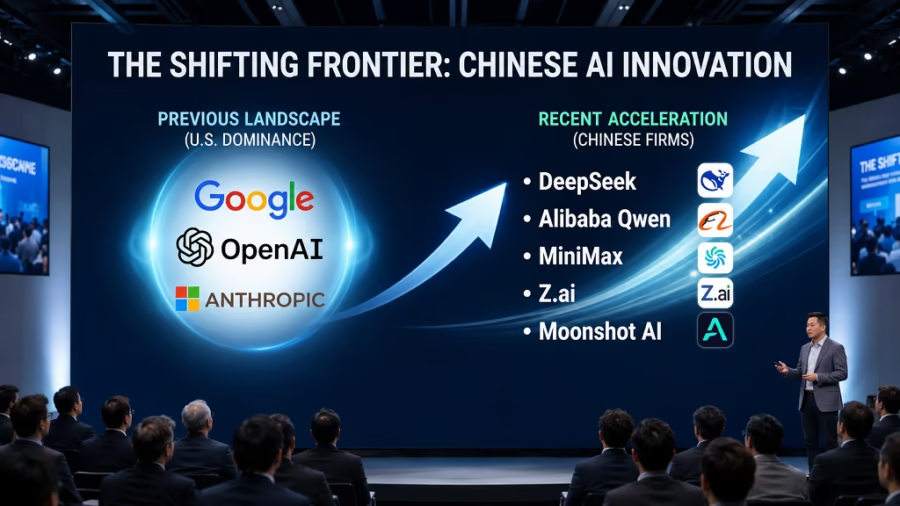
This launch is yet another minor milestone on China‘s seemingly accelerating AI ecosystem. There are several reasons for its importance.
Narrowing the AI Gap:
For years, U.S. firms held sway over frontier AI development.
Recent releases from Chinese firms such as:
- DeepSeek
- Alibaba Qwen
- MiniMax
- Z.ai
- Moonshot AI
Lower Deployment Costs:
According to industry analysts, Chinese artificial intelligence systems tend to be less expensive to run than many of their American equivalents. Lower operating costs make them attractive for:
- Businesses
- Startups
- Developers
- Educational institutions
This affordability makes Chinese AI models attractive on the global stage.
Market Reaction to Kimi K3-
The announcement‘s effect was felt immediately within China‘s AI industry.
Following the launch:
- The Z.ai stocks tumbled.
- MiniMax had yearly losses, too.
- Investors perceived that the Kimi K3 raised the benchmark of Chinese AI talent development.
Analysts think rival companies may be about to pick up their model development pace.
What Makes Open-Weight Models Different?
Open-weight AI models differ from closed proprietary systems.
Open-Weight Models:
These models allow developers to:
- Access to model weights
- Customize the AI
- Adjust your model for more industry-related tasks
- Deploy on private infra
Closed Models:
Companies such as OpenAI and Anthropic usually make their models available via an API, but not accessible as weights.
Open-weight models promote increased experimentation, research and enterprise adoption.
Why Kimi K3 Matters for the Global AI Race-
Artificial Intelligence has emerged as a strategic technology affecting economic growth, national security, healthcare, education, scientific research and software development.
The release of Kimi K3 highlights:
- China- Continuing to advance AI speed
- Increasing international competition in foundation models
- More access to hard-weight open-weight AI systems
- Rapid innovation despite hardware limitations
- Broadening options for businesses and developers globally
Additionally, it points to how the race for dominance in AI is quickly becoming a competitive one rather than being led by a handful of Western firms.
Key Highlights-
The Chinese startup Moonshot AI developed Kimi K3
- There are 2.8 trillion parameters.
- They can use up to 1 million tokens.
- It is now China‘s largest open-source AI model.
- Intended for Reasoning, coding and AI agents, enterprise application.
- Competing with top models from OpenAI and Anthropic.
- Supported by Alibaba and Tencent.
- Symbolises the increasing strength of China in this area.
Conclusion-
Kimi K3 is another major step forward in China‘s efforts at artificial intelligence and further highlights the country‘s rising ability to rival the world‘s top AI companies in the U. S. With Kimi K3‘s open-weight model, 2.8trillion-parameter architecture and one million token context window, the model not only beats the previous generation but also demonstrates considerable gains in reasoning, coding and enterprise AI.
While Moonshot AI admits that its Kimi K3 is not yet at the same level of performance as the most recent flagship models from OpenAI and Anthropic, its benchmark scores nonetheless exemplify the rapid pace of advancement in Chinese AI. As the race for AI supremacy heats up, the Kimi K3 will likely be an influential contributor to the future development of open AI and enterprise AI.