
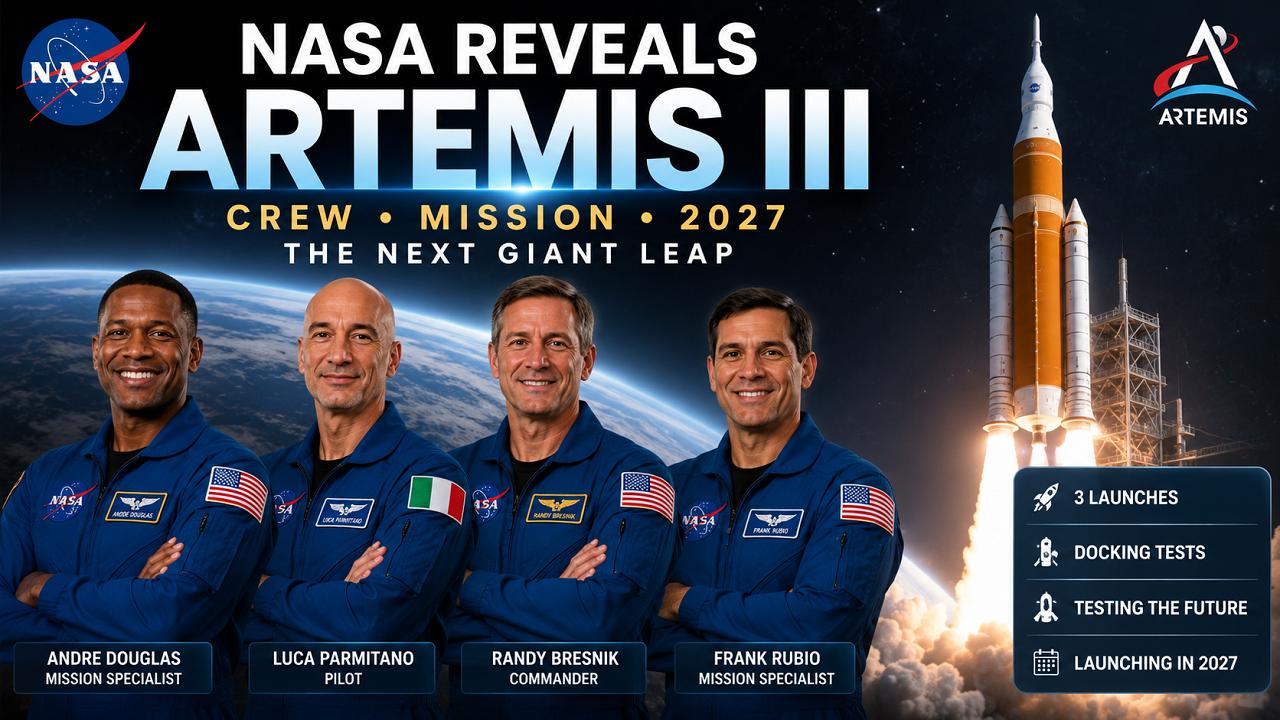
More evidence that NASA has moved another big step toward the future of human deep-space exploration has been released. Today, the space agency disclosed the crew of its Artemis III mission, recently scheduled to lift off in 2027. This mission will be one of the most technically challenging ever mounted and is viewed as a vital precursor to both robotic and crewed lunar landings, all leading up to a Mars mission.
Previously, the Artemis III mission was to be a Moon landing mission; however, NASA has now reconfigured the flight as an important Earth-orbit demonstration test. It will serve to evaluate new technologies and spacecraft systems, docking methods that will be utilised during Artemis IV, to be launched as the first crewed lunar landing flight of the Artemis program in 2028.
ALSO READ- India’s Nuclear Arsenal Grows: SIPRI 2026 Reveals
NASA Announces Artemis III Crew-
The Artemis III crew was officially announced by NASA on 9 June 2026 at an event at Johnson Space Centre in Houston.
The four astronauts selected for the mission are:
- Randy Bresnik (NASA) – Commander
- Luca Parmitano (European Space Agency) – Pilot
- Frank Rubio (NASA) – Mission Specialist
- Andre Douglas (NASA) – Mission Specialist
- The backup crew members include NASA astronaut Bob Hines.
The crew for Artemis III is a fusion of seasoned astronauts and a novice, and among today’s space travellers, that team will be able to handle one of the most difficult missions.
What Makes Artemis III Different?
Originally meant to be the first mission sending astronauts back to the Moon after Apollo 17 in 1972, Artemis III was modified by NASA in early 2026.
Artemis III do not land on the Moon, but focuses on the testing of technologies and spacecraft operations in low Earth orbit.
NASA states that the mission will “further reduce risks involved with upcoming lunar missions by testing various spacecraft systems working together in a space environment prior to sending astronauts farther out into space.”
The mission will require several launches, sophisticated docking operations and teamwork between NASA and commercial space companies.
Artemis III Mission Objectives-
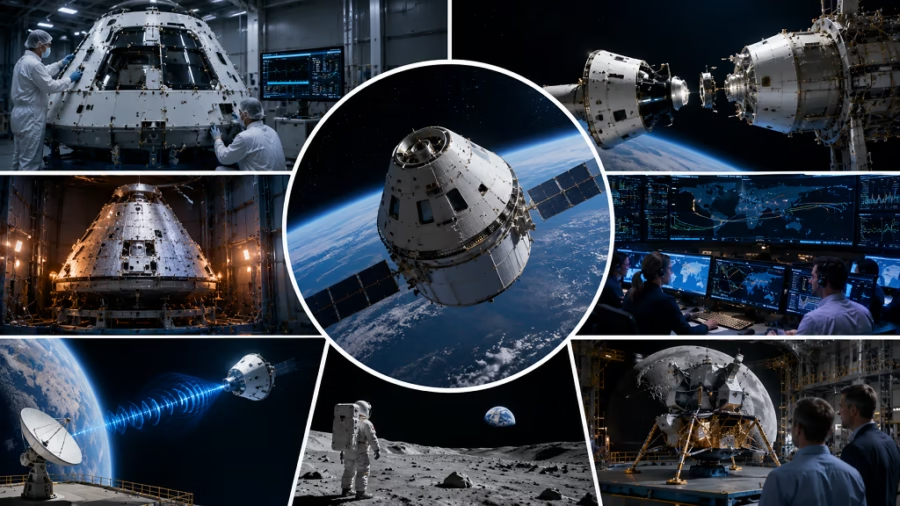
The mission is meant to demonstrate several critical capabilities that will be required for future lunar missions.
Key objectives include:
- Testing the various systems of the Orion spacecraft
- To show rendezvous and docking procedures
- Assessing space vehicle integrity
- Testing communications and navigation systems
- Operational procedures validation for future lunar missions
- Backing commercial lunar lander development
NASA feels these tests are necessary before astronauts undertake long-duration missions close to the Moon.
A Mission Featuring Three Major Rocket Launches-
One reason Artemis III is attracting global attention is the complexity of its mission architecture.
NASA plans to use three separate launches during the mission.
First Launch:
A Blue Origin spacecraft will launch into Earth orbit and remain there waiting for the crew.
Second Launch:
The Orion spacecraft will be launched on a Space Launch System (SLS) rocket with four astronauts on board from the Kennedy Space Centre in Florida. Once in orbit, they will rendezvous and dock with the vehicle.
Third Launch:
Next, a SpaceX Starship test vehicle will reenter orbit. Once the tests with the Blue Origin craft are concluded, Orion will undock again and perform another rendezvous and docking with Starship. This sequence will enable NASA to test the interaction of Orion with spacecraft being built by both commercial companies.
Testing Commercial Human Landing Systems-
One of the primary areas of interest for Artemis III is the exploration of the Blue Origin and SpaceX spacecraft.
While both vehicles were adapted from future lunar landers, the vehicles for the Artemis III mission are considered test articles rather than more conventional Moon landers
Blue Origin Test Vehicle:
The Blue Origin spacecraft is expected to include:
- Operational life-support systems
- Crew-accessible interior
- Docking capability with Orion
- Extended orbital duration
Astronauts will enter the spacecraft and perform system evaluations.
SpaceX Starship Test Vehicle:
The Starship test article will include:
- Docking systems
- Flight-control testing
- Interface demonstrations
However, astronauts will remain inside Orion because Starship’s crew-support systems will not yet be operational.
Meet the Artemis III Astronauts-
Randy Bresnik – Commander:
Bresnik is an experienced astronaut and former U. S. Marine colonel. He has previously flown on a Space Shuttle and worked on the International Space Station.
With 1000+ flight hours on several types, he offers vast leadership and operational experience.
Luca Parmitano – Pilot:
Parmitano will be the first European Space Agency astronaut to fly on an Artemis mission. This will also be his third spaceflight, and he was previously the ISS commander. Focus on international collaboration in the Artemis program has been emphasised.
Frank Rubio – Mission Specialist:
Rubio gained prominence after living for 371 days on the International Space Station, the longest single stay in space by an American astronaut.
His experience in such a long-term spaceflight will be useful in the future Artemis missions.
Andre Douglas – Mission Specialist:
This is Douglas, the newest addition to the crew and his first trip to space.
Considering his engineering background and working experience in high-tech development, he is a great asset to the mission team.
Progress on Artemis III Hardware-
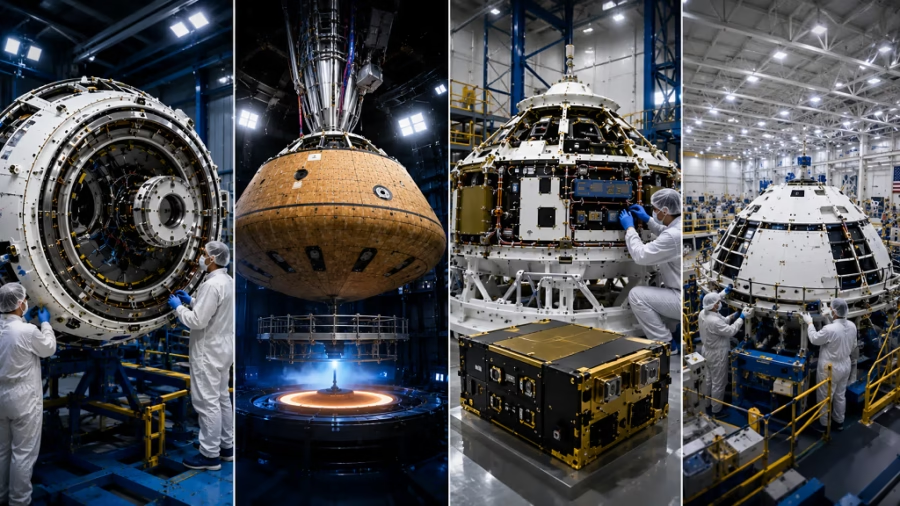
NASA and its partners are making significant progress on spacecraft and rocket preparations.
Orion Spacecraft:
The engineers are still putting together the Orion Artemis III spacecraft.
Key developments include:
- Docking system in the integration.
- Continued heat shield testing
- Installation of important flight hardware
- Tight production schedules
Space Launch System Rocket:
SLS rocket to this day remains the foundation of the Artemis program.
Recent milestones include:
- Delivery of core-stage hardware
- Arrivals of booster parts
- Preparation of the mobile launch tower.
- Next engine install
NASA announced they will conduct major stacking operations toward launch.
Why Artemis III Is Important-
Even though Artemis III will not land astronauts on the lunar surface, most of the experts view it as the vital mission of the entire Artemis program.
The mission will test technologies, techniques and collaborations needed for future exploration.
From the experiences of Artemis III, NASA is expected to improve the performance of the next moon project.
The mission will simultaneously develop the working relationship and enhance the ties that exist between NASA, ESA, Blue Origin and SpaceX, contributing to a sustainable humans-on-Mars future.
Looking Ahead to Artemis IV-
NASA plans that Artemis IV will be the first crewed lunar landing of the Artemis period.
The technologies and operational experience will be directly applicable to that mission.
Successful Artemis III will allow astronauts to land again on the Moon, build sustainable exploration, and ultimately send humans to Mars.
Conclusion-
Artemis III is no doubt a large achievement in returning humanity’s presence to deep-space exploration. By utilising the strengths of NASA, the European Space Agency, Blue Origin and SpaceX, the launch is sure to test every important system needed for future lunar landings and journeys to the outer regions of the solar system. Supported by a veteran crew, cutting-edge spacecraft, and a multi-launch strategy, the Artemis III mission is sure to be one of the most talked-about space missions in the 2020s.