


On this International Day for Conservation of Nature, which is observed all over the world on 5 June 2026, India joins the rest in focusing on climate change and conservation issues. This day‘s theme, Inspired by Nature. For Climate, For Our Future is also relevant to India, which is trying to strike a balance between development and the resources that sustain life.
In the last ten years, India has greatly extended its environmental activities such as installation of renewable energy, afforestation campaigns, conservation programmes for biodiversity, solid waste management reforms and public-driven climate campaigns. With the advent of the new Prime Minister Narendra Modi, ‘environment’ has gone beyond the realm of governmental endeavour to establish itself as a national movement of communities, enterprises, and citizens.
From the bold Ek Ped Maa Ke Naam campaign to record-breaking growth in renewable energy, India’s climate story is now seen as a model for sustainable development in the developing world.
ALSO READ- India–Oman CEPA: A New Trade Milestone
Why World Environment Day 2026 is Crucial-
Every year on the 5th of June, the world celebrates World Environment Day. The day is celebrated to create awareness and encourage citizens to take action for the environment’s welfare. The day was originally led by the United Nations as a reminder to the general public about the growing dangers of climate change, biodiversity loss, pollution, etc. Emphasises the importance of nature-based solutions and its team. Working together is central to delivering a sustainable life for all future generations.
While in the meantime, many communities worldwide bear the brunt of extreme weather and climate shifts and worsening environmental trends, even more countries are compelled to ramp up their climate responses. India has responded with a big response.
PM Modi’s Environmental Vision: From Policy to People’s Participation-
In fact, public participation has been a constant characteristic of Indian environmental policy for the simple reason that people’s participation and convergence of interest are always easier to find than ‘coercive intervention’ (Jain, 480).
Prime Minister Narendra Modi has been unequivocal that the chapter of climate change should not be limited to the climate change action of governments or even the climate change international conferences, but needs to be incorporated into our daily lives.
This approach is often reflected in his message: Reduce, Reuse and Recycle
While it is a simple goal, it is an effective one to get the citizens to modify their habits in ways that, taken together, make a real difference.
Hence, they have been formed in order to relate two different aspects: caring for our environment and involving everyone in caring for our environment.
Ek Ped Maa Ke Naam: Planting Trees with a Purpose-

One of the most heavily discussed eco-movements is Ek Ped Maa Ke Naam has been started in the 2024 who has been declared as World Environment Day.
The campaign urges citizens to plant a tree in memory of their mothers, such that they develop a connection between saving the environment and saving their family values.
Key Highlights of the Campaign:
- More than 262 crore saplings have been planted across India.
- Participation from schools, communities, and government institutions.
- Meri Life platform is also used for digital tracking purposes.
- Encouragement of long-term protection of the environment.
What the campaign has successfully achieved is one of the emotional appeals. Associating forestation with love and thankfulness towards mothers turns it into a personal mission.
Renewable Energy Drives India’s Green Transformation-
One of the most indisputable pieces of evidence of what an equally ambitious climate goal committed by India is in the country’s acceleration of renewable energy.
In the last ten years, it has been one of the world’s most rapidly expanding renewable energy markets.
Solar Energy Leads the Way:
The installed solar capacity in India has grown exponentially from several GW in 2014 to well above 100 GW.
Several factors have contributed to this growth:
- Falling solar panel costs
- Government incentives
- Major Solar parks
- Rooftop solar programmes
Thus, solar power is now one of the cheapest electricity production resources in the country.
Wind Energy Continues to Expand:
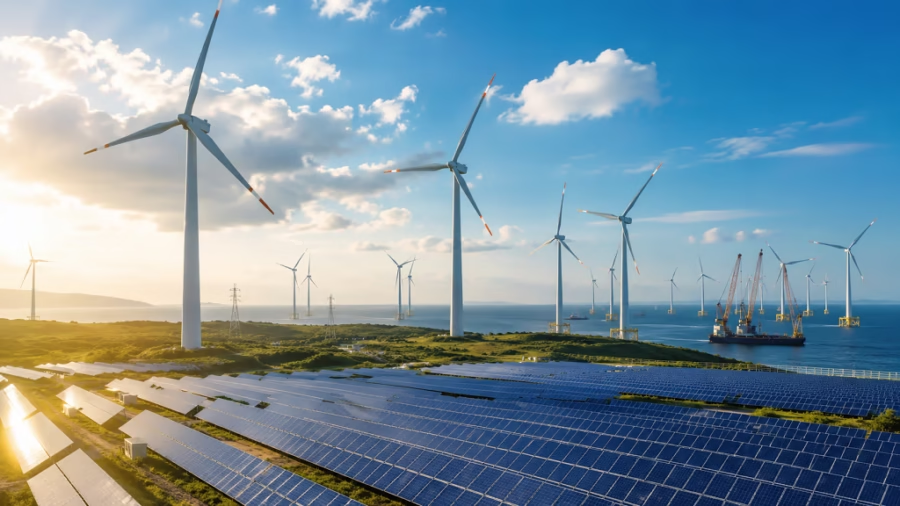
In addition to solar power, India has strengthened its wind energy sector.
Important achievements consist of :
- Significant increase in installed wind capacity
- New investments in offshore wind projects
- Build more renewable capacity
Together, wind and solar are reducing our reliance on fossil fuels and enhancing energy security.
PM Surya Ghar Yojana: Bringing Solar Power Home-
A significant scheme being implemented in the range of policies for fulfilling India’s clean-energy objectives is the PM Surya Ghar Muft Bijli Yojana.
This scheme is designed to open up the market for rooftop solar systems to millions of households.
Benefits of the Programme:
- Lower electricity bills.
- Greater energy independence
- Lower carbon products, purchases and emissions
- Economic support in the form of subsidies
Therefore, the programme is trying to involve common people in India’s transition to clean energy.
Green Hydrogen and the Future of Clean Industry-
India is not only focused on renewable electricity but also on pouring in investments to improve green hydrogen technology.
The mission aims to make India a global hub of hydrogen production and exports.
Expected Benefits:
- Decreased reliance on imported fossil fuels
- Generating employment
- Cleaner industrial processes
- Improved energy security
However, as the global economy seeks low-carbon options, green hydrogen may be a key element of future climate measures.
Forest Conservation and Afforestation Efforts Gain Ground-
Reducing emissions is a necessary but not sufficient part of an environmental solution. There must also be safeguards to avoid degrading our large natural ecosystems.
Amazingly, aware of this, India has stepped up efforts to expand forest cover and rehabilitate degraded forest lands.
Major Achievements:
- Rise in forest and tree cover
- Increase in the sink functions of forests.
- Massive afforestation projects
- Urban green-space development
These programs are essential to sequester CO2, maintain biodiversity and enhance climate resilience.
Wildlife Conservation Delivers Positive Results-
India has also been successful in conserving its wildlife apart from its forest resources.
The overall achievements for the protection of endangered species have been excellent, with some flagship programmes standing out:
Notable Success Stories:
Project Tiger:
Wild Tigers today, reclaiming the territories of India, currently supports the largest population of wild tigers in the world. Tiger numbers are increasing steadily.
The number of protected habitats has increased substantially
Project Cheetah:
The reconviction of these predators worldwide is a major step towards ecological restoration.
Project Lion:
Asiatic lion population has been preserved, and the range of parks and protected areas has grown.
It is encouraging to find that such is the case with these programmes, are evidence of the success that can be achieved with short-term plans.
Namami Gange and River Rejuvenation-
The rivers of India form the very heart and soul of the country. In order to take care of pollution and destruction of the ecosystem, the government started the Namami Gange Programme.
Key Outcomes:
- Upgrades to sewage treatment facilities
- Reduction of industrial pollution
- Projects for the development of the riverfronts
- Ecological conservation of aquatic diversity
- Increased public participation
This project has become the world’s biggest river restoration programme and continues to achieve real benefits for the environment.
Waste Management and Circular Economy Reforms-
Saving the best for last, a green transformation that India is moving towards would also bring with it significant improvements to its waste management.
Over the years, the shift from disposal to resource recovery and recycling has occurred.
Key Developments:
- Increase waste-processing capacity
- Scientific approach to the problems of municipal waste.
- Extended Producer Responsibility (EPR) frameworks
- Circular economy policies
- Reduced legacy waste dumpsites
These reforms are helping create cleaner cities while supporting sustainable economic growth.
India’s Growing Role in Global Climate Leadership-
Due to its progress on the environment, India has improved its standing on the world stage.
Country plays an active part in developing international climate debates by:
International Solar Alliance:
Co-founded by India, the alliance promotes solar energy adoption across the world.
Mission LiFE:
This was set up to promote sustainable lifestyles and responsible consumption behaviour worldwide.
Climate Commitments:
India has already missed some Climate Targets. India has shown that these goals are achievable despite putting economic development first.
This has further increased India’s credibility as a trustworthy partner on the global climate stage.
Conclusion: Making a Sustainable Future-
World Environment Day 2026 is a powerful reminder that saving nature is a joint effort.
All of this is seen in the case of India in the last decade, where this development has been created based on the combination of policy reforms, innovations, people’s efforts, etc. Whether through sapling plantation, creation of renewable energy sources or monitoring the wildlife, rejuvenation of the river or through the campaign Ek Ped Maa Ke Na, the country is moving to a greener era.
Nevertheless, challenges remain, but India’s high experience has much to offer: where climate change will become more and more a worldwide concern, countries with a common objective of greener development can succeed. In view of the size of the country as well as the stability of its low-carbon policies, the Indian case of green development may encourage others.