


To promote fair coal practices in India, the Ministry of Coal has released the AAROH Annual Report on Mine Closure on 22 July 2026 (Wednesday) in New Delhi. It is a big step forward in its move towards sustainable mining operations and clean energy generation, with the reclamation of 42 abandoned coal mines along with the release of the AAROH (Advanced Analytical Report on Operational Heritage) report. The report was launched alongside the signing of an India-Germany Implementation Agreement with GIZ (Deutsche Gesellschaft für Internationale Zusammenarbeit) to promote scientific mine closure and sustainable post-mining land use. The event also witnessed the inauguration of Coal NEER Plants and the signing of an MoU for skill development under the Revised Jharia Master Plan.
ALSO READ- What Is Kimi K3?
Why is this Coal Mine Initiative Important?
For many decades, coal has been the backbone of India’s energy industry. However, many years of extraction activities have resulted in several abandoned mines, which pose various environmental and socio-economic problems. These abandoned mines have been associated with adverse effects such as land degradation, pollution of water bodies, emission of greenhouse gases, and safety risks to the people living around them. Since independence, for the first time, such a report has been released by the coal ministry, as a part of the Indian government’s efforts to integrate economic progress with environmental sustainability.
The coal ministry stated that mine closure is a critical stage in the mining lifecycle, encompassing ecological restoration, land reclamation, and the productive repurposing of post-mining sites for community and economic benefit.
The program will exhibit ground-level innovation in areas of mine reclamation, ecosystem restoration, and community-based rehabilitation. Exhibition programs will include initiatives implemented by Coal India Limited (CIL), as well as their subsidiary organisations NLC India Limited, Singareni Collieries Company Limited (SCCL), NTPC, and private mining companies. Honourable chief guests such as G. Kishan Reddy (Union Minister for Coal and Mines), Bhupinder Yadav (Union Minister for Environment, Forest and Climate Change), and Jitendra Singh (Union Minister of State for Science and Technology) graced the event, declaring the report, agreement with Germany and inauguration of the Coal NEER Plant. Acknowledging the significance, the Ministry has developed frameworks such as RECLAIM, which involves stakeholder consultation; the L.I.V.E.S. Framework for mine closure and repurposing; and SUVIKALP, which is an interactive decision-support tool used for evaluating mine reclaiming alternatives.

What is the AAROH Report?
AAROH report acts as a holistic analysis of abandoned coal mining sites in the country. It offers scientific study, mapping, environmental assessment, and reclamation methods of idle mining sites. The AAROH report provided by the Ministry of Coal (India) will act as a crucial planning tool for planners, policy makers, mining authorities, environmental agencies, and investors in that it will help them in:
- Identification of mining sites that need urgent attention.
- Environmental and ecological assessments.
- Recommendations for appropriate reclamation methods.
- Renewable energy generation possibilities.
- Sustainable use of the mining lands.
- Long-term environmental monitoring.
Instead of declaring abandoned mines as problematic areas, the AAROH report encourages stakeholders to consider them as assets that can contribute to green development.
Inauguration of Coal NEER Plants-
With the release of the AAROH report, the event will also inaugurate Coal NEER Plants to provide safe drinking water. Coal NEER Plants are safe water supply plants built by Coal India Limited (CIL) and its subsidiaries for coal-producing regions. These NEER plants will be created to ensure a clean and sustainable supply of water to local populations, especially people living in mining zones where there is an inadequate supply of safe drinking water. This program underscores the role of Coal India in the betterment of the people through initiatives related to corporate social responsibility.
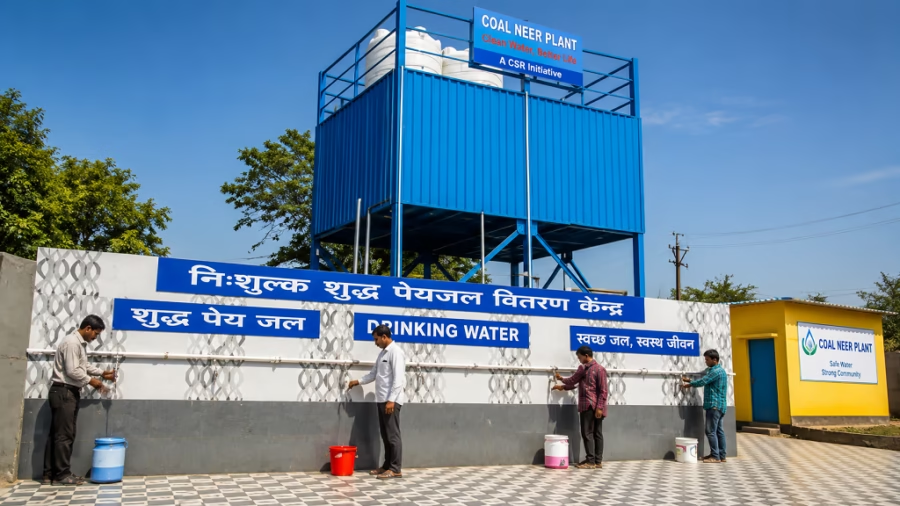
Technological Advancements in Mine Restoration-
The technological advancements in mine restoration are the reason why modern mine restoration processes have become more effective and eco-friendly. According to the AAROH Report, there is an increased use of:
- Artificial Intelligence (AI) and data analytics help in making decisions based on environmental data analysis
- Geographic Information Systems (GIS)
- Remote sensing
- Satellite images
- Drone monitoring
- Digital mapping
These technologies will assist in mine restoration for assessing the status of abandoned mines and designing effective mine restoration projects. The technology helps monitor land use, identify possible risks to the environment, and check the progress of the mine rehabilitation process in real-time mode. There is continuous digital monitoring of soil conditions, water resources, vegetation, and biodiversity to restore ecological balance.
Why is Reclamation of Coal Mines Necessary?
- Restoring the environment: Reclaiming mines will assist in restoration of degraded lands through improved soil quality, protection against erosion, reforestation, and biodiversity conservation.
- Prevention of Environmental Threats: Reduces environmental threats including land subsidence, water contamination, air pollution, and methane emissions from old mines.
- Sustainable Land Use: Transformation of waste lands due to mining into productive uses such as solar parks, water storage, farming, forestry, and eco-tourism sites.
- Improves the Lives of Local Communities: Improves their safety, provides employment during the restoration process and ensures socio-economic development in the long run.
- Better Policy Making and Planning: Provides credible information and best practices for decision-making on mine closure and post-mining developments.
- Helpful in Achieving India’s Climate Change Goals: Supports India in achieving its goals of carbon sequestration through afforestation, promotes sustainable resource management, and contributes to India’s net-zero and environmental sustainability commitments.
FAQs-
A. The AAROH Report is the first-ever report of India that deals with the scientific closure and rehabilitation and sustainable re-development of abandoned coal mines.
A. The AAROH report reduces environmental degradation, promotes renewable energy and green infrastructure, generates livelihoods, and helps India’s climate and sustainability goals.
A. According to the Ministry of Coal, 42 coal mines that were abandoned have been reclaimed successfully through the AAROH report. It is indeed a landmark achievement in mine closure and restoration activities in India.
A. The mine reclamation program includes Coal India Ltd, NLC India Ltd, Singareni Collieries Company Ltd (SCCL), NTPC, and a few private mining companies.
A. The India-Germany implementation agreement is designed to enhance scientific mine closure by incorporating German experience in ecological restoration and land development after mining operations.