
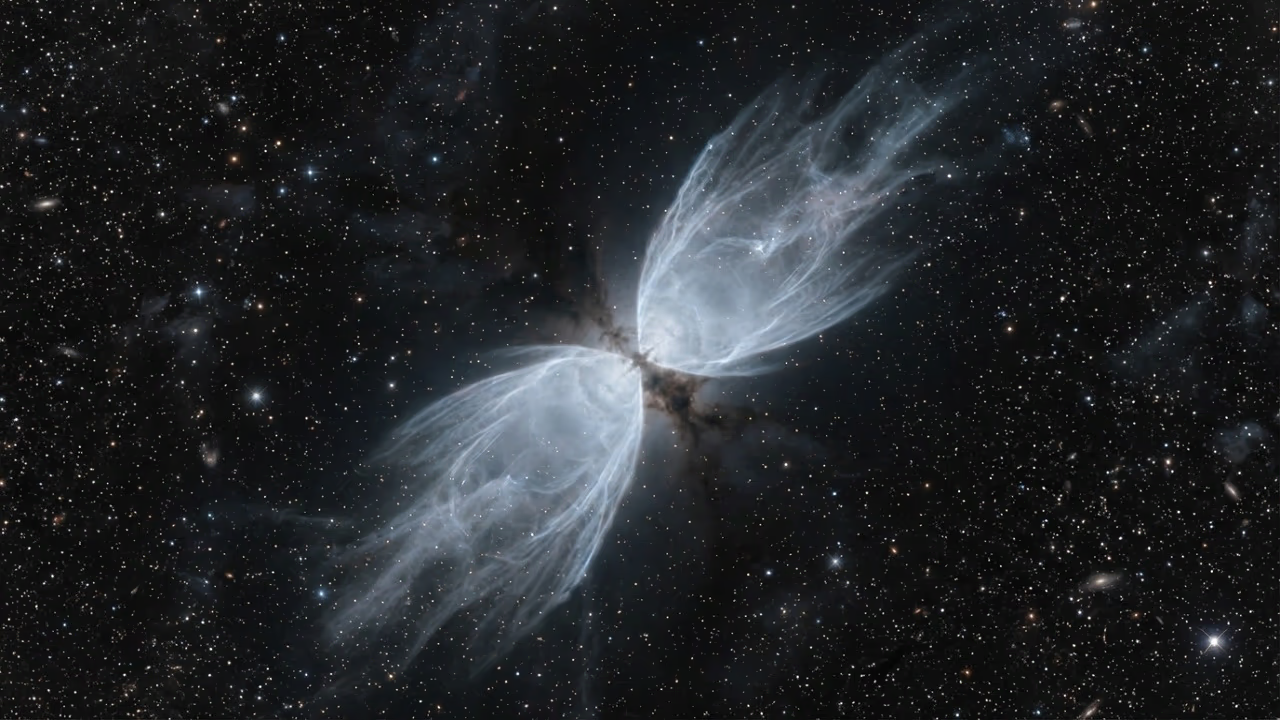
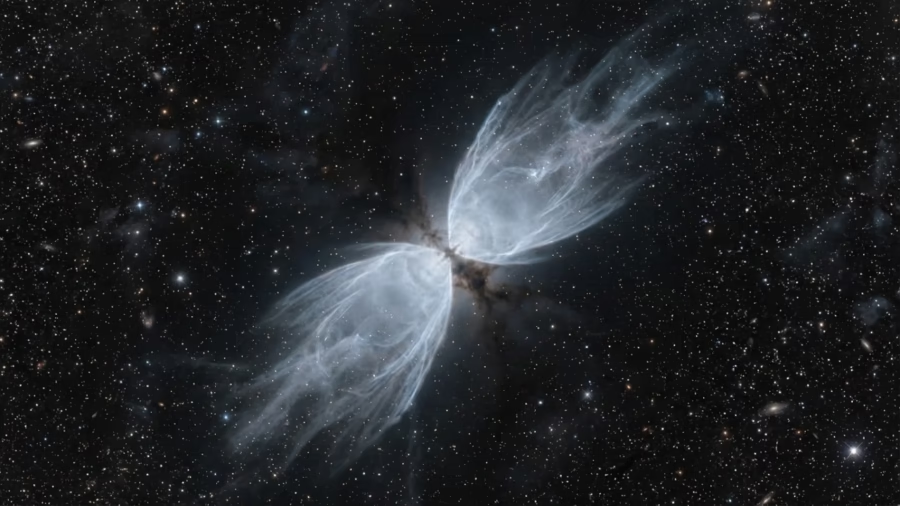
The universe is full of extreme phenomena, from ultra-hot black holes to frozen cosmic clouds. However, frozen is a relative term; in fact, the Boomerang Nebula is the coldest natural place in the universe known to man, at a staggering 1 degreesKelvin (-272 degreesC).
In the Centaurus constellation, 5,000 light years from Earth, is the Boomerang Nebula, a region of space which is determined to be colder than the rest of the universe (the CMB, which is the leftover light from the Big Bang itself), and one of the most interesting space discoveries of all time.
ALSO READ- Why Is the Save Shivalik Protest in the News?
Why Is the Boomerang Nebula in the News?
The Boomerang Nebula has once again gained interest from the scientific community and the general public, over two decades after it was learned that it is the coldest place in the universe and a comparatively hot cosmic destination. With the dramatic improvement of telescopes used by astronomers to study extreme places in the universe, the nebula remains the coldest naturally occurring place.
The fact that it can become even colder than the surrounding universe defies the current understanding of how stars evolve and how expanding gases behave.
What Is the Boomerang Nebula?
The Boomerang Nebula is a protoplanetary, a short phase transition between a dying red giant star and a planetary nebula.
Key facts include:
- It is approximately 5,000 light-yearsfrom Earth.
- Located in the Centaurus constellation.
- Estimated temperature: 1 Kelvin -272DHCPdegrees C
- An entity created by a sun-like star in the process of dying.
- Looks like a bow tie or hourglass.
From the initial ground-based observations, it appeared boomerang-shaped, which gave this spacecraft its popular name.
Why Is the Boomerang Nebula So Cold?
The freezing temperature is a result of a physical process called adiabatic expansion.
The central star is throwing enormous quantities of gas off at 500,000 kilometres per hour. Once this is exposed to the vast emptiness of space, it cools very rapidly.
This sudden expansion causes the gas to cool down to a temperature of about 1 Kelvin. Cooler than the CMB (-270.45 degrees C) at a temperature of about 2.7 Kelvin.
Most other bodies in space gain heat from the cosmic microwave background, but the Boomerang experiences a net cooling.
How Cold Is the Boomerang Nebula?
To appreciate its remarkably cold temperature, compare it against other familiar cold places.
- Boomerang Nebula is about -272 degrees C (1 Kelvin)
- Cosmic Microwave Background: Around -270.45 degrees C
- Absolute Zero: -273.15 degrees C
- Vostok Station, Antarctica: -89.2 degrees C
- The Boomerang Nebula has a temperature of ~1 K, just above absolute zero (0 K).
How Does It Compare With Antarctica?
The coldest air temperature ever clocked on the Earth’s surface came at Vostok Station, Antarctica, where it was -89.2 degrees C.
While Antarctica is Earth’s coldest place, it is far less cold than the Boomerang Nebula.
Comparison:
- Boomerang Nebula: -272°C
- Antarctica (Vostok Station): -89.2°C
This means the nebula is nearly 183°C colder than Earth’s coldest recorded temperature.
Discovery of the Boomerang Nebula-
The Boomerang Nebula was discovered in 1980 by astronomers:
- Keith Taylor
- Mike Scarrott
Through ground-based telescopes in Australia, the astronomers looked at a strange dust and gas cloud in the shape of a boomerang.
Years later, in 2003, with the powerful Hubble Space Telescope, it was found that the object is in fact a spectacular hourglass or bow-tie shape by bipolar gas flows.
Why Does It Have a Bow-Tie Shape?
There are several variables affecting different processes contributing to the nebula’s amazing form.
These include:
- Very fast bipolar gas flows
- Strong stellar winds.
- The dust around the central dying star.
- Gas being etched into two lobes on opposite sides
These two work points combine to produce the beautiful hourglass shape you see in present-day astronomical images.
Fascinating Facts About the Boomerang Nebula-
Some of the most interesting facts include:
- It is the coldest natural body ever observed.
- It is colder than the Cosmic Microwave Background.
- Is found about 5,000 light-years away from Earth.
- Comets were born in what was once a star like our Sun.
- Gas begins to expand away from the wall of the vacuum vessel at a speed of the order of 500,000 km/hr.
- Temperatures are maintained close to 1 Kelvin, just above absolute zero.
Today it can be seen in modern observations that it is hourglassed and not a genuine boomerang.
What Is the Hottest Place in the Universe?
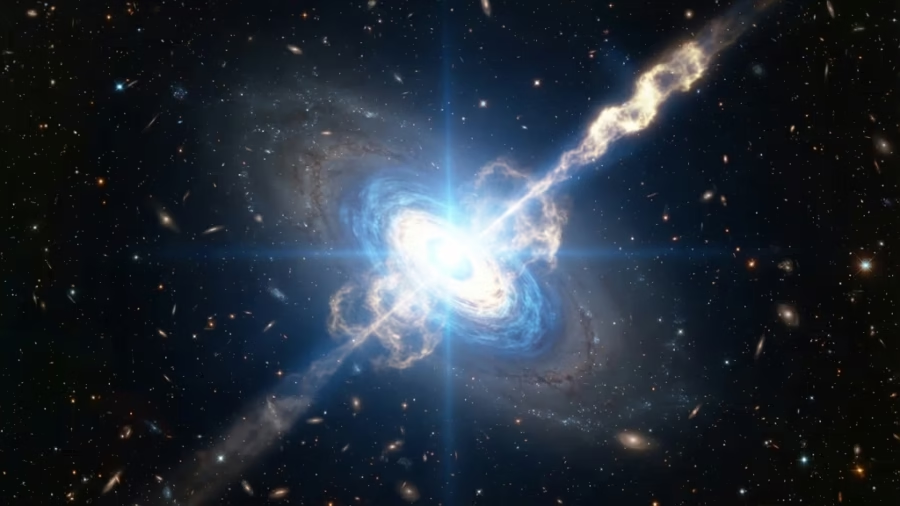
Although the Boomerang Nebula is the coolest known place, it is thought that the hottest parts of the universe are around active, feeding supermassive black holes.
One prime example is quasar 3C273, which lies about 2.4 billion light-years from Earth.
According to scientists’ calculations, its core area is believed to be near 10^12 Kelvin; thus, it is the hottest identified environment observed naturally at present.
It is the accretion disc (the fast-spinning band of dust and gas around the black hole) that is heated, not the black hole. The accretion disc (also called the ergosphere) is heated by friction, magnetic phenomena and colliding particles.
Other Extremely Hot Cosmic Events-
Apart from quasars, several cosmic events also produce enormous temperatures.
These include:
- Supernova explosions
- Gamma-ray bursts
- Neutron star mergers
- Relativistic jets from black holes
- Quark-gluon plasma created shortly after the Big Bang
Some massive stars are believed to reach over 100 billion Kelvin just before exploding as supernovae.
Is There a Maximum Possible Temperature?
Scientists believe there may be a theoretical upper limit known as the Planck Temperature. This temperature is estimated at approximately: 10³² Kelvin
At this unimaginable temperature: It will affect the nature of space and time, which may no longer act in a manner consistent with established physics.
- Gravity and quantum mechanics no longer seem to be on par.
- Our current physical theories are inadequate to explain matter.
- An entire theory of quantum gravity would need to be developed.
The Planck temperature, hence, defines the maximum meaningful temperature that current theoretical physics can reach.
Coldest vs Hottest Places in the Universe-
The contrast between these two extremes highlights the incredible diversity of the cosmos.
Boomerang Nebula:
- Temperature: Approximately 1 Kelvin
- Formed by a dying star
- Cooled through rapid gas expansion
Quasar 3C273:
- Estimated temperature: 10 trillion K
- Light powered by a supermassive black hole.
- Chiron is also being heated by an accretion disk of extremely high energy.
These wonderful objects show how the universe is capable of existing in two places at once, nearing absolute zero and reaching hellishly high heat.
Why Scientists Continue Studying the Boomerang Nebula-
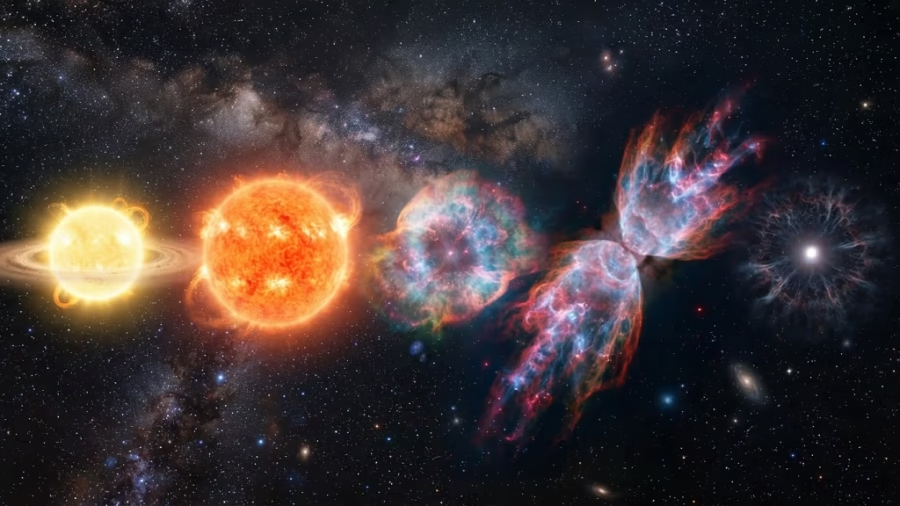
The Boomerang Nebula serves as a natural laboratory for understanding:
- The evolution of stars.
- The physics of gas expansion
- Planetary nebulae formation
- Cooling around the universe.
- The evolutionary history of Sun-like stars.
Now, this knowledge is limited. But future observatory missions, such as an Infrared observatory and a Space observatory, could potentially provide more information about the characteristics and evolution of this object.
Conclusion-
The coldest spot in the universe is the Boomerang Nebula, which is approximately -272degreesC. This extreme temperature is due to the gas separating from a dying star at an incredible rate. Conversely, certain areas around supermassive black holes, such as quasar 3C273, can have temperatures of trillions of Kelvin. The incredible contrast provided by these temperatures is only the tip of the iceberg in the remarkable variety of the universe.