
For almost a hundred years, the people of Punjab’s Majha area have been waiting for the railway line project, which will change trade connectivity and bring about prosperity in the form of new economic opportunities. It was first proposed during the British era, and the Qadian-Beas Railway Line got stuck in paperwork, political discussions and administrative delays for decades.
In this groundbreaking infrastructure move, Union Minister of State for Railways and Food Processing Industries, Shri Ravneet Singh Bittu, has announced the revival of the legendary Qadian-Beas Railway Line Project. The project has an estimated cost of ₹1,400 crore and is considered to be among the major railway projects for Punjab’s Majha region in recent times.
ALSO READ- India-France Innovation Roadmap 2030
The Historical Traces of Qadian-Beas Rail Link-
The history of the rail link between Qadian and Beas can be traced back to the period of the late 1920s. The available documentation indicates that approval for the construction of the railway track was granted during 1928-29 under the then North Western Railway of British India.
- The objective of this groundbreaking project was to link the Majha region of Punjab with a railway corridor directly connecting cities or towns between Qadian and Beas.
- Survey and construction operations began promptly following approval. The development of the railway system was gaining momentum, and some sections of the route were ready.
- The historical documents show that the railway reached up to Qadian on November 14, 1928, under the Batala-Butari railway project, and later the idea was to extend it further to Butari and Beas.
- By the early 1930s, it is stated that almost one-third of the project had been completed. As the priorities of the administration changed and financial considerations in the British era, the project came to an end. The partially constructed portion was said to be dismantled, and the extension from Qadian was stopped.
- Understanding its significance, Indian Railways revived the proposal under its “Socially Desirable Rail Connectivity” program, and it was sanctioned under the Supplementary Railway Budget 2010–11.
- The Qadian–Beas New Railway Line Project was formally sanctioned, with the proposed line length being approximately 39.6 km. The estimated project cost at that time was around ₹205 crore.
- Though the project obtained clearance, there were still problems prevailing with the execution, for instance, land acquisition problems, misalignment, opposition at the local level and legal issues.
- Due to constant delays and problems, the Indian Railways decided to put the project on “freeze” or “abeyance”; the construction did not happen for several years.
Revival of the Majha Region Railway Project-
For more than seven decades, the project remained dormant. However, the rail corridor had immense significance for the Majha and its residents, politicians, agriculturists, industrialists, and religious sections who were constantly urging for its revival.
- As stated by Union Minister Ravneet Singh Bittu, the project’s revival is a historic moment for Punjab. He also thanked the Honourable Prime Minister, Narendra Modi Ji, and the Railway Minister, Ashwini Vaishnaw, for the support rendered to the revival of the long-overdue rail corridor.
- As per the statement, the project has been given new life by an estimated revision of its cost to ₹1,400 crore, based on the present construction norms, acquisition cost of land and other facilities required for railways.
- The revival is a landmark event after almost a century of waiting for the people of the Majha region.
- Union Minister of Railways, Ravneet Bittu, announced the revival of the project on 18 June 2026, discussing the proposal’s objectives, intakes and what it will have, such as advanced technology for logistics and traffic management. The overall project investment is ₹1,400 crore.
Key Features of the Qadian-Beas Rail Project-
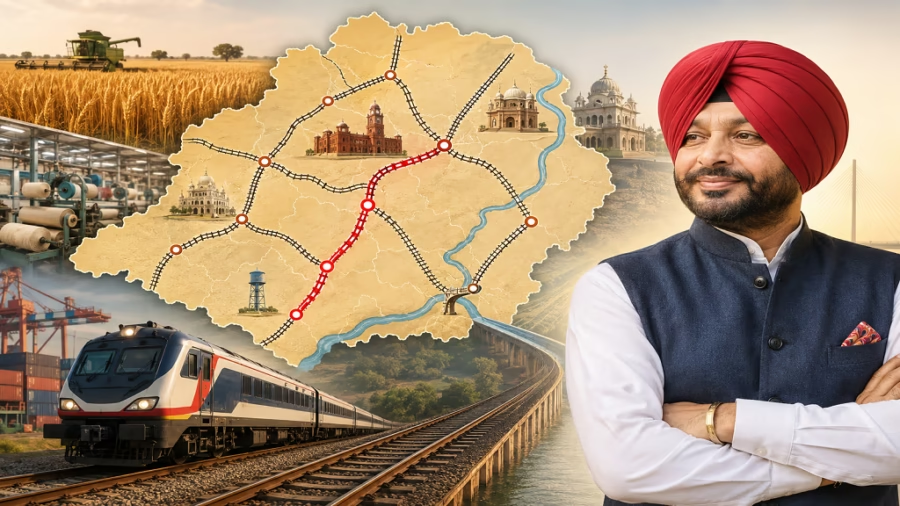
The Qadian and Beas Rail link project is constructed to create a link between Qadian in the Gurdaspur district and Beas in the Amritsar district of Punjab via a broad-gauge railway line with a total length of 39.68 km, and will be implemented by the Northern Railway.
- Cover underserved routes: With the proposed alignment of the railway, some of the underprivileged parts of Punjab’s Majha region will now have access to rail connectivity. The cities or towns of the Majha region included in the new rail corridor project are given below:
- Qadian
- Dhapai
- Ghuman
- Butala
- Sathiala
- Beas
- Modern stations: The project will also introduce two modern crossing railway stations 一 Ghuman and Butala, intended to improve passenger and operational efficiency.
- Advanced systems for safety and management: Other major constructions included in the Qadian-Beas Railway line are: 11 major bridges, 121 minor bridges, 54 Road Under Bridge (RUB), an advanced signalling & telecommunication system for traffic management, efficient logistics, and the Kavach train protection system (an automated system to avoid accidents by applying the brake if the loco pilot fails to do so).
ALSO READ- Artemis III Space Mission
Why is the Qadian-Beas Railway Project Important for Punjab?
The Qadian-Beas railway line is not just another rail line for local purposes and is anticipated to bring about numerous benefits to the Majha region in terms of economics, sociology, transportation, logistics, religion, and tourism.
- Regional Connectivity: Currently, several regions in the Majha district of Punjab rely on roads to connect them to cities, towns, and villages. The construction of a new rail corridor between Qadian and Beas will provide faster, economical, and reliable transport available to everyone, including peasants, locals, students, labourers, and industrialists.
- Agricultural Support: Punjab is one of the leading and most important agricultural provinces in India, which produces the maximum of the country’s output. Moreover, the farmers rely on an efficient transport system to make their produce available to markets. The construction of the railway line will help:
- To improve market access for agriculture
- To reduce transportation costs
- To allow the quick transportation of produce
- To increase the profit levels of farmers
- Enhancing the logistics will enable agricultural societies to compete effectively in the market.
- Economic growth and employment: Majha regions such as Batala and Gurdaspur have a reputation for their engineering and manufacturing industries. Industry experts feel that an enhanced rail transport network would play an important role in improving the manufacturing environment of Punjab. Railway development would lead to:
- Creation of employment opportunities during construction
- Generation of jobs due to railway operations
- Industrial investment
- Efficient cargo transport
- Supporting SMSEs (small and medium-scale enterprises)
- Fostering Tourism in Majha Region: The railway route connecting Qadian and Beas was constructed primarily with the purpose of promoting tourism and making the area accessible. Improved connectivity for tourists, thus increasing revenues from the tourism industry. The following holy sites will be accessible:
- Qadian: home to the Ahmadiyya Muslim Community
- Dera Baba Jaimal Singh, Beas wale
- Sri Darbar Sahib, Amritsar (Golden Temple)
- Dera Baba Nanak
- Gurdwara Achal Sahib
- Gurdwara Bhagat Namdev Ji, Ghuman
- Gurdwara Sahib Patshahi Panjavi
- Burj Sahib
- Pandori Dham
- Ram Sharnam Temple
- Shirdi Sai Temple, Gurdaspur

Conclusion-
The revival of the Qadian-Beas Railway line marks the accomplishment of an almost 100-year-old dream for the people living in the Majha area of Punjab. As an undertaking that will link towns, develop the agricultural sector, boost industries, promote religious tourism and help in regional development, this ₹1,400 crore project holds great promise for the socio-economic future of the area. While the construction process is underway, the historic railway line serves as a testimony to the long-term innovation in infrastructural development.