
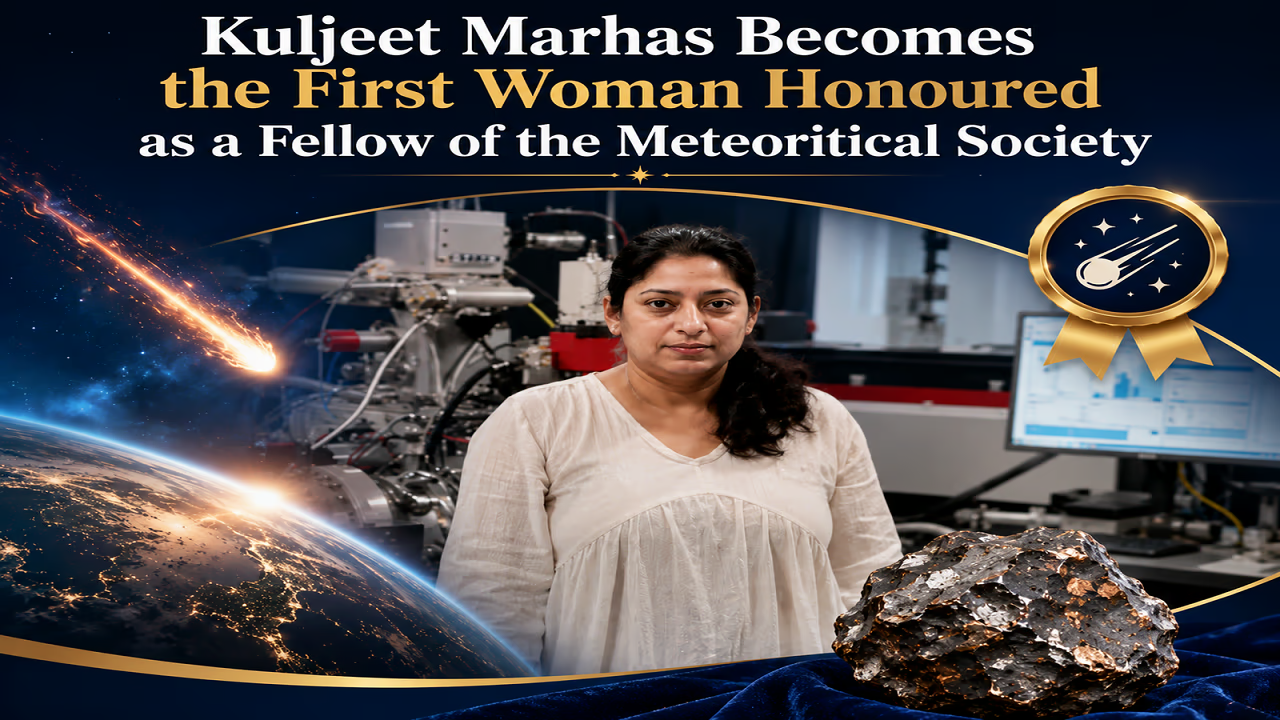
A remarkable achievement made by an Indian woman in the 93-year history of the Meteoritical Society, Kuljeet Kaur Marhas, has bagged a significant role in the field of planetary science. A professor at the Physical Research Laboratory (PRL), a research lab sponsored by the Government of India’s Department of Space and ISRO to facilitate, in Ahmedabad, Gujarat, she was selected as the third Fellow of the Meteoritical Society, after the two Indian scientists, Devendra Lal and JN Goswami. Well recognised for her revolutionary contributions that involve focusing on decoding ancient Solar System secrets through meteorite research that was conducted under the auspices of ISRO. The prestigious honour offered to Kuljeet Kaur is an inspiration for many future scientists and Indian women who want to excel in the space science field. The Meteoritical Society was established in 1933 and emerged as a large organisation related to meteoritics and planetary science to provide a global platform to pioneering scientists.
ALSO READ- India Sanctions ₹3936C for Semiconductor Units in Gujarat Boost
Breakthrough that Earned Kuljeet Kaur Fellowship-
On 9 May 2026, Professor Kuljeet’s historical achievement of being the first Indian woman elected as a Fellow of The Meteoritical Society. Professor Marhas was given the Fellowship after the other Indian scientists, such as Devendra Lal and JN Goswami.
The award won by Dr Kuljeet Kaur becomes a great source of motivation for future scientists and Indian women who aspire to enter this field. She was selected based on her contributions, such as
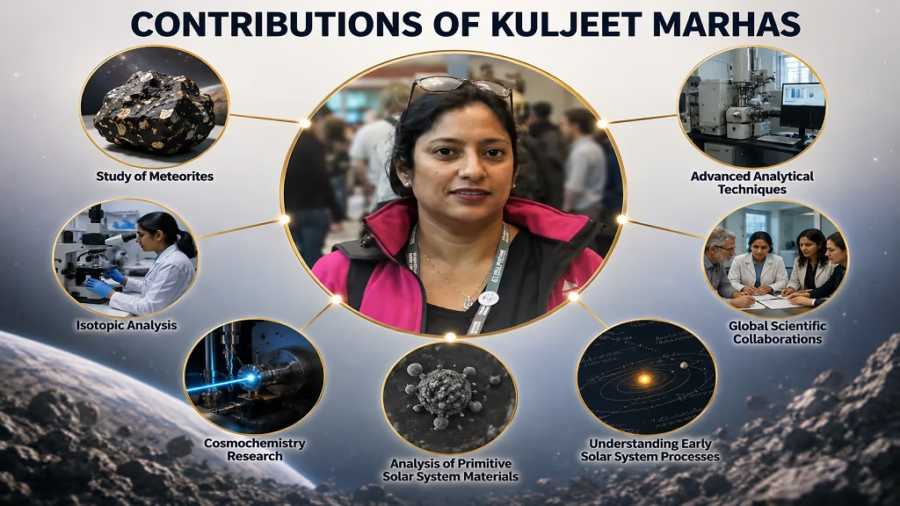
- Deciphering secrets of the ancient Solar System via meteorite study, which took place under ISRO supervision.
- Fundamental advancements in measuring and interpreting the short-lived radionuclides
- Studies on pre‑solar grains and their heavy isotopic components, such as calcium‑aluminium‑rich inclusions (CAIs), hybinites, chondrules, and Organic matter in meteorites
- Recognising techniques for high-spatial resolution or secondary-ion mass spectrometry.
- Together, these studies by Professor Kujeet will provide insight into the chemical and chronological development of the early Solar System.
Background of Kuljeet Kaur Marhas-
Professor Kuljeet Kaur Marhas is an ISRO scientist who developed her proficiency while studying physics and chemistry at the college level and then became a successful planetary science researcher on the global stage.
Kuljeet’s dissertation was concerned with the isotopic analysis of primitive meteorites, especially their short-lived radionuclides and isotopes, which play an essential role in studying early solar system events.
- At that time, she was employed as a Postdoctoral Fellow in Planetary Science at the Max Planck Institute for Chemistry in Germany.
- At Washington University in St. Louis in the USA, she has worked as a Research Associate in Planetary Science in collaboration with distinguished geochemists and cosmochemists in analysing mission and laboratory samples.
- Professor Marhas set up the high-end analytical laboratories at PRL, especially the NanoSIMS (nano secondary ion mass spectrometry) lab, when she returned to India.
- With the help of this high spatial resolution tool, her team can analyse nanometer to micrometre-sized grains found in meteorites or returned sample materials from various space missions like Apollo, Stardust, and Hayabusa-1.
- The short-lived radionuclides studied by her research group include 7Be, 10Be, 26Al, 41Ca and 60Fe, along with heavy elements in presolar grains, useful in studying planet formation.
- Her exemplary work in in-situ, high spatial resolution (SIMS and nano SIMS) mass spectrometry of micro-particles of extraterrestrial origin to probe for pre-solar grains.
- In 2019, she was awarded the Devendra Lal Memorial Medal from the American Geophysical Union and recently, with the Fellowship of the Meteoritical Society in planetary science and cosmochemistry.
The Meteoritical Society’s Fellowship-
The Meteoritical Society, founded in 1933 (93 years ago), is an esteemed international scientific organisation that focuses on the study of meteorites, planetary sciences, and the formation of our solar system and provides Fellow status to the scientists who have made distinct contributions. Selection as a Fellow is made on the basis of scientific distinction and contribution to the field.
The awarding of the fellowship to Kuljeet Marhas, making her the first Indian woman to be honoured, is an important milestone in the history of this science. The Meteoritical Society organisation encourages:
- Scientific investigation and access to advanced technologies
- International cooperation provides a global platform to showcase studies and research.
- Publications and meetings are organised to display the new findings or important research.
- Recognition of leading scientists who have contributed and consistently worked in planetary science and meteoritics.
How Kuljeet’s Remarkable Achievement Impacts India?
- Boosts India’s reputation in planetary science globally:
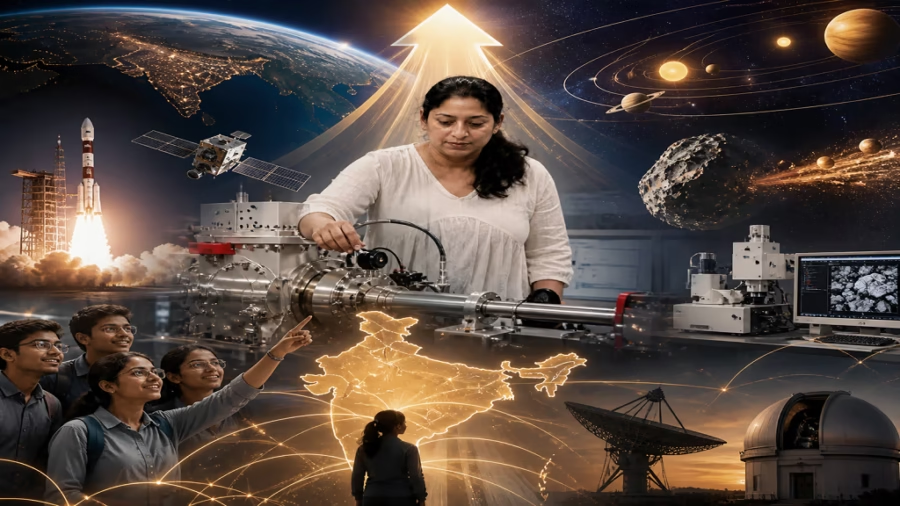
The selection of Kuljeet Kaur Marhas as the first female Fellow of The Meteoritical Society in India marks an increase in India’s prominence in the fields of meteoritics, cosmochemistry, and planetary science, making Indian organisations such as PRL and other ISRO-associated facilities a notable part of the international landscape of space science.
- Enhances India’s research capabilities in cosmochemistry:
Prof. Marhas’s research work on short-lived radionuclides, stable isotopes, and presolar grains has brought about a transformation in cosmochemistry in India. This has resulted in significant investments in advanced instrumental techniques such as nanoSIMS and collaboration with missions abroad.
- Women pursuing careers in STEM and space sciences:
Marhas’ achievement of breaking the 93-year-old glass ceiling in an elite international organisation makes her an inspiring figure for aspiring women in STEM and space sciences who want to pursue their passions in these male-dominated scientific disciplines.
- Fosters inclusivity and diversity in Indian scientific culture:
This success highlights the significance of gender inclusiveness in awarding committees and science institutions, encouraging Indian academic institutes to build more welcoming atmospheres, provide mentoring opportunities, and financial support to female researchers.
- Strengthens homegrown and intrinsic scientific research efforts:
The trajectory of Marhas, from a physicist studying at IIT Roorkee to a distinguished fellow based out of PRL, proves that India is capable of producing exceptional scientists within its own educational system and inspires budding scientists to conduct intrinsic scientific investigations in fields such as planetary material studies.
FAQs-
A. Kuljeet Kaur Marhas is the first Indian woman to be honoured as a Fellow of The Meteoritical Society. This marks a significant milestone in the history of scientists and an increase in India’s prominence in the fields of meteoritics, cosmochemistry, and planetary science.
A. The Fellowship is one of the most prestigious awards in the study of the planets. It is conferred upon those scientists who have contributed significantly over an extended period of time to meteoritics and associated sciences.
A. Prof Marhas’s work on short-lived radionuclides, stable isotopic analysis, and presolar grains, deciphering secrets of the ancient Solar System via meteorite study, which took place under ISRO supervision. Also, her works include recognising techniques for high-spatial resolution.
A. Cosmochemistry is the branch of science that involves the study of the chemistry of celestial bodies, including meteorites, planets, asteroids, and cosmic dust.
A. Kuljeet Marhas’ achievements serve as an example of the increasing role that women have played in scientific studies and motivate young girls to pursue careers in astronomy and astrophysics.