
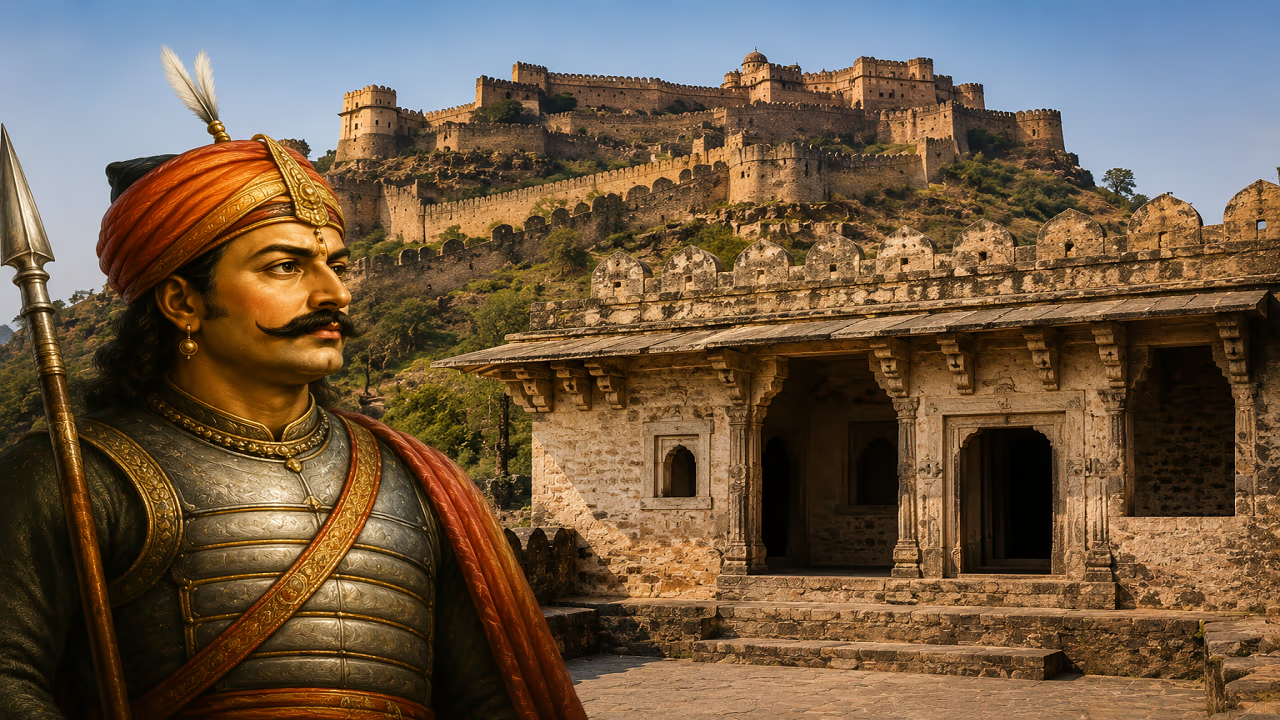
In the recent survey by the United Nations Educational, Scientific and Cultural Organisation, after thorough documentation, Rajasthan’s Kumbhalgarh Fort (in Rajsamand district) was found to be the second-longest continuous wall in the world, after the Great Wall of China, which is approximately 21,190+ km long. Built to cover nearly 36 kilometres across the Aravalli hills, this enormous wall reflects the remarkable engineering prowess and power of medieval Rajasthan. Previously, Kumbhalgarh had also been included in the “Hill Forts of Rajasthan” UNESCO World Heritage Sites category together with seven other historical forts. As an epitome of Rajput bravery and architectural excellence, Kumbhalgarh Fort can be regarded as the “Great Wall of India.”
ALSO READ- Is Gold Investment a Smart Choice During the 2026 Crisis?
Know Rajasthan’s Kumbalgarh Fort-
Historically, the existence of the Kumbhalgarh Fort began between 1443 and 1458 AD, as built by King Rana Kumbha, who was a mighty monarch in Mewar and ruled Rajasthan. The fort is situated at a distance of 84 km from Udaipur city in the Aravalli range of Rajasthan. King Rana Kumbha was not only a brave warrior but also had a great fascination for art and architecture. The architect of the military fortress, Kumbhalgarh, is credited to Mandan, who had immense skills in architecture and had refined military knowledge. His exceptional work and capabilities are reflected in its architecture, as no enemy was able to conquer the majestic fort.
The Kumbhalgarh Fort made a great defence fort for Mewar and offered great defence against any attacks from the enemy forces, with 700 bunkers constructed within it. One remarkable thing about the Kumbhalgarh Fort is that it was never captured by any other enemy forces in history due to its great architectural value, and the fort was also very significant religiously, having over 300 temples of either the Hindu or the Jain religion. The Kumbhalgarh Fort has played an important role in the birth of one of the great warriors of Mewar, King Maharana Pratap, in the history of India.
Great Wall of India: Kumbalgarh Fort Recognised by UNESCO-
The recognition of Kumbhalgarh Fort as a UNESCO World Heritage Site took place on 21st June 2013 at the 37th session of the World Heritage Committee that was held in Phnom Penh, Cambodia.
- Kumbhalgarh Fort is one of the seven serial fortress properties, collectively called the “Hill Forts of Rajasthan”, recognised by UNESCO.
- This serial property includes six majestic forts, including Amber, Chittorgarh, Gangron, Jaisalmer, Kumbhalgarh, and Ranthambore.
- For the first time, UNESCO declared this historical symbol as a series and gave it due recognition for its unique architecture, cultural significance and representation of Rajput military architecture.
- The nomination process of the Hill Forts was done by the Archaeological Survey of India and ratified by UNESCO.
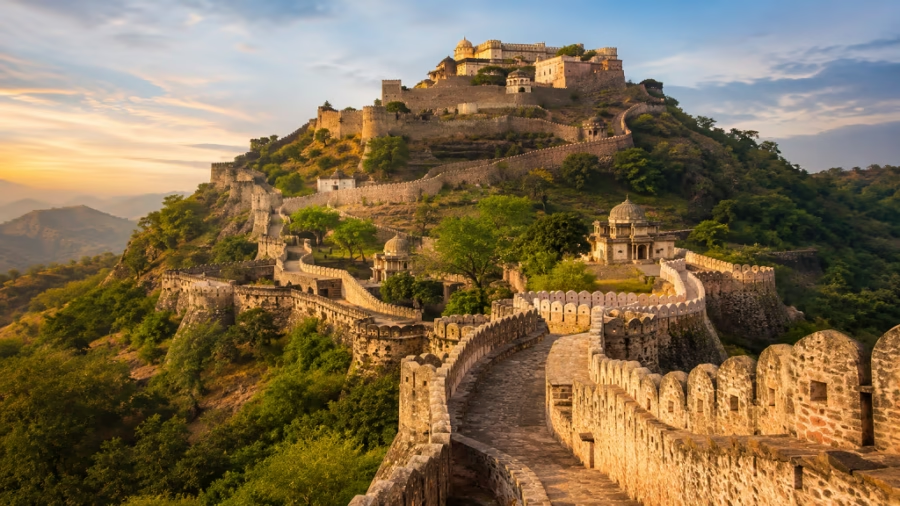
- The Kumbhalgarh Fort received the distinction of the world’s second-longest continuous wall because of its huge wall covering a distance of 36-38 kilometres in perimeter, which is bigger than any other wall in the world except the Great Wall of China.
- The wall’s width of 15-25 feet made it possible for the eight horses to move inside-by-side, thus making it one of the longest continuous walls of any fort ever constructed in history.
Architectural Distinctions of Kumbalgarh Fort-
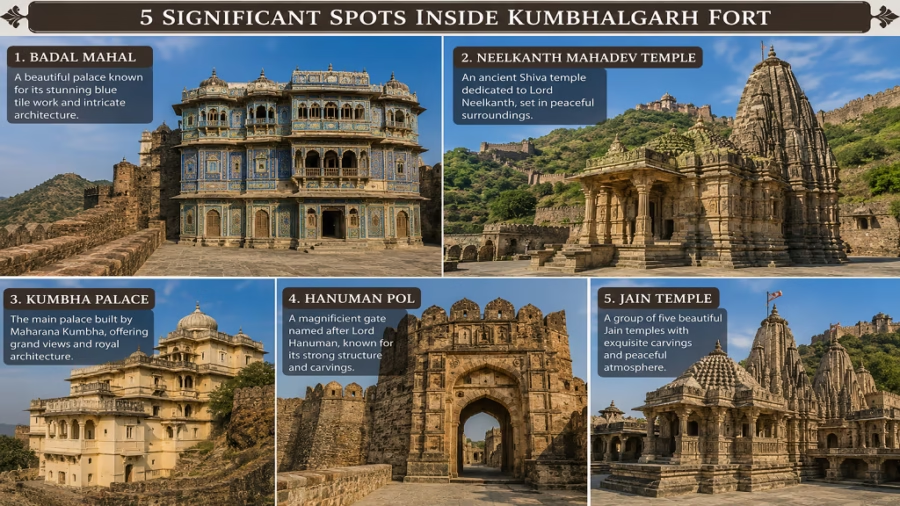
Kumbhalgarh Fort is the epitome of Rajput military architecture. Within the boundaries of Kumbhalgarh are located a palace, a mini-town, and various temples. Among the most famous structures is the Badal Mahal, also known as the Palace of Clouds, which stands at the highest point in the Kumbhalgarh fort.
The Kumbhalgarh Fort has a total of seven main gates called Pols. These Pols are Polo Gate, Hanuman Gate, Ram Pol, Vijay Pol, Jorla Pol, Gol Pol, and Loha Pol, which means Iron Gate. All these gates were strategically designed as defences against possible invaders.
The various structures within the fort include the following:
- Badal Mahal, also called the ‘Palace of Clouds’, is a four-storied palace with wall paintings known for its historical and architectural significance, which is located on the highest point of the Fort.
- There are 360 Hindu and Jain temples in respect for religion and culture in Rajasthan.
- Jain Temples, which were built during the 15th century to honour Lord Mahavira and the Jain religion.
- The Plain temple and Neelkanth Mahadev Temple are ancient shrines dedicated to Lord Shiva, who is called Neelkanth.
- The Palace Complex consist of royal palaces with carved decorations.
Location and Defence Significance-
The Kumbalgarh Fort has a strategic location and natural defence significance, making it a strong barrier system against its enemy:
- Built upon the hilltop with a high elevation of 1,100 meters (3,600 feet) in the western range of the Aravalli mountains, the fort has the advantage of its location, where one can see the enemies coming from afar.
- On three sides, the fort is surrounded by cliffs, which make an attack almost impossible. Together with the artificial wall built on the other side, it forms an invincible defence system around the fort.
- The fort’s elevated position helps its defenders observe the movement of enemies in nearby valleys and plan further defence strategy before their enemies get close enough to attack.
- Surrounding the fort, the wildlife sanctuary with dense forests provides yet another natural barrier for invaders, preventing them from entering the fort grounds unnoticed while helping the defenders hide behind the bushes and trees.
ALSO READ- India’s Metrology Push: Boost Trade & Consumer Protection
Cultural and Tourism Importance-
- Being the birthplace of India’s Greatest warrior king, Maharana Pratap of Mewar, who fought against the Akbar Army, the place holds great historical importance in the history of Rajasthan as well as India.
- Symbol of Rajputana Clan’s Courage and Valour: The fort is the living symbolism of valiant bravery and an architectural marvel of the Rajputs, who were known as a warrior clan in India. This fort is strategically important because it has always resisted any kind of foreign intrusion into its territory.
- Tourist Destination: In recent years, the Kumbhalgarh Fort has become one of the best tourist destinations in the state of Rajasthan. Each year, many tourists come from all corners of the world to visit the fort and witness the massive structures of stone. The fort looks more attractive after sunset when its beauty is enhanced by the shining rays of the sun.
- Festivals or events: In addition, there is the famous Kumbhalgarh Festival held by the Department of Tourism of Rajasthan, which enables tourists to get acquainted with the rich culture, dances, and music of Rajasthan. Tourists also come to see the sound and light show at the fort, which narrates the history of the kingdom of Mewar, King Rana Kumbha, and Maharana Pratap.