
India is updating its dam safety system at a critical period. With ageing infrastructure, stress on water caused by climate change and rising demands for water, the rehabilitation of dam infrastructure is becoming a national concern.
ALSO READ- The Last Titan: Scientists have Discovered a Massive New Dinosaur in Thailand
India’s Dam Safety Push-
India is ranked third in the world in the number of large dams and has 6628 specified dams. Dam safety is a major concern in the country. More than 26% of these dams are aged more than 50 years, and repair, inspection and monitoring have emerged as an important requirement.
One hundred and fifty years after the first dam was built in the United States, the government implementation arm utilises policy coupled with technology and rehabilitation on the ground. We see the Dam Rehabilitation and Improvement Project, the Dam Safety Act of 2021 and digitalised systems such as DHARMA working synergistically to improve safety and long-term performance.
Why Dam Safety Matters-
Dams provide water for irrigation, hydroelectric power, drinking water, reduce flood peaks and contribute to water security. They are critical to agriculture, industry and urban life, and failure leads to high economic and human costs.
Ageing infrastructure, sedimentation, changing rainfall, and climate mean new risks are emerging. This is one reason why dam management in India is moving away from just investment in new infrastructure and beginning to upgrade existing structures.
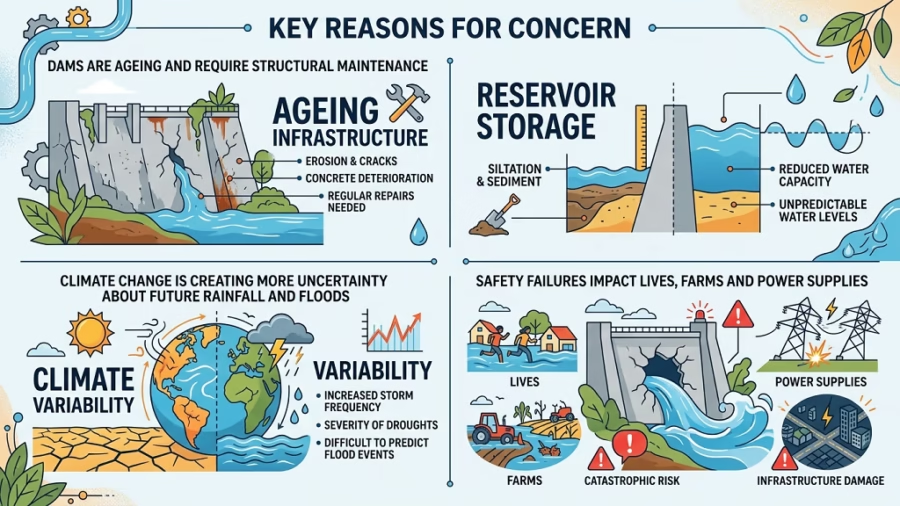
Key Reasons for Concern:
- Thousands of dams are ageing and require structural maintenance.
- Sedimentation is reducing reservoir storage.
- Climate change is creating more uncertainty about future rainfall and floods.
- Safety failures impact lives, farms and power supplies.
India’s Dam Profile-
India has 6,545 operating dams and 83 under construction, providing an estimated gross water storage of approximately 330 billion cubic metres. One thousand six hundred and eighty-one dams are thought to be more than 50 years old, and 291 are more than 100 years old.
Construction of the earliest major irrigation work, the Kallanai or Grand Anicut in Tamil Nadu, has been working for some 2,000 years. This reflects the significant lessons to be learnt about the requirement for maintenance, assessment and renewal of water infrastructure.
| Dam category | Number |
| Total specified dams | 6,628 |
| Operational dams | 6,545 |
| Under construction | 83 |
| Over 50 years old | 1,681 |
| Over 100 years old | 291 |
DRIP Builds Safer Dams-
The Dam Rehabilitation and Improvement Project (or DRIP) is the marquee government dam safety initiative. It is being rolled out in stages to refurbish ageing dams, upgrade gates and spillways and install more advanced surveillance systems.
The first phase of Dam Safety and Rehabilitation of Irrigation Projects (DRIP), conducted with support from the World Bank, occurred from 2012 to 2021 and encompassed 223 dams in seven states. Its objectives included dam safety, emergency action planning and the development of the DHARMA platform.
What DRIP Phase I achieved-
- The technical capacity of states increased.
- Rehabilitation works were completed for 223 dams.
- Rehabilitation proposals were awarded for 144 dams.
- Emergency Action Plans were put into place.
- Inspections of dam health became more organised.
DRIP Phase II and III-
The AIIB and World Bank jointly financed phase II and III DRIP in October 2021. These cover 736 dams, spread over 19 states and three central agencies.
Total expenditure is 10,211 crore, made up of 7000 crore of external loans and 3,211 crore from states and central agencies. The expenditure for the implementation of DRIP II up to 31 March 2025 is 2225 crore. The physical rehabilitation work has been completed with respect to 43 dams.
Main components of DRIP II and III-
- Physical restoration of dams and other facilities.
- Institutional strengthening at the level of the state and the central government.
- Revenue metrics for sustainable maintenance.
- Effective project management for smooth and successful implementation.
Some of the major dams included in these phases are Bhakra, Ranjit Sagar, Nagarjuna Sagar, Gandhi Sagar, Kadana, Jirgo, Imphal barrage, et al. The size of the programme indicates how seriously India considers dam safety as a long-term asset management issue.
Dam Safety Act, 2021-
The Dam Safety Act, 2021 (HPA) has been effective from 30 December 2021, and establishes a legal mechanism for monitoring, inspecting, operating and maintaining.
specified dams. It also imposes on the owner of a dam to ensure its safety performance by the appropriate response at the right time.
The Act further established a four-level organisational set-up, comprising the National Committee on dam safety, the National Dam safety Authority, State Committees on Dam safety and State Dam safety Organisations to provide management of safety issues at the national and state levels.
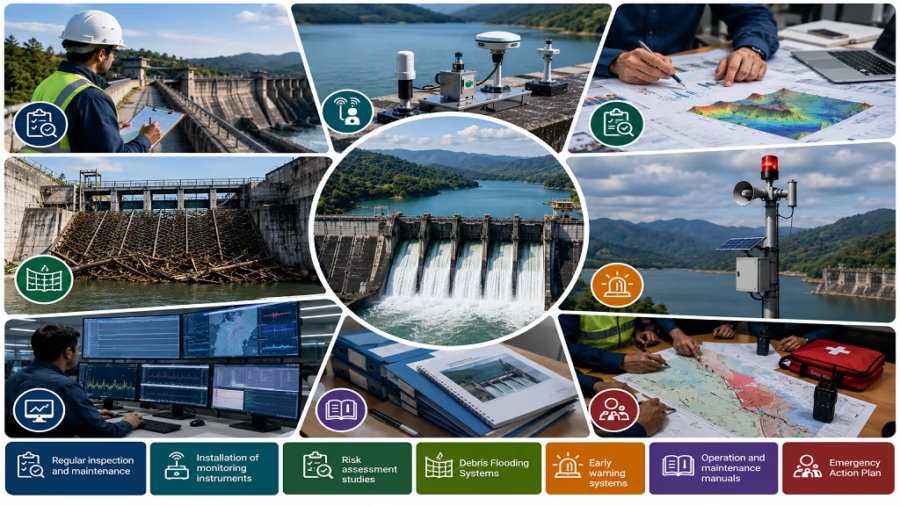
What the Act requires-
- Regular inspection and maintenance.
- Installation of monitoring instruments.
- Risk assessment studies.
- Debris Flooding Systems.
- Early warning systems.
- Operation and maintenance manuals.
- Emergency Action Plan.
Digital Monitoring Through DHARMA-
Technology is playing an increasingly significant role in dam safety in India, and the Dam Health and Rehabilitation Monitoring Application (DHARMA) has perhaps seen the greatest application. All 6,628 specified dams have been registered on the system, and the digital database has been created.
This system also serves to monitor the condition of the dam in terms of inspection, maintenance and safety in real time. Together with instrumentation and early warning systems, it provides dam managers with better means of rapid, informed decisions.
Digital safety benefits:
- Improved reporting and response.
- Improved records of examinations.
- More transparent.
- Better data-led planning.
- More robust monitoring in times of severe weather
Inspection and Risk Checks-
Pre- and post-monsoon inspections carried out compulsorily are incorporated into the safety system of the nation now. Based on the condition and urgency of repair, dams are classified as follows:
Category I list critical deficiencies that, if not addressed, would cause failure. Category II lists major deficiencies that require action within a reasonable time frame (likely short or immediate). And Category III lists dams with minor or no deficiencies.
Inspection Status-
- 3 dams were placed in Category I.
- 188 dams were placed in Category II.
- Remedial measures must be taken in a time-bound manner.
Capacity Building and Research-
The training of dam safety professionals is further being developed through academic collaborations here as well. Centres of Excellence are being established at IIT Roorkee and IISc Bangalore, and a National Centre for Earthquake Safety of Dams at MNIT Jaipur.
These organisations are engaged in seismic hazard maps, sedimentation, risk assessment, building materials and methods of rehabilitation. M. Tech programs have been introduced in dam safety, indicating that the country is training a new generation of specialists.
Future Roadmap-
Future dam safety in India will require continued investments, firmer enforcement, and improved technology. Dams are no longer merely regarded as structures; they are evolving into living systems, having to be managed over their entire life cycle.
Future priorities should include:
- Accelerated rehabilitation of ageing dams.
- Greater application of digital surveillance means.
- Improved funding for scheduled maintenance. A more robust system to forecast floods and provide early warning.
- Additional state-level dam safety team training.
ALSO READ- Trump China Visit: Deal on Taiwan Stability After War, Trade & Hormuz Act
Conclusion-
India’s dam safety management is becoming new, organised, and more technology-oriented. As the Dam Safety Act, DRIP, and DHARMA complement each other, a safe and resilient water infrastructure system is in the offing.
The importance of this hinges on the fact that dams provide food security, energy security, and drinking water to millions. By investing in safety today, India is saving lives, bolstering infrastructure and preparing for a more climate-uncertain future.