
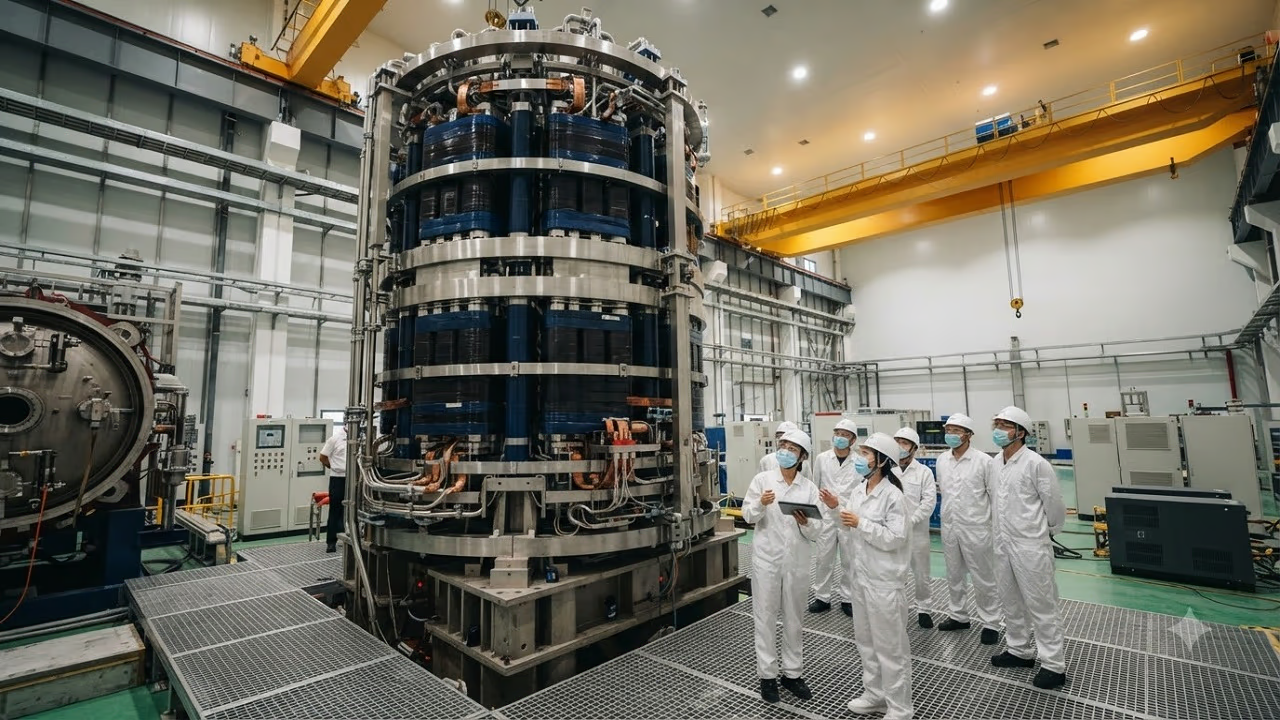
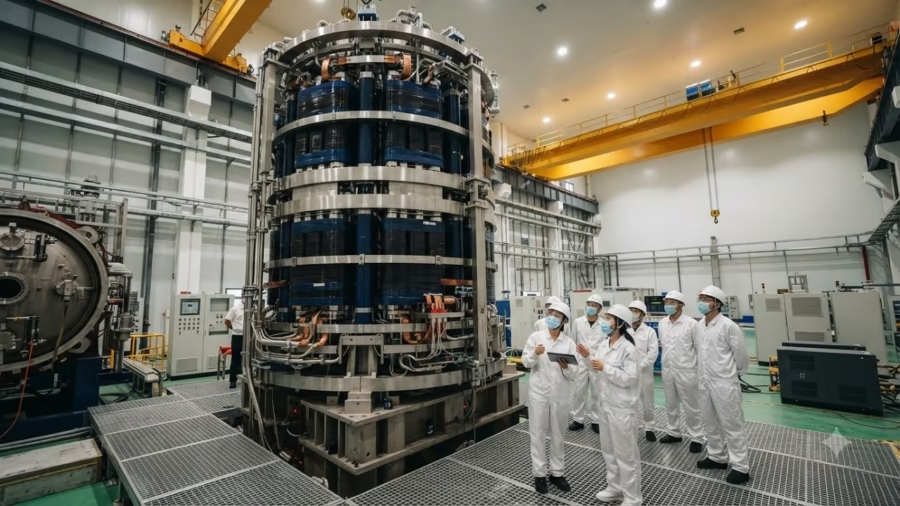
China has achieved a significant breakthrough in the international efforts to develop nuclear fusion energy with the successful test of the largest-ever superconducting fusion magnet. This milestone is just another giant step in China’s grand “Artificial Sun” programme, which is to produce virtually unlimited, environmentally friendly power.
The testing was completed on June 27 2026, at the Institute of Plasma Physics (ASIPP) of the Chinese Academy of Sciences in Hefei, Anhui Province. Scientists performed the full-parameter testing and expert acceptance of the two most critical superconducting magnet systems for China’s new-generation fusion reactor.
While commercial fusion energy is years away, specialists note the importance of this breakthrough as an indication of China’s increasing strength in cutting-edge energy innovation.
ALSO READ- Assam Flood Explained: Causes, Effects, Recovery and Future
China Successfully Tests World’s Largest Fusion Magnet-
The single greatest achievement of the project is a 582 tonne toroidal field superconducting magnet, which was, at the time of completion, the world’s largest fusion reactor magnet.
The D-shaped magnet measures:
- 21 meters in length
- A width of 12 metres
- 582 metric tonnes by weight
Its main function is to produce an extremely strong magnetic field that can contain the plasma within a tokamak reactor. This is because the plasma in fusion experiments has such a high temperature (close to 100 million degrees Celsius) that no substance can contain it. The magnetic fields contain the plasma inside a vacuum chamber.
And according to Chinese results, the magnet’s performance reached the world’s advanced level when tested.
Why Superconducting Magnets Are Essential-
Nuclear fusion is trying to mimic the same process that heats the Sun. Fusion, unlike the nuclear fission used in nuclear power plants today, involves fusing lighter atoms to release huge quantities of energy. However, plasma must be confined at extremely high temperatures for stable fusion to occur.
Superconducting magnets make this possible because they:
- Carry huge currents across miles of wire, with near-zero resistance
- Create intense magnetic fields
- Operate well at cryogenic temperatures
- Achieve sustained and consistent plasma confinement.
- No magnetic fields, and no nuclear fusion.
High-Temperature Central Solenoid Also Passes Testing-
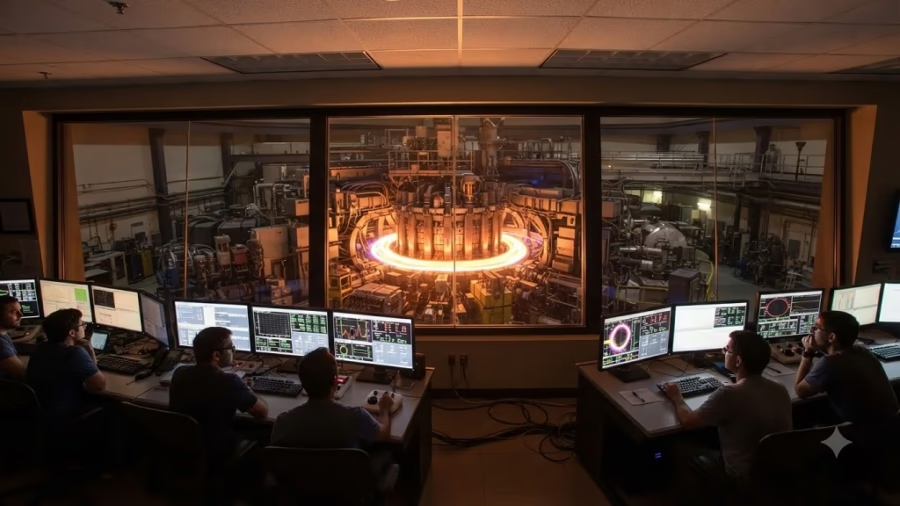
In addition to the toroidal field magnet, the high-temperature superconducting central solenoid coil, a third essential tokamak reactor component, was tested in China.
It’s often called the “engine” or “spark plug” of a fusion reactor. This central solenoid performs several important duties:
- Begins to form plasma
- It drives plasma current (TC not resonant)
- Helps form part of the 29 stable plasma
- Supports the development of sustained fusion reactions
The successful testing of both systems can be seen as a great engineering achievement for China’s fusion programme.
Built Entirely with Domestic Technology-
Perhaps the most impressive part of the project is that every part was made in China.
According to official reports:
- The input materials are all domestic.
- The manufacturing was all done using Chinese technology.
- This project led to a total of 47 patents.
- Six years of engineering work for development.
Indicative of China’s greater focus on enhancing its own high-tech manufacturing ecosystem and reducing reliance on imported suppliers.
Part of China’s CRAFT Fusion Programme-
The latest version of the magnets has been tested for use in the CRAFT research facility, which is being constructed in China.
CRAFT not only supports the country’s long-term fusion roadmap, but also provides an engineering platform to demonstrate advanced fusion concepts before commercial deployment.
The superconducting magnets will be installed in the Burning Plasma Experimental Superconducting Tokamak (BEST), which is 80% complete and is expected to be completed in 2027. Engineering hours for the project are projected to be about 80% testing, as of now, even though the full plant has yet to be assembled.
Larger Than ITER’s Comparable Magnets-
Recent versions of the magnets have been tested for the CRAFT research facility being built in China.
CBREAT not only is a contributor to the country’s long-term fusion roadmap, but also opened up an engineering test bed for proving advanced fusion concepts.
The superconducting magnets will be placed into the Burning Plasma Experimental Superconducting Tokamak (BEST) in 2008 and are scheduled to be completed around 2027. Currently, the project will require about 80% of the engineering hours spent on testing without the full plant assembled.
What Is China’s Artificial Sun?
The ‘Artificial Sun’ of China: this does not mean that its nuclear fusion project acts as a replacement for the real Sun. It heats the hydrogen isotopes using tokamak technology until they form a plasma several times as hot as the Sun.
Key characteristics include:
- Plasma temperature greater than 100 million degrees C.
- Magnetic confinement utilising a superconducting coil
- No carbon produced in power production
- The no uncontrolled chain reaction exception. For example, no chain reactions of the sort involved in nuclear fission.
China’s research EAST (Experimental Advanced Superconducting Tokamak) at the beginning of the 2000s has gone all the way to breaking numerous world records for long-duration, high-temperature plasma.
The new superconducting magnets should be a major improvement for future fusion experiments.
Why Fusion Energy Matters-
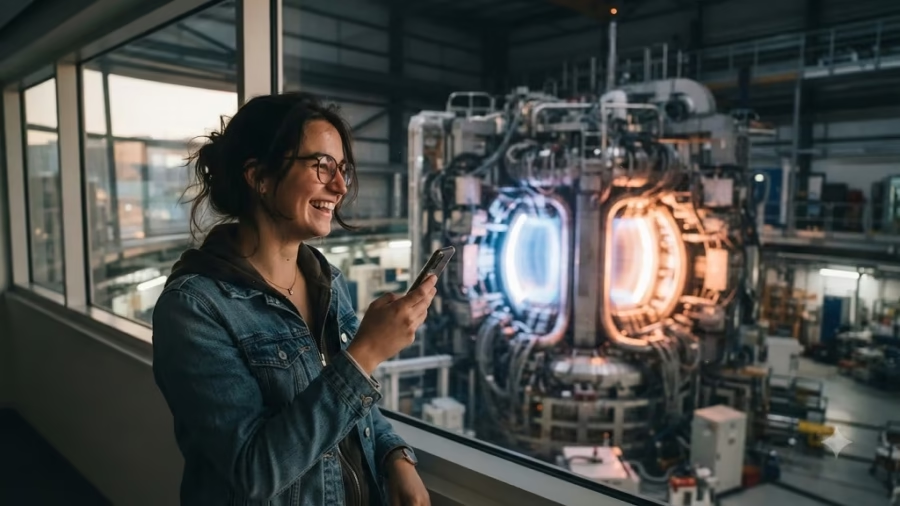
There is a worldwide reputation for fusion as one of the most promising energy sources in the future because there are many advantages to it.
Potential benefits include:
Clean Energy Production:
Fusion, of course, generates electricity without carbon dioxide during operation.
Abundant Fuel Supply:
Fusion fuel is virtually limitless as it can be taken from seawater.
Improved Safety:
Contrary to nuclear fission, a fusion reaction will simply cease if the operating conditions change.
High Energy Output:
Some claim to have designed a device that can produce vast quantities of power from very little fuel.
The above benefits make fusion one of the top contenders for future low-carbon energy systems.
Commercial Fusion Still Years Away-
However, experts warn that commercial fusion electricity is not expected at this breakthrough.
China’s current roadmap suggests:
- The fusion demonstrations most likely around 2030
- The design of engineering demonstration reactors in the 2030s
- Commercial introduction of fusion between 2040 and 2050
Other significant engineering problems still have to be solved, such as establishing a stable plasma state over a long period, developing better materials for reactors, and decreasing the overall cost. However, each step along the path to fusion brings scientists one step closer to achieving man-made fusion energy on a commercial scale.
Global Competition in Fusion Research-
China is one of several countries investing heavily in fusion technology.
Major fusion programmes are also underway in:
- France (ITER)
- United States
- United Kingdom
- Japan
- South Korea
- European Union member nations
Private companies are exploring innovation, too, adding to the international competition to find viable fusion solutions.
What This Means for the Future-
Another breakthrough in fusion engineering has been achieved when China tested the world’s biggest superconducting fusion magnet.
However, domestic use of electricity from fusion reactors is still many years away. Innovations such as this strengthen the trust that commercial fusion is a feasible clean energy source we can rely on in the future.
Should the next milestones be successful, fusion could revolutionise electric generation on the planet with cheap, plentiful, low-carbon energy to meet the increasing needs of industries, electric vehicles, and AI-driven data centres.