
India’s electronics sector is on the cusp of ultimate transformation. With the government cracking down on quality lapses, the Electronics Component Manufacturing Scheme (ECMS) now demands Six Sigma standards. Union Minister Ashwini Vaishnaw just now warned industry players: shape up or lose out on incentives. This move aims to propel India from mere assembly lines to a global design powerhouse. Let us get into why this matters and how it’s reshaping the landscape.
ALSO READ- Nasha Mukt Vidyalaya: MoE’s 3-Year Action Plan for Drug-Free Bharat
Why Six Sigma Is Important-
The electronics boom in India has been excellent and worthy —mobile phone production jumped sixfold in the previous decade. But Minister Vaishnaw isn’t impressed with the standard. In a recent function in New Delhi, he established the fourth tranche of ECMS approvals worth Rs 61,000 crore across 75 projects. His message was clear: without Six Sigma, firms’ possibilities are sidelined.
Six Sigma isn’t just a buzzword—it’s a battle-tested methodology born at Motorola in the 1980s. These stats and data slash defects to just 3.4 per million chances. In electronics, where a tiny flaw can doom a smartphone camera module or PCB, this precision is non-negotiable. Global companies such as Apple and Samsung won’t touch vendors without it.
Vaishnaw slammed industry body ICEA for dragging its feet. “We’re not here for subsidy rides,” he said, pushing for in-house design over cheap imports. This aligns with “Make in India,” targeting USD 500 billion in electronics by 2030-31.
Breaking Divisions of Six Sigma Standards-
Imagine baking a cake where 99.99966% come out perfect—that’s Six Sigma’s promise. Here’s how it works in practice:
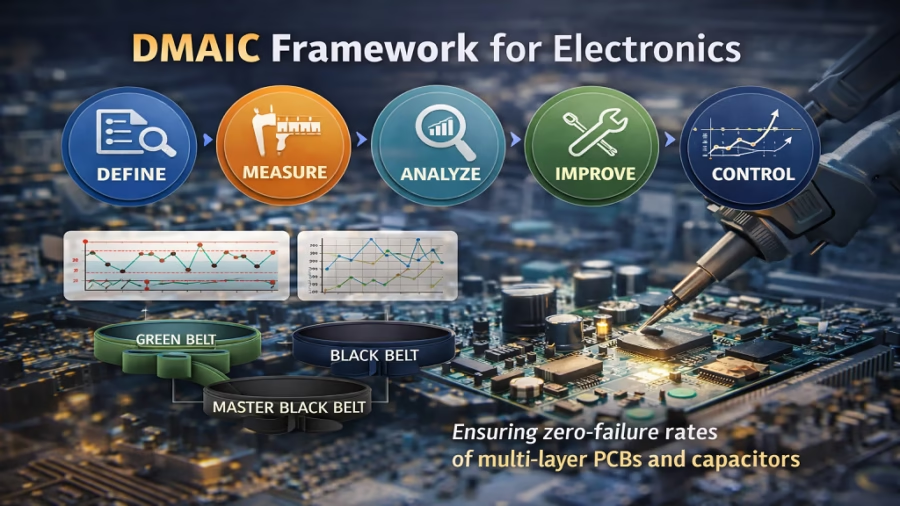
- DMAIC Framework: Define problems, Measure defects, Analyse causes, Improve processes, Control gains.
- Data-Driven Decisions: Important tools, such as control charts and root-cause analysis, spot issues early.
- Belt System: Green Belts handle projects; Black Belts lead; Master Black Belts train teams.
- Electronics Fit: Ensures multi-layer PCBs or capacitors hit zero-failure rates, vital for 90% of phone BoM costs.
Indian companies such as VVDN Technologies are already training engineers in-house. Puneet Agarwal, their CEO, says it’s releasing bigger global contracts. Without it, you’re stuck in low-margin assembly, not high-value innovation.
Inside the Electronics Component Manufacturing Scheme (ECMS)-
Launched by MeitY in 2025 with an allocation of Rs 22,919 crore, ECMS received a massive boost in the Union Budget 2026-27, with an allocation of Rs 40,000 crore. It is built to attract investments, create jobs, and weave India into Global Value Chains (GVCs).
Essential Characteristics at a glance:
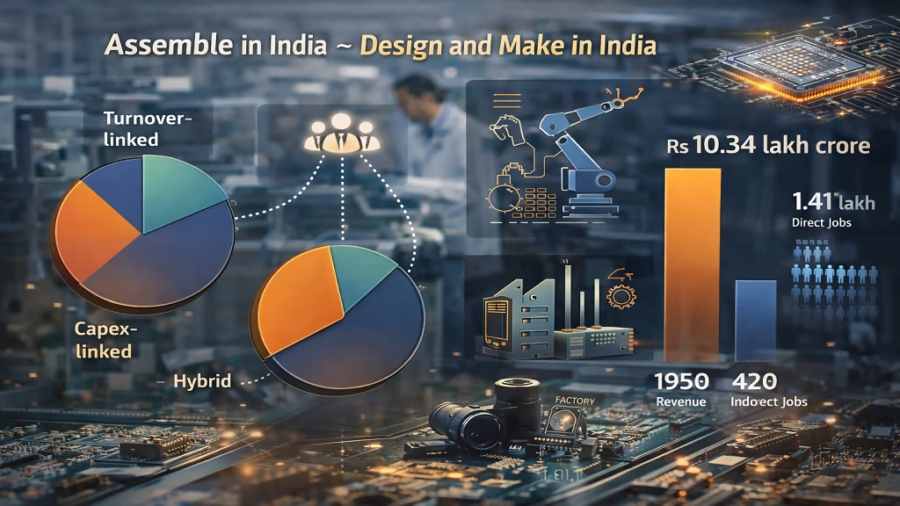
- Incentives: Turnover-linked, capex-linked, or hybrid—tied to jobs created.
- First-Come, First-Served: Quick approvals for ready producers.
- Timeline: Six years total; one-year gestation for turnover perks, five for capex.
- Focus Areas: Sub-assemblies (cameras, displays), bare parts (PCBs, resistors), factory gear.
- Impact Projections: Rs 10.34 lakh crore revenue, 1.41 lakh direct jobs, lakhs more indirect.
Already, 75 projects approved signal big momentum. ECMS isn’t a silo—it syncs with the India Semiconductor Mission (ISM), PLI schemes, and EMC 2.0 to create a “plug-and-play” ecosystem. The goal? Shift from “Assemble in India” to “Design and Make in India.”
Government’s Demands: Transform for Real Development-
Vaishnaw’s ultimatum packs 5 important pillars to future-proof the sector:
- Quality Leap: Mandatory Six Sigma certification—no shortcuts.
- Design Muscle: Build in-house R&D, partner with unis for IP ownership.
- Swadeshi Chains: Cut import reliance on China-dominated supplies.
- Talent Pipeline: Mandatory skilling via centres of excellence.
- Strict Accountability: Time-bound plans or face incentive cuts.
Industry leaders are on board. ICEA Chairman Pankaj Mohindroo calls it a “valid, timely” nudge. Dixon Technologies’ Sunil Vachani stresses coordinated roadmaps: “India must become a product nation.” This isn’t punishment—it’s tough love to grab high-value GVC slices, where design claims the fattest profits.
Expert Views: From Assembly to World Leaders-
Experts hammer home the design edge. “Design dictates value and partnerships,” says one analyst. Assembly? It’s commoditised, low-profit grunt work. Six Sigma ensures your designs don’t flop in production.
Take VVDN: Their antenna and heat sink wins under ECMS stem from early Six Sigma bets. Dixon’s digital push and uni tie-ups tackle Industry 4.0 head-on. The message? Subsidies fund transitions, not complacency.
Broader ripple effects include export surges—electronics could rival top exports soon. But success hinges on execution: firms must climb the “learning curve” Vaishnaw described.
Objections and the Road Ahead-
Hurdles remain. Many SMEs lack Six Sigma expertise or design talent. Import dependence lingers at 70-80% for components. Skilling millions for precision work? Daunting.
Yet optimism rules. With Rs 61,000 crore invested, ECMS could spawn self-reliant hubs. Government flexibility—like tweaking rules—keeps it adaptive. If industry aligns, India’s electronics story flips from volume to value.