
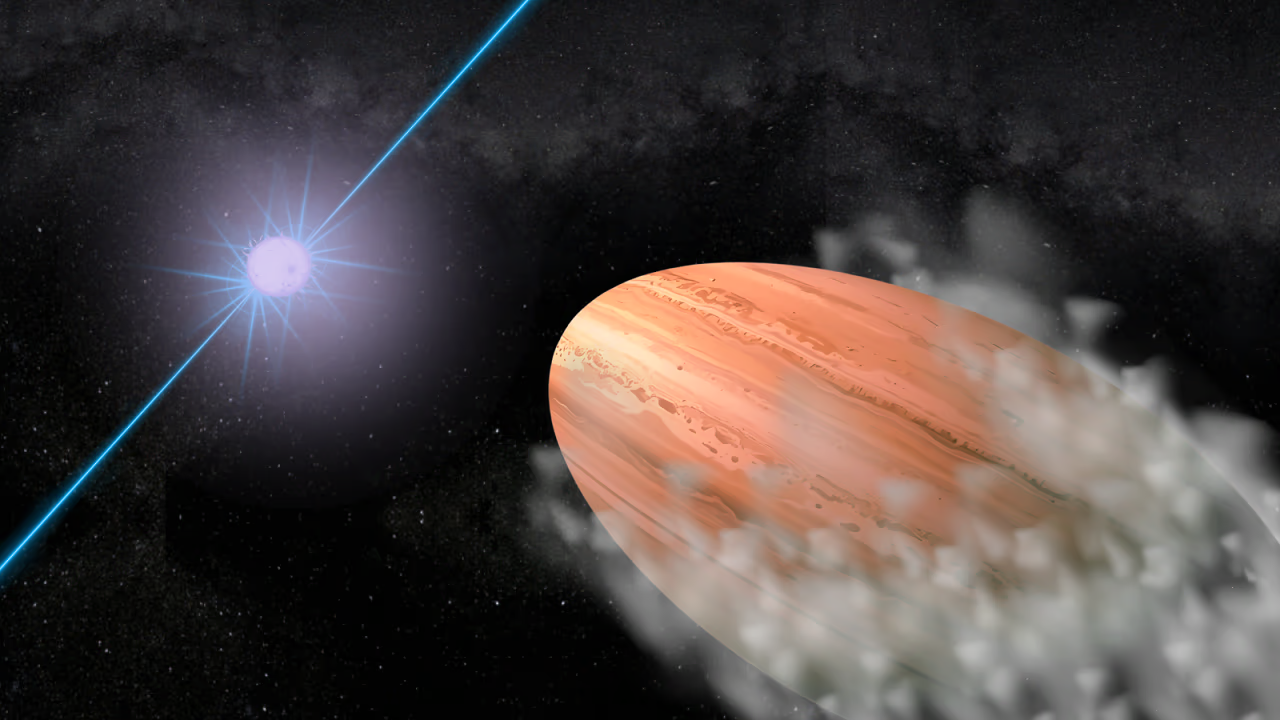
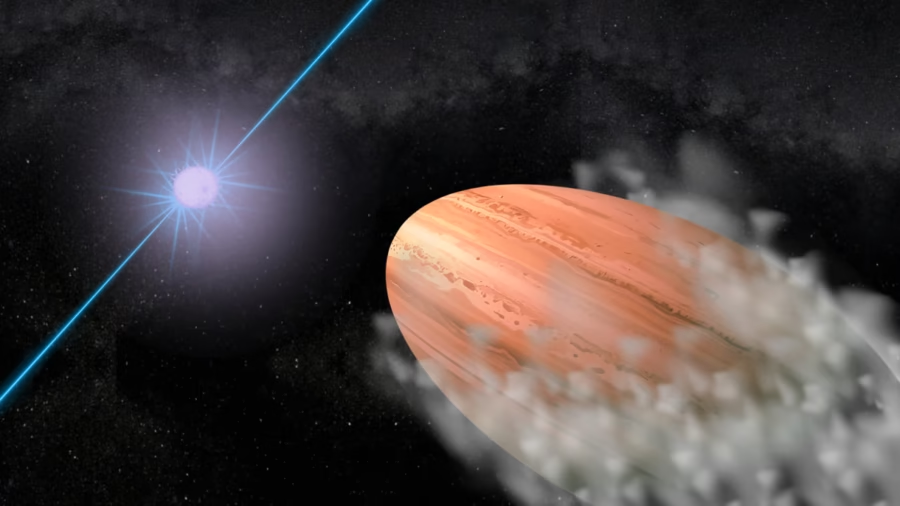
NASA’s James Webb Space Telescope has amazed astronomers with the discovery of a peculiar and extreme exoplanet that is beyond comparison with all the previously known ones. The planet, which has been given the name PSR J2322‑2650b, is located at a distance of about 2,000 light-years from our planet and has an elongated shape, thus being referred to as a “lemon-shaped planet.”
This finding, which has been supported by Webb’s cutting-edge infrared devices, is making scientists rethink planetary development, the structure of planets, and the composition of their atmospheres. This weird planet that orbits a pulsar instead of a regular star is living under such conditions that it is right on the verge of being classified as a known planet based on current science principles.
ALSO READ- Empowering Tribal Lands: PESA Mahotsav 2025
A Planet That Breaks the Rules of Shape and Structure-
The majority of planets are round because their own gravitational force pulls the matter uniformly to the centre. PSR J2322-2650b presents a different scenario. Rather than a nearly perfect sphere, this exoplanet looks like it has been pulled out and has a form similar to that of a lemon. Researchers give the leading role of the unusual shape to the strong gravitational forces that are exerted on it by its pulsar, a collapsed neutron star remaining after a supernova explosion of a massive star.
Why the Shape Is So Unusual:
- The planet travels very close to the pulsar.
- The uneven pull of the pulsar’s gravity affects the planet.
- The continuous tidal forces are at work, unravelling the planet’s shape.
- The change is much more powerful than the star-planet systems’ tidal stretching.
- This unending struggle between gravity keeps the planet from being in a stable, round form.
Orbiting a Pulsar: A Host Star Like No Other-
PSR J2322-2650b, unlike Earth, does not revolve around a bright star suffused with life and warmth like our Sun. Rather, it revolves around a pulsar—an extremely dense neutron star that has a diameter similar to that of a city but retains a mass equal to that of the Sun.
Pulsars are superlatively extreme in the hierarchy of heavenly bodies. They not only turn rapidly and release powerful rays but also produce huge gravitational and magnetic forces.
Key Facts About the Host Pulsar:
- Millisecond pulsar was their classification.
- Rotation occurs hundreds of times per second.
- The output of huge radiation and gravitational waves is the consequence.
- Dwarfed in size but with a normal star’s characteristic density.
Because of the unfriendly conditions, the continued existence of PSR J2322-2650b—and its form—is particularly astonishing.
Extreme Temperatures on a Fast-Orbiting World-
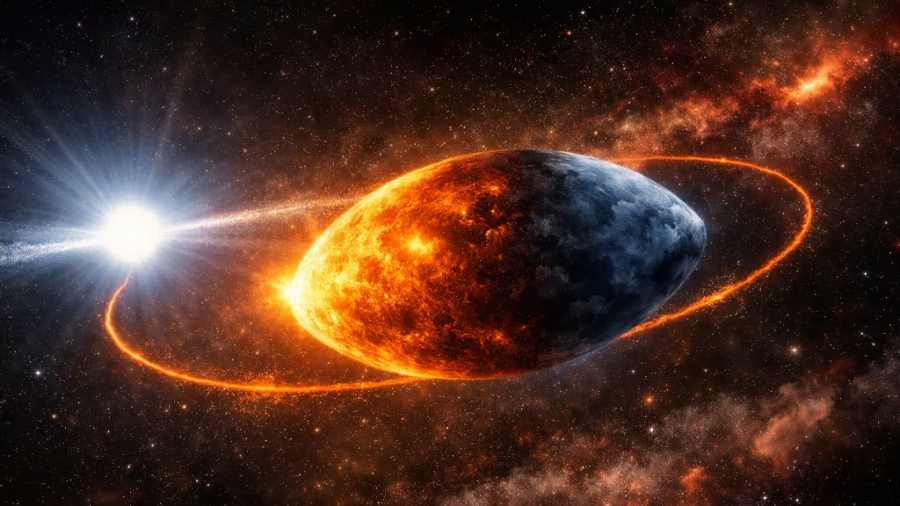
The exoplanet travels around its pulsar at a distance of approximately one million miles, which is much nearer than the distance between the Sun and the Earth. The entire orbit period is only 7.8 hours, which is the reason why this planet is one of the fastest orbiting exoplanets discovered so far.
Such nearness brings about very high and very low temperatures around the planet.
- Day side temperature: ~3,700°F (2,040°C)
- Night side temperature: ~1,200°F (650°C)
These amazing differences are also one of the factors that lead to the planet’s unusual shape and active atmospheric dynamics.
An Atmosphere Unlike Any Ever Seen-
The planet’s atmosphere was analysed using Webb’s infrared technology and yielded one of the most amazing results.
Scientists observed a peculiar mixture of helium and rare carbon bones rather than the usual water vapour, methane, or carbon dioxide, which are the prevailing gases on Earth.
Atmospheric Composition Highlights:
- Helium content
- Diversity of carbon chains like C₂ and C₃
- Extremely low concentrations of oxygen and nitrogen
- No water or methane detection
Among more than 150 exoplanets that have been thoroughly investigated, this atmospheric composition was not found in any of them.
Carbon Clouds, Soot, and Possible Diamonds-
The overwhelming presence of carbon in the atmosphere of PSR J2322-2650b has given rise to super-absurd scenarios. The scientists are proposing that:
- There might be very dense clouds, resembling soot, made of carbon.
- Over-the-top pressure could convert carbon into crystal structures.
- Deep inside the planet, diamond formation is feasible.
Why This Discovery Challenges Planetary Science-
The traditional planet formation models have a hard time not only defining but also coming up with ways in which such a world could be produced. Most of the time, planets are created from protoplanetary disks containing large amounts of hydrogen, oxygen, and nitrogen. The carbon-rich atmosphere of PSR J2322-2650b doesn’t match these scenarios.
Scientific Questions Raised:
Q. What was the planet’s formation process around a pulsar?
Q. What is the cause of the oxygen’s almost complete depletion?
Q. Is it possible for a planet to hold on to an atmosphere under these radiant conditions?
Q. Are standard accretion models sufficient to account for its make-up?
A few speculations indicate that the planet could be the bare core of a star that was previously a companion, but this interpretation still has lots of questions left open.
Why Webb Was Able to See What Others Couldn’t-
In a paradoxical situation, the faint visible light of the pulsar came to the rescue of the Webb telescope in its observatory process. Pulsars, being less luminous in the optical spectrum than huge stars, thus not overpowering the instrument, allow the planet’s atmosphere to be studied more accurately.
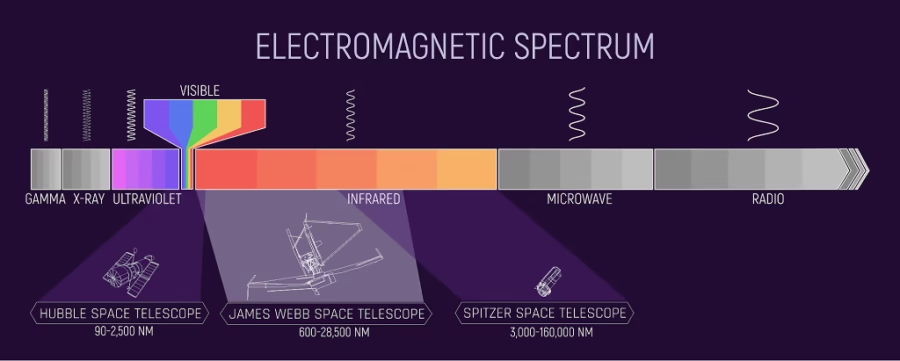
Webb’s infrared discernment was a key factor in obtaining the very delicate signatures of the chemicals that uncovered the planet’s real identity.
What This Means for Future Exoplanet Research-
PSR J2322-2650b might be only the first one of its kind. However, in the opinion of astronomers, there could be a lot more severe planets, covered up in environments that were previously considered unfit for planets at all.
The observations suggested by the future could:
- Locate other planets revolving around pulsars
- Introduce new chemical compositions in the atmosphere
- Enhance the understanding of planetary survival through models
- Broaden the range of criteria that determines a “planet”
ALSO READ- DPIIT Launches Digital Sponsorship Module for e-B4 Visa
A Reminder of How Strange the Universe Can Be-
PSR J2322-2650b is a remarkable case of how the universe can still bring surprises even to the most veteran scientists. The James Webb Space Telescope’s ongoing discoveries are like this one, and they show a very strong fact: planetary systems can develop in such weird ways that even the current theories cannot completely describe them.
This world, having the shape of a lemon, is not only an object of curiosity for astronomers but also a challenge that calls upon science to broaden its imagination beyond the established cosmic rules.