
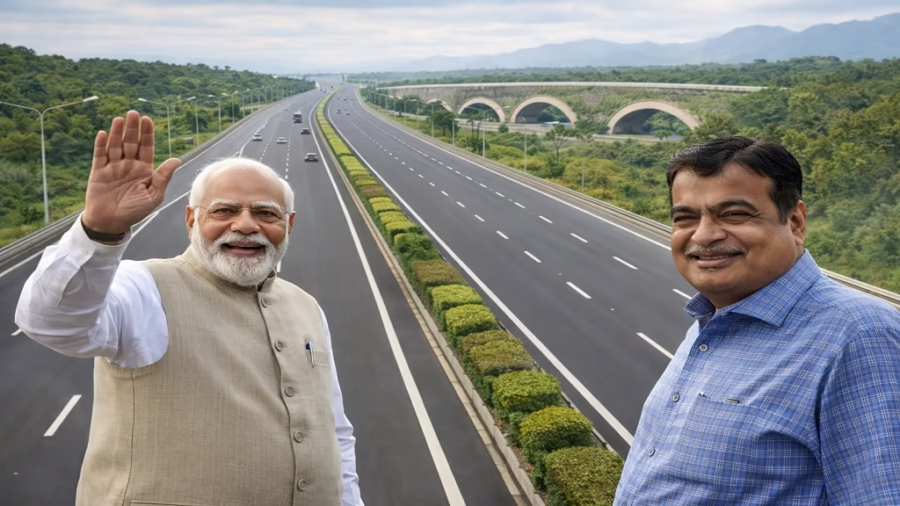
On Tuesday, 14th April 2026, the Prime Minister Narendra Modi, in coordination with MoRTH, implemented the vital Expressway project in Dehradun, as stated by Nitin Gadkari in the recent X post. The expressway, also called as “Samridhi ka Highway”, will drastically lower the time required to travel from Delhi to Dehradun from 6 to 2.5 hours. This six-lane highway is expected to bring economic prosperity through easy business and transportation, supporting the economic activities and tourism hubs in the region. In this article, we’ll guide you through this exclusive highway project that upholds the prospects for modern infrastructural development through the rural landscape for transformative growth.
ALSO READ- e-SafeHER: Empowering 1M Rural Women as Cyber Sakhis by 2029
Details of the Delhi-Dehradun Expressway-
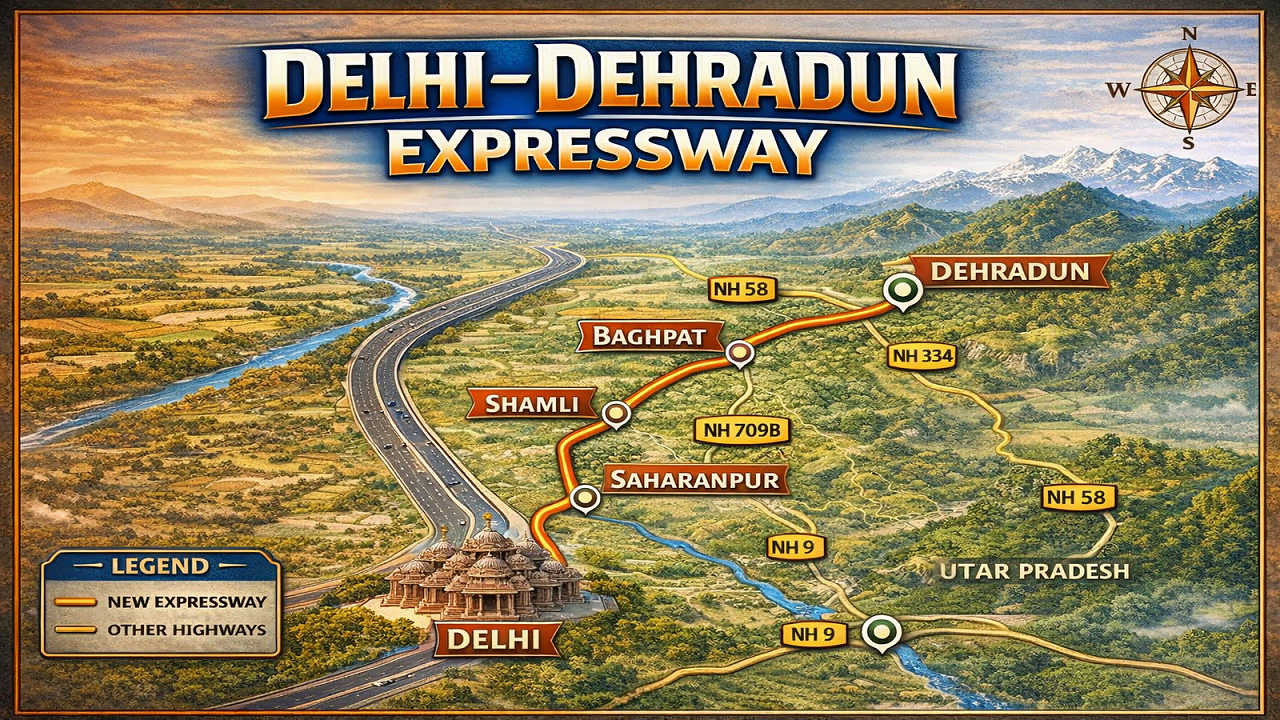
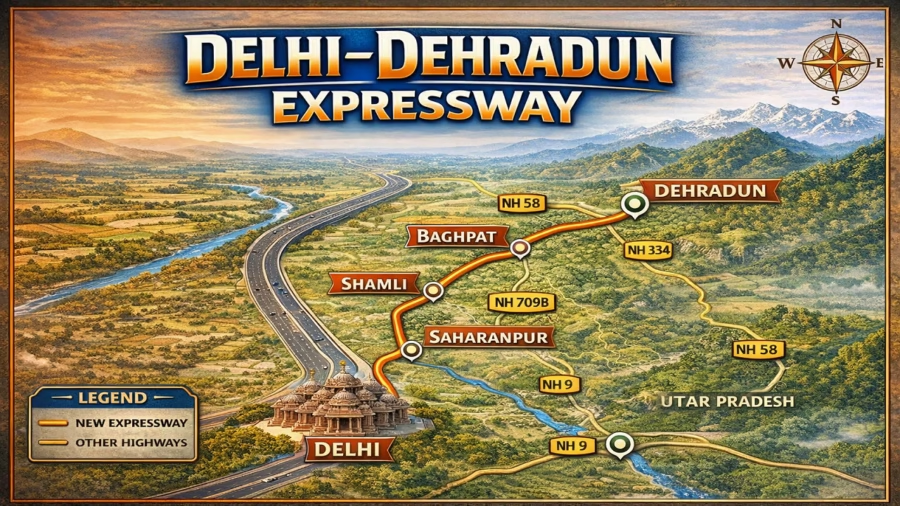
The Delhi-Dehradun Expressway or Economic Corridor is the pathway to improve road connectivity in North India to boost tourism, business and transportation. The upcoming project is the economic booster, also called “Samriddhi ka Super Veh”, that connects brownfields and greenfields upgrade and spreads over cities like Delhi, Bhagpat (U.P.), Baraut (U.P.), Muzzaffarnagar (U.P.), Shamli (U.P.), Saharanpur (U.P.), and Dehradun (to several parts of Uttarakhand).
Features of the 6-Lane Delhi-Dehradun Project:
- The road length of the Delhi-Dehradun Corridor is 210 and 213 kilometres, which is the shortest route for Dehradun, which is connected to other significant places in U.P. and Uttarakhand.
- The total financial support that the Government of India has provided for this project amounts to 1.2 to 1.3 crore, enabling the travel time to be reduced from six hours to 2.5 hours once the construction is complete, according to MoRTH.
- The starting point of the project is from the Akshardham Temple, which includes a 32 km 12-lane stretch to Dehradun with tunnels and elevated sections.
- The lane also stretches to the Eastern Peripheral Expressway (EPE) near Bhagpat, a 118 km Saharanpur Bypass, 40 km to Ganeshpur and 19.5 km via Rajaji National Park to Dehradun.
- Moreover, the corridor features 16 points of entry and exits, 5 rail overbridges, 10 interchanges, 113 underpasses, 12 way sides after every 25 km and service roads at 76 km along with an Advanced Traffic Management System (ATMS).
Historical Trace of the Project-
Under the Bharatmala Project in 2020, the Delhi-Dehradun Highway Project was originated whose foundation stone was initiated by Mr Nitin Gadkari (the Minister of Road Transport & Highways, India) in February, 2021. In addition to this, the project was also unveiled by the Hon’ble Prime Minister, Mr Narendra Modi, announcing its implementation and construction in December, 2021. The Delhi-Dehradun Expressway project consisted of four developmental stages under the EPC Model. The NHAI construction agencies like Krishna Constructions, GAWAR Constructions & Ceigall India handled the project. The project, which took about 5-6 years, is now ready for its operational stage from April 2026. Moreover, on 14 April 2026(Tuesday), the Honourable Prime Minister Mr Narendra Modi inaugurated the 6-lane Delhi-Dehradun Highway Project and sought darshan and performed Pooja at Jai Maa Daat Kali Temple at Dehradun.
Inclusion of 10.97 km Wildlife Corridor-
- The Delhi-Dehradun Economic Corridor includes a 10.97 km Wildlife Corridor (animal underpass) between the 20 km long stretch from Ganeshpur and Asharodi. The purpose of creating this corridor is to avoid human conflict in a biodiversity hotspot between Delhi and Dehradun.
- As said by the Uttarakhand Forest Minister, Shri Subodh Uniyal, the 20 km stretch (Ganeshpur-Asharodi) will pass through the dense Shivalik Forest Division in Uttar Pradesh, Rajaji Tiger Reserve, and Uttarakhand Forest Division.
- An elevated wildlife corridor of 12 to 14 km was built over Rajaji National Park, which is Asia’s longest wildlife corridor.
- During the developmental phase of the project, maximum priority was given to wildlife safety by installing soundproof and light barriers to avoid noise and light pollution.
- It also includes 8 animal underpasses, two 200 m elephant underpasses, twin tunnels of 2.3 km, a tunnel of 370 km near Maa Daat Kali Temple (Dehradun, Uttarakhand) and a 4.8 km flyover with 6 km clearance for animals with high-safety road features.
Afforestation and Vegetation Monitoring During the Project:
As the Delhi to Dehradun Highway Project required clearance of 17,913 during the construction, the Union Minister Nitin Gadkari has assured compulsory afforestation in the 157.2 hectares of land that will be carried out by the respective forest departments of the region.
- According to Subodh Uniyal, around 45,000 trees were felled for this project; however, more than 33,500 trees were saved, as stated by the forest minister.
- Also, large-scale compensatory afforestation will be carried out in the regions of Delhi, Uttar Pradesh and Dehradun to compensate for the forest land that was used for it.
- NHAI assures more than 50,000 plantation of trees planted on the sides of the Delhi-Dehradun highway lane as an environmental mitigation measure.
- Additionally, IRC- Indian Road Congress Codal provisions will take responsibility for landslide mitigation measures.
- NHAI, in collaboration with Wildlife Institute of India (WII), launched a report “Landscapes Reconnected” which is a detailed documentation of a 40-day monitoring programme under surveillance of 150 high-tech cameras, 29 AudioMoth acoustic recorders and volunteers to keep a check on construction techniques to ensure no fauna is harmed.
- In this, more than 1 lakh images of animals, humans and wild animals, along with 40,000+ images, were of 18 recognised unique species, in which Nilgai, Sambar, Golden Jackal and Spotted Deer were the main highlights.
Economic Significance of the Project-
The 6-lane Delhi to Dehradun Expressway holds the future of modern infrastructure and environment-friendly techniques promoting safer movement of animals within the region. This corridor is significant because:
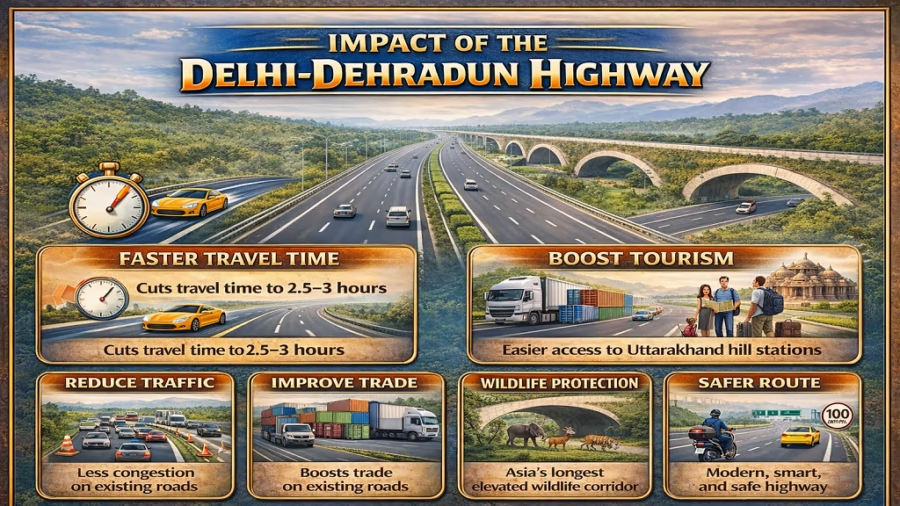
- Superhighway of Prosperity: The project of Delhi-Dehradun Expressway of 213 is entitled as “Samridhi ka Super Veh” or “Superhighway of Prosperity” as the project invites economic growth in the region by easing and reducing time for transportation, commerce and businesses.
- Promotes Tourism: As the highway interlinks different regions between the two states, it will enhance the religious connectivity, as the project begins from Akshardham itself in Delhi. The lane is supposed to connect tourism sites like Haridwar, Rishikesh, Mussoorie, Char Dham Highway, EPC Highway and other Uttarakhand hill stations, boosting tourism in the region.
- Increase in Economic Activities: The new expressway is supposed to encourage economic activities like trade, development of hotels, restaurants, local markets, logistics, businesses, urbanisation and real estate. Moreover, these job opportunities will also be generated, thus boosting economic growth.
- Reduces Travel Time and Traffic Congestion: The new Delhi-Dehradun expressway is designed using the latest techniques and engineering layouts to reduce travel duration and traffic congestion. Earlier, it took 6 hours to travel from Delhi to Uttarakhand; now it will take only 2.5 to 3 hours to reach the capital, Dehradun. Also, the 6-lane highway is constructed in such a way as to divert traffic.
ALSO READ- One Health Approach: Uniting Humans, Animals & Planet for Complete Safety
FAQs-
A. The new 6-lane Delhi-Dehradun Expressway is an economic booster project intended to reduce travel time with advanced engineering techniques and the latest road safety measures.
A. The government of India and MoRTH introduced a budget of 1.2 crore to 1.3 crores for creating a robust highway that has 6 points of entry and exits, 5 rail overbridges, 10 interchanges, 113 underpasses, 12 way sides after every 25 km and service roads at 76 km along with an Advanced Traffic Management System (ATMS).
A. The Delhi-Dehradun Economic Corridor includes a 10.97 km Wildlife Corridor (animal underpass) between the 20 km long stretch from Ganeshpur and Asharodi. The purpose of creating this corridor is to avoid human conflict in a biodiversity hotspot between Delhi and Dehradun.
A. The project will begin from the Akshardham temple in Delhi. It will cross the cities in Uttar Pradesh, such as Bhagpat, Baraut, Muzzaffarnagar, Shamli, Saharanpur, and Dehradun (the capital of Uttarakhand).