
Anthropic has released version 4.7 of Claude Opus, the current stable model, and claims it is better suited for complex software engineering, long-term tasks, and high-resolution vision tasks. According to the company, it‘s a direct upgrade over Opus 4.6, and costs remain the same for customers and developers.
ALSO READ- Delhi–Dehradun Expressway Gets Green Signal
What Changed-
According to openness, Opus 4.7 responds more consistently to tasks requiring complex coding, is more accurate with instructions, and exhibits better self-verification before answering. The final update to the model, anthroposarchic, is said to have better memory throughout long meetings, further supporting higher fidelity context throughout multi-movement work.
The new version also accepts higher resolution images than previous Claude models, which are better for taking in the detail of dense screenshots, pulling information from diagrams, and working with delicate visual references. This improved fidelity to vision is a model change according to Anthropic, so there is no enabling to be done on the user‘s end.
Safety and Cyber Controls-
Safety is a priority for the launch, too. Anthropic claims Opus 4.7 is equipped with warning systems that can deter and restrain requests related to banished or dangerous cybersecurity tasks. Such a strategy embodies Anthropic‘s wider goal of a cautious deployment of increasingly powerful models in the wake of the recent Project Glasswing.
In a genuine security context, whether it‘s vulnerability research, pen-testing, or red-teaming, Anthropic open the door to anyone who wants to be part of its Cyber Verification Program. The company states the practical use case of these safeguards will eventually dictate which researchers get access to more powerful “Mythos-class” models.
Pricing and Access-
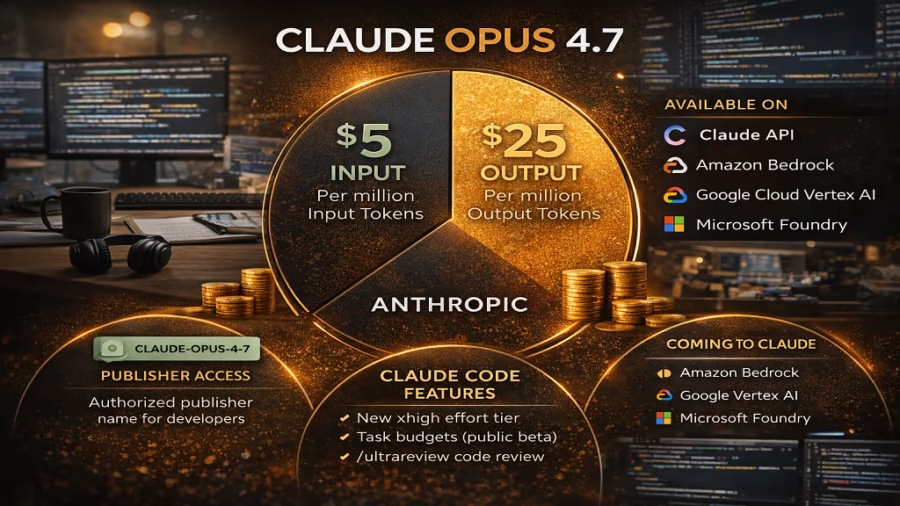
Pricing remains the same as Opus 4.6. According to Anthropic, the model is priced at $5 per million input tokens and $25 per million output tokens. It is accessible throughout Claude products and the Claude API, Amazon Bedrock, Google Cloud‘s Vertex AI, and Microsoft Foundry.
Developers are allowed to use the model under the publisher name claude-opus-4-7. Additionally, Anthropic has mentioned that Claude Code users will be getting additional new features during the rollout, including a new xhigh effort tier, task budgets in public beta, and a /ultrareview command for in-depth code review sessions.
Why It Matters-
It‘s more of a frontier model optimisation than a splashy consumer update. Anthropic gives us a big hint that Opus 4.7 is targeted at code completion, doc tasks, lengthy context, and multimodal workflows that demand precision over quick responses.
A separate model, the company claims, is “less broadly capable” than Claude Mythos Preview but significantly safer for public release. So, Anthropic seems to still be trading off between capability and increased oversight, particularly in the cybersecurity-sensitive fields.
Key Takeaways-
Opus 4.7 is the latest overall Claude model released by Anthropic.
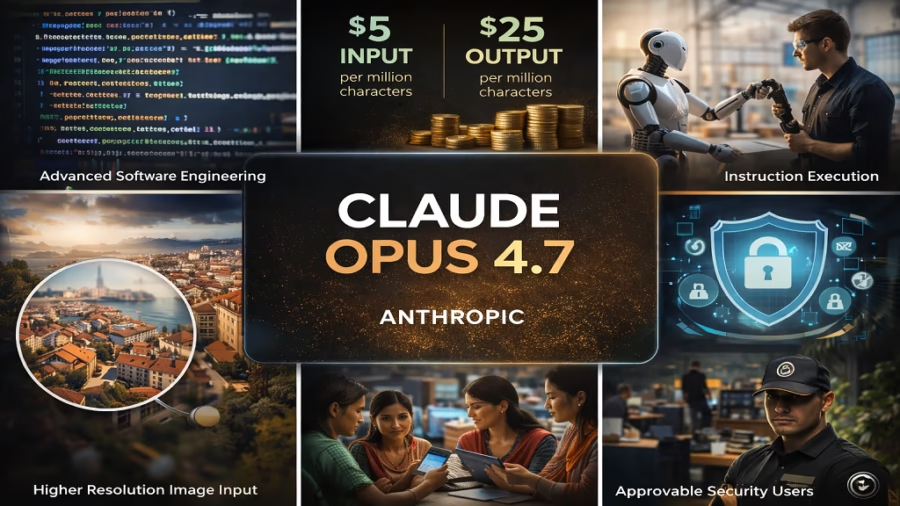
- It enhances sophisticated software engineering, instruction execution, memory and vision.
- It allows for higher resolution image input and longer running processes.
- The prices are to remain at $5 input and $25 output per million characters.
- New controls will prevent risky cyber requests, and security users authorised by an approval procedure can apply for the same.
Developer Impact-
Perhaps the main benefit for developers will come in how instructions are handled. Anthropic has indicated that the model adheres very literally to prompts, which can result in easier performance but also possibly bring light to having impractical or archaic prompting techniques. Organisations that use templated prompts, chained automation, or agent workflows will likely need to validate results more thoroughly before broader release.
ALSO READ- e-SafeHER: Empowering 1M Rural Women as Cyber Sakhis by 2029
Long-Running Workflows-
The additional memory allowance and increased task consistency may be most relevant when you have multi-step tasks. Think of jobs such as code refactoring, document drafting, data extraction, working between multiple sessions, etc. This can translate on the organisational level to less supervision and minor correction loops.
Vision and Multimedia-
Another interesting improvement is the enhanced image handling. Anthropic mentions that Opus 4.7 is capable of receiving higher-resolution images, allowing better rendering of dense charts, fast screenshot inputs, user interface mockups, technical drawings, and the like. This makes the model genuinely more applicable to a product, design, support, and operations environment.
FAQs-
A. Yes. Anthropic says it improves on Opus 4.6 across software engineering, instruction following, and several work-oriented benchmarks.
A. No. Anthropic says Opus 4.7 is less broadly capable than Mythos Preview, but it is the safer model chosen for wider release.
A. Anthropic says the updated tokeniser and higher effort levels can increase token usage, so developers should measure performance on real traffic.
A. Claude Opus 4.7 is Anthropic’s latest generally available model, built for coding, agentic work, knowledge tasks, and higher-resolution vision.
A. Yes. Anthropic says it is available across Claude products, the API, Bedrock, Vertex AI, and Microsoft Foundry.
A. No. Anthropic kept the same pricing as Opus 4.6: $5 per million input tokens and $25 per million output tokens.
A. Yes. Anthropic notes that Opus 4.7 follows instructions more literally than earlier models, so prompts and harnesses may need adjustment.