
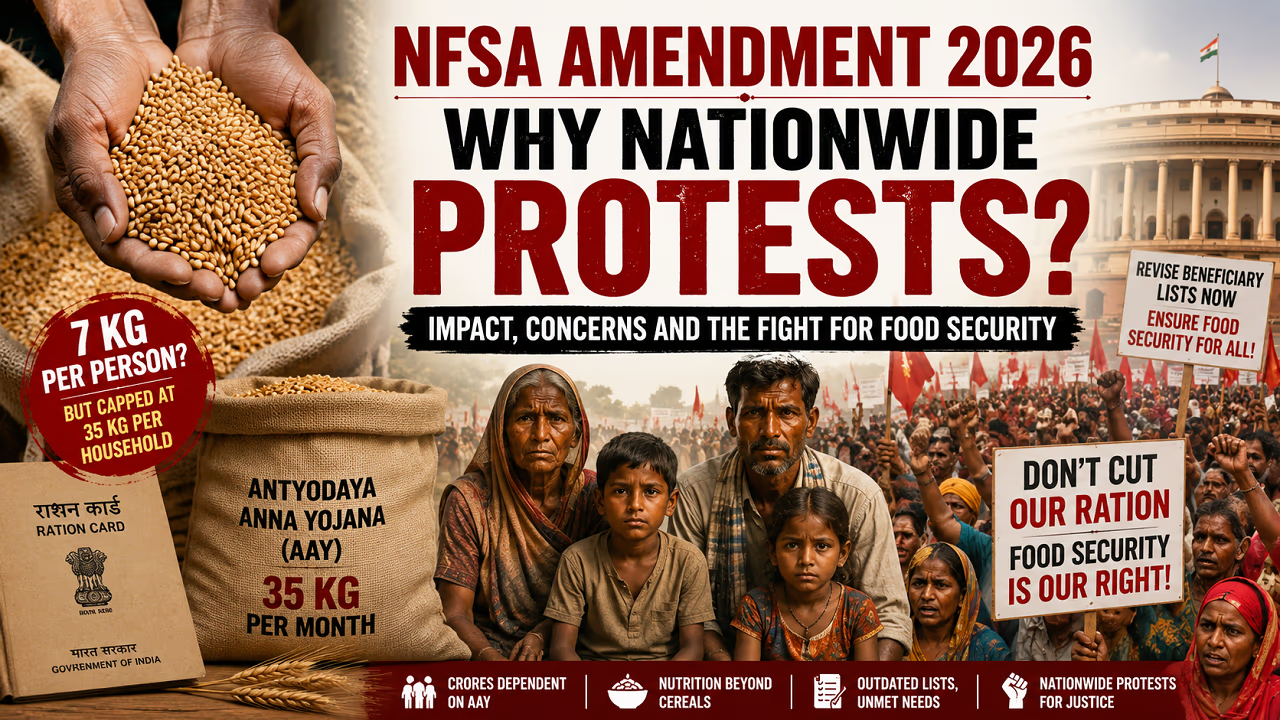

Several farmer unions, labour organisations and social groups came onto the road to protest against the latest draft introduced by the Central Government on the National Food Security (NFS) 2026. These amendments have caused a lot of protest because there is an issue that the proposed amendments may affect the poor farmers whose livelihood depends on the subsidised food grains. The government has brought amendments to the Antyodaya Anna Yojana (AAY) scheme in the NFS Act 2013 that raises the question about inequality in the quantity distributed in AAY households. But the response from the people has made the government realise the need for reconciliation of the bill. Read this article on the proposed amendments to the NFSA bill, the issues that have prompted the demonstrations, the government’s point of view, and the consequences.
ALSO READ- Village Telecom Survey: India’s Largest Rural Mobile Network Performance Survey
National Food Security and the AAY Bill-
- NFSA 2013 is the National Food Security Act, 2013, a welfare act for food security across India and food availability at reduced or subsidised prices using the Public Distribution System (PDS) among the economically weak segments of society, which constitutes 2/3rd of the total population.
- This scheme provides grains via the Targeted Public Distribution System by distributing food grains like rice, wheat, and coarse cereals at reduced prices.
- Apart from this, NFSA also ensures nutritional security through different programs such as ICDS, PM POSHAN (former Mid-Day Meal Scheme) and maternal health services for qualified women.
- Another major component of NFSA is Antyodaya Anna Yojana (AAY), which was established specially for the poor and vulnerable people of India in 2000 and was later included in NFSA.
- Subsidised food grains are distributed among the families living under very poor circumstances and belong to socially backward sections, like landless labourers, old people with no support, widows, the physically challenged, beggars, and many more.
- At present, 35kg of food grains/month are supplied to each recognised AAY family. As the income of most AAY families is irregular, this scheme is an important safety net for these families.
Controversial Proposed AAY Bill 2026-
The proposed draft by the Central Government of India has made changes in the ration quotas availed to the beneficiaries by the Department of Food and Public Distribution.
Earlier, the ration provided to the families was 35 kg per family; however, the revised draft states that the 35 kg will be provided to families with more than 5 members. Others were entitled to 7 kg per person. According to the government, the intention behind this amendment is to resolve the problem of uneven distribution of food grains among smaller and larger families with “7 kg of food grains per beneficiary individual”. But this line of argument is criticised on grounds of inconsistency, as what this amendment does is to reduce the ration quota for many beneficiaries. The “35 kg per family ceiling” has been maintained in the draft amendment as well, which implies that any family having more than five members would still get less than the promised 7 kg per person. Thus, this problem of uneven distribution is not resolved by this amendment, as the larger families would still be getting less allocation per capita.
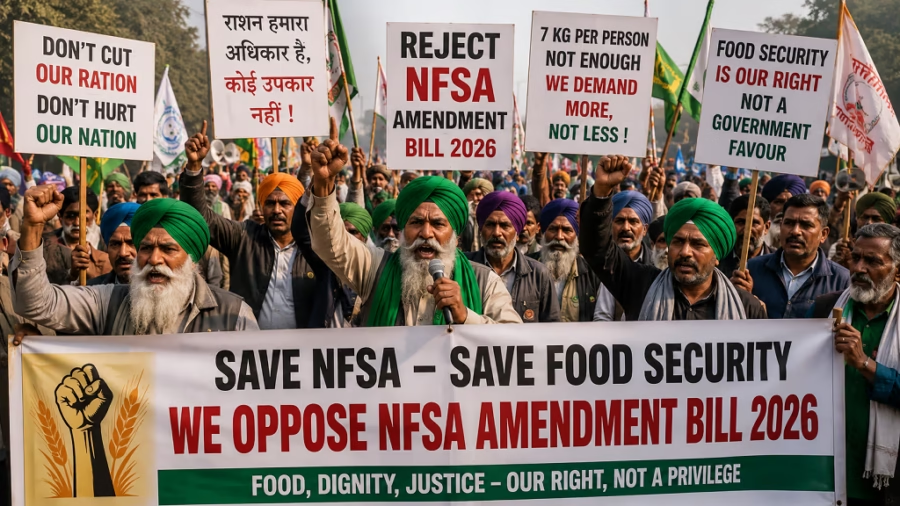
Why the Public is Criticising the Proposed Draft?
Major organisations such as All India Agriculture Workers’ Union (AIAWU), All India Kisan Sabha (AIKS), All India Democratic Women’s Association (AIDWA) and Centre for Indian Trade Union (CITU) called for a nationwide protest against the proposed changes and emphasised that the implications can reduce food security for small households.
Reduction in the Ration Quota:
- Despite having 2-3 members in the family, the 236.9 household beneficiaries in India registered under AAY were entitled to 35 kg. But according to the new system proposed, families with fewer than five members will be provided 7kg per month, which means they will get:
- 1 member x 7kg =7kg
- 2 member x 7kg =14kg
- 3 member x 7kg =21kg
- 4 member x 7kg =28kg
- Thus, the quantity is less than 35 kg. The “Antyodaya Anna Yojana (AAY)” benefits close to “939.4 lakh beneficiaries”, and for many of these beneficiaries, the scheme serves as an important means of food security.
- The various beneficiaries of the scheme are unorganised workers and traditional workers, agricultural labourers, landless families, self-employed people, Dalits, Adivasis, senior citizens, widows, disabled persons, single women, homeless people, and others who are economically weaker sections of society.
- For many of these sections of society, there is still limited access to proper employment, quality health care services and adequate social security.
- For many poor families, the scheme of AAY gives the comfort of getting regular food. Critics pinpointed that reducing the entitlement of food grains under the existing scheme will worsen food security for the economically weaker sections.
Health Concerns:
Food security researchers also note that food security is not just about the quantity of food but the nutritional value of food, too. Though cereal grains can be useful in satisfying the energy demands of households, their sole consumption does not result in nutritional balance in food intake.
- Researchers from the public health and nutrition sectors have thus advised that the subsidised food basket should be expanded to include legumes, oilseeds, millets, and other foods rich in protein.
- Several researchers have also noted that 7 kg of food grain per individual may not suffice for the nutritional demands of vulnerable communities. This is especially so for children, pregnant and nursing mothers, elderly individuals, and poor households in general.
Outdated Beneficiary List:
One of the most frequently raised objections concerns the use of the 2011 census data for calculating NFSA benefits. Since the last decade, the population of India has grown significantly, but there has been no adjustment in the number of beneficiaries. Thus, numerous eligible families are reportedly excluded from the scheme. The opponents believe that revision of the list of beneficiaries is more important than any change in entitlement.
Possible Outcomes of Draft Revision-
As the drafted bill is publicly criticised, the government may take a decision after discussing the amendments with the state government. Moreover, the government can accept the public suggestions, decline the current draft and make amendments in favour of the beneficiaries. Also, they may retain the current bill, remove a few clauses or try to make some modifications.
Organisations and Unions: The farmer organisations and labour unions are pressurising the government to withdraw the proposed bill, as the bill harms the small labourers. The protestors are also concerned about revising the current list with the updated census. Further, the beneficiaries demand more food security and inclusion of more nutritional food, such as pulses and other food essentials.
FAQs-
A. The proposed amendment seeks to replace the system of entitlement through AAY on a household basis with an entitlement of 7 kilograms of food grain per person per month, but not more than 35 kilograms per household.
A. According to the government, the amendment aims to make food grain distribution more equitable by linking allocations to the number of eligible family members instead of providing the same quantity to every AAY household.
A. The opponents think that through the amendment, there will be lower food grain entitlement for smaller families, but larger families will still be restricted to the 35 kg limit. They feel that the amendment does not completely remove the inequalities.
A. There will be an analysis of the responses made during the consultation stage prior to determining whether there will be any changes to be made, approved, or withdrawn altogether. The bill will then be enacted into law once it is passed through Parliament.