
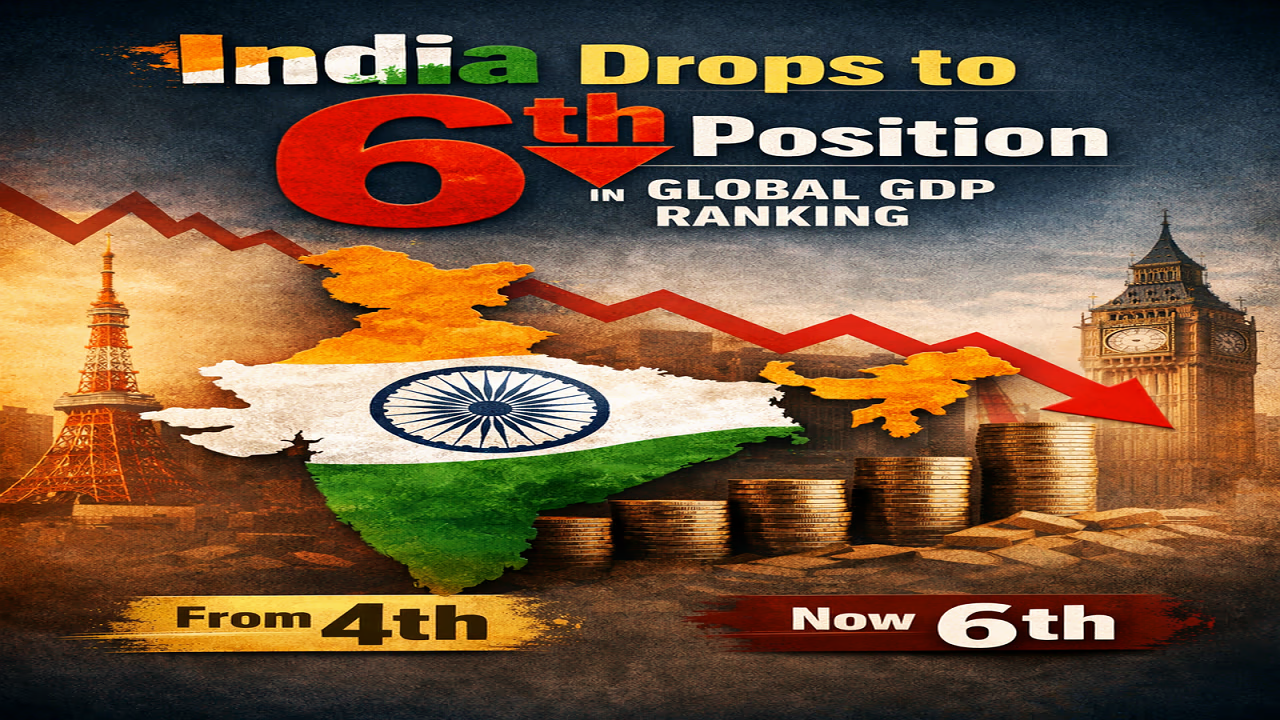
The IMF (International Monetary Fund) had just released the nominal GDP ranking around the world, where India was ranked 4th, but then dropped down to become 6th among others in the list of nations. The nominal GDP numbers for India in the year 2025 were estimated to reach $3.92 trillion, but increased to $4.15 trillion in 2026. In the same regard, India’s nominal GDP numbers are below those of the UK, with an estimated GDP of $4 trillion and $4.26 trillion in 2025 and 2026, respectively. The GDP decline shows the depreciation of India in rupees, where more rupees are needed to pay a dollar. However, in the economic race, the U.S., China, Germany and Japan have retained their position since the last World Economic Outlook report.
ALSO READ- Claude Opus 4.7 Debuts With Stronger Coding Tools
Why is the IMF’s GDP Ranking Important?
The annual Global GDP Rankings published by World Economic Outlook (WEO) represent the economic strength of a nation in terms of trade, productivity, and investments. These rankings are headed under the International Monetary Fund (IMF), along with decisions influenced by the World Bank and G20 (an international forum for the global economy comprising 19 nations, including India). The countries with higher ranks, like the U.S.A. (1st position) and China (2nd Position), are said to have the strongest economies with greater negotiating power in trade, geopolitics and finance management.
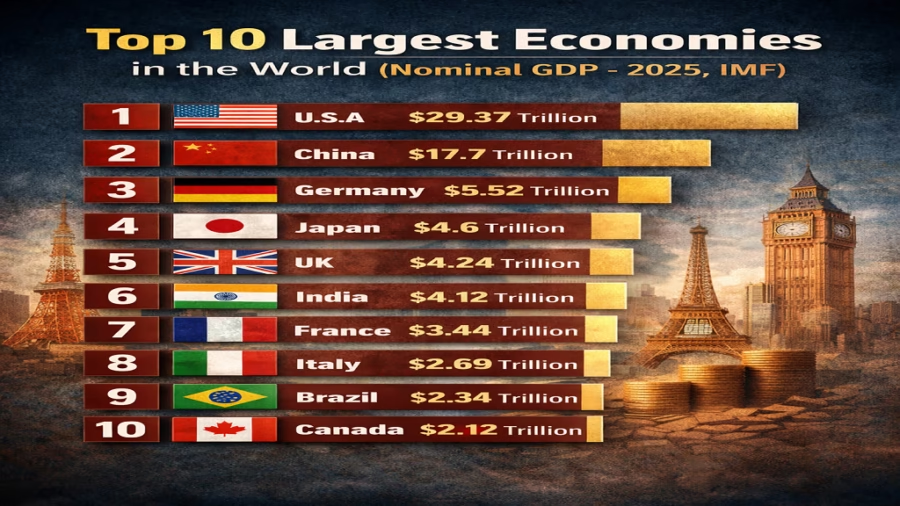
Latest GDP Rankings of 2026:
| Nations Ranked by the IMF | GDP Valuation in US Dollar (USD) |
| United States | 32.38 trillion |
| China | 20.85 trillion |
| Germany | 5.45 trillion |
| Japan | 4.38 trillion |
| United Kingdom | 4.26 trillion |
| India | 4.15 trillion |
| France | 3.6 trillion |
| Italy | 2.74 trillion |
| Russian | 2.66 trillion |
| Brazil | 2.64 trillion |
These rankings are beneficial in terms of:
- Foreign investors closely observe the rankings to invest in the policies of particular nations (FDI).
- A high GDP of a nation builds confidence in the international market, ensuring stability while investing in bonds and shares.
- Large economies have more stable currencies; however, low-ranked nations have wider exchange rates. More currency is required to buy high-ranking nation denominations.
- The rankings do not mean a sudden economic slowdown, but currency fluctuations.
- This also tells how good the country has an international trade relationship. Also, it redefines bilateral and multilateral trade relations.
What is ignored in the ranking?
- GDP Rankings ignore qualitative aspects like birth rate, death rate, standard of living and life expectancy of a nation.
- It doesn’t measure the unequal distribution of income among its people.
- The currency fluctuations are affected by nominal GDP.
What does the Shift to 6th Position Mean to India?
- In 2025, India, which was ranked 4th with a nominal GDP of 3.19 trillion, is now ranked third with 4.15 trillion nominal GDP, replaced by Japan and succeeded by the UK.
- Although these rankings are economic strength indicators, they are solely based on trade relations, finances and geopolitical engagement, that does not cover countries’ other valuable indicators that are required to improve the prevailing situation.
- This shift does not signal an economic slowdown, as there is no major drift in the previous rankings. However, the nation may face a slight fall in the rupee.
- The Indian economy is anticipated to continue growing strongly, and forecasts indicate that India may be able to reclaim its high positions within the next few years.
- The IMF and other organisations predict that India’s GDP will reach nearly $6.79 trillion in 2031, surpassing Japan and returning to one of the world’s top three economies.
Why India’s GDP Rank Drops in IMF-WEO 2026?
The decline in India’s GDP ranking from 4th to 6th globally, according to the IMF, is not caused by an economic downturn but is largely attributed to technical and external reasons. This is why India’s GDP Rank fell:
- Decline in Rupee Value:
- Generally, GDP rankings are calculated in terms of the US Dollar nominal GDP. Despite development programmes and domestic growth, the Indian rupee seems smaller in terms of dollar value, indicating the rupee weakens against the US Dollar.
- Real Growth is confused with nominal GDP, as it is indicated by nominal GDP. Real GDP of the nation shows real economic expansion affected inflation and exchange rates.
- Data Revisions and Changes by the IMF have contributed to the change of the rankings overnight, with factors influencing such as GDP estimates, base year calculations and data collection methods.
- Countries that succeeded Japan and the UK have improved their trade relations, have strong currencies and better nominal GDP. This indicates that, though India is developing and growing, the UK and Japan are performing better in economic terms.
- Exchange rates can drastically influence the nominal GDP, depending heavily on exchange rates that fluctuate due to interest rates, geopolitical conditions and cash flow.
- Thus, the economy has not declined or economic slowdown. The results are purely due to statistical and currency-driven adjustments.
How India Can Come Back in the WOE Ranks?
India will be able to reestablish its ranking within the IMF’s World Economic Outlook (WEO) reports through the following means:
- Maintaining a high economic growth rate: This involves maintaining an annual GDP growth rate of 6.5 to 6.7% in infrastructure, development and reliable policies.
- Stabilise the rupee and external sector: Control inflation, narrow current-account deficit, and manage foreign flows so as not to see rupee depreciation that will lower India’s GDP and ranking in dollar terms.
- Raise the investment ratio to near 40% of GDP: Expand public-private investments in manufacturing, energy, transportation and logistics so that capital-intensive investments boost production and productivity.
- Labour reallocation towards more productive industries: Shift the labour force away from the agricultural sector into the industries/services sectors using skills development/education/regulation to do so.
- Human capital investments: Invest in education, training, healthcare, and especially female employment so as to develop additional productive workers.
- Strong macro institutions: Fiscal consolidation, reduction of subsidy leakage, and prudent debt management so that international markets view India as a stable and good investment.
- Target multitrillion-dollar economic base: Targeting economic base from $4 trillion in GDP currently to over $10 trillion by the early 2030s, so that high growth naturally leads India back into the top-3 countries globally in both nominal and PPP rankings.
ALSO READ- Delhi–Dehradun Expressway Gets Green Signal
FAQs-
A. A drop in GDP rank from 4 to 6 position, in terms of international standing based on GDP, India’s ranking among the world’s biggest economies has changed in comparison to other countries. This is not to say that the Indian economy has contracted; it is purely a matter of international standing.
A. No, the shift in 4th to 6th rank does not imply India is slowing down. This is just an indication of its ranking among other nations globally. India continues to be among the fastest-growing economies, at a rate of about 6-7%.
A. Not really, the ranks by WOE will affect the global image of India as being a good power. India has continuously progressed in different sectors and focuses on growth expectations. However, investors may show less interest in investing in India, but as India is on the top list.
A. The main reasons include:
Depreciation of the Indian rupee
Changes in IMF data and methodology
Better performance (in dollar terms) by other economies