
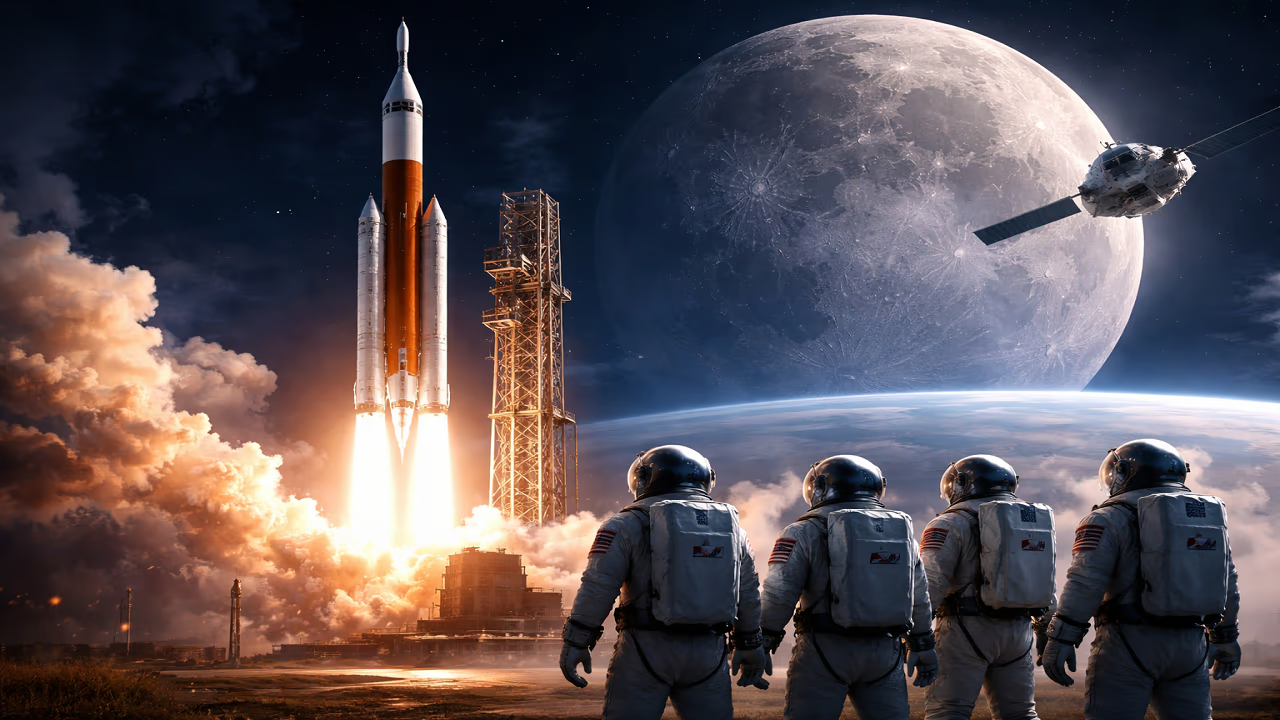
NASA has begun its run-up to the Artemis II mission, which will send astronauts beyond Earth for the first time in human history. The 10-day moon mission, which will happen on April 1, will go beyond its ceremonial purpose to attain a successful lunar orbit. The mission tests advanced technology and human limits while demonstrating the narrow space between victory and disaster.
This is not a normal mission. It is a calculated risk.
For the very first time in over 50 years, humans will leave low Earth orbit and travel into deep space again—this time aboard a spacecraft that has never carried people before.
ALSO READ- Major Trends in Global Terrorism Index (GTI) and Emerging Risks in 2026
A Mission Formed on Peril, Not Comfort-
The Artemis II mission will carry four astronauts—three from the United States and one from Canada—on a journey spanning more than half a million miles. The spacecraft Orion will travel to the Moon and back to Earth without making a landing.
No room for blunder. Not at this distance.
“This is not just another spaceflight,” said Dr Elaine Porter, a fictional aerospace analyst at the Lunar Policy Institute. “You’re testing systems in an environment where rescue isn’t an option. That changes everything.”
The crew will spend about 10 days inside a capsule roughly the size of a minibus. Tight quarters. Limited privacy. Constant pressure.
And yet, they signed up for it.
The Astronauts at the Centre of It All-
The mission is under the command of Commander Reid Wiseman, who operates with pilot Victor Glover and mission specialists Christina Koch and Jeremy Hansen. The two astronauts share more than 20 years of space experience, though they will be making their first spaceflight together.
They’ve trained for years. Simulations. Emergency drills—psychological conditioning.
Still, training only goes so far.
“Space doesn’t care how prepared you are,” said former astronaut (fictional) Mark Reyes. “It will test you anyway.”
Launch Day: Where Things Can Go Wrong Fast-
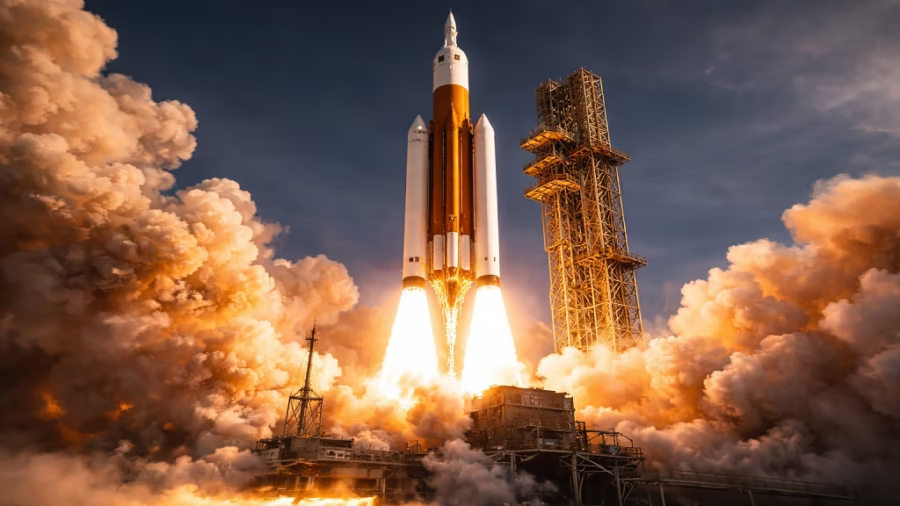
The mission begins at Kennedy Space Centre in Florida—the rocket: the Space Launch System (SLS), the most powerful ever built by NASA.
Standing nearly 100 meters tall, it’s a machine designed for brute force.
What Makes the SLS So Critical-
- Two massive solid rocket boosters generate the initial thrust
- Four engines burn liquid hydrogen and oxygen
- The core stage holds over three million litres of fuel
- A Launch Abort System sits at the top for emergency escape
If something fails during liftoff, the abort system must act in seconds. No hesitation.
“The first eight minutes of flight are the most dangerous,” said aerospace engineer (fictional) Kavita Sharma. “After that, your odds improve—but only slightly.”
The SLS has flown once before. No crew onboard. This time, it carries lives.
Orion: A Spacecraft Tested, But Not Proven-
The Orion spacecraft begins its mission after reaching orbital space. The spacecraft will transport astronauts into the area beyond Earth, which contains increased radiation levels.
This is where things get serious.
Orion’s life support systems will be tested with humans for the first time. Oxygen supply, temperature control, waste management—every system must work flawlessly.
Key Challenges Inside Orion:
- Limited space for movement and sleep
- Continuous exposure to deep-space radiation
- Communication delays as distance increases
- Psychological strain from isolation
“There’s no quick return,” said behavioural scientist (fictional) Dr Neha Kapoor. “Once they’re on that trajectory, they’re committed.”
The spacecraft will also face a communications blackout when it passes behind the Moon. For several minutes, Earth will hear nothing.
Silence in space is not poetic. It’s unsettling.
The Voyage Around the Moon-
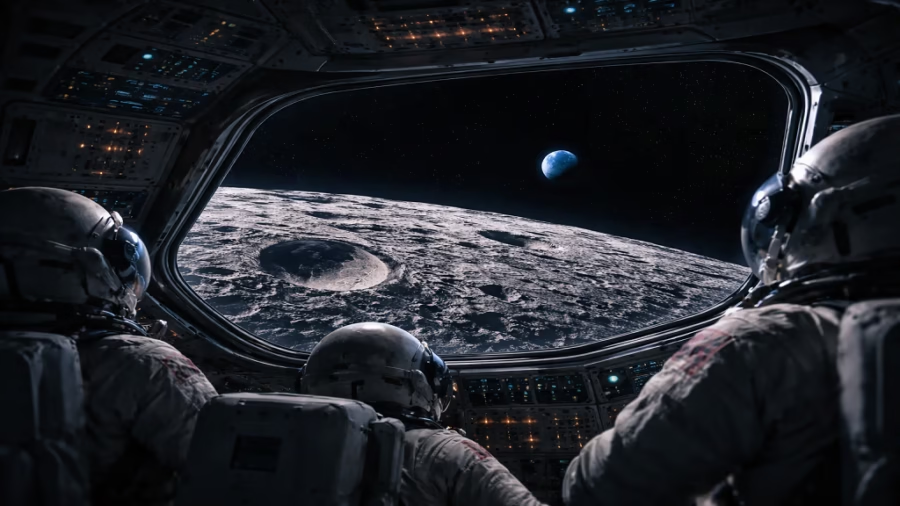
Orion will begin its first mission after launch by executing translunar injection, which will send the spacecraft to its Moon mission. The spacecraft will travel beyond limits established by human exploration when it reaches the far side of the Moon about three days after the launch.
The team plans to achieve a new distance record, which will surpass the Apollo 13 mission record if everything proceeds as expected. That moment will be historic. And tense.
What the Crew Will Experience-
- A view of Earth shrinking into a distant blue dot
- The Moon’s far side—never visible from Earth
- Temporary loss of communication
- Microgravity for the entire mission
- “They’ll see something no human has seen in decades,” said space historian (fictional) Daniel Brooks. “But they’ll also feel the weight of that distance.”
Why Artemis II Matters More Than It Seems-
This mission is not about planting flags. It’s about proving that humans can survive—and function—far from Earth.
NASA plans to use Artemis II as a stepping stone for future missions, including a lunar landing and eventually a permanent Moon base.
That’s the long game.
What Artemis II Will Help Achieve-
- Validate Orion’s life support systems
- Test deep-space navigation and communication
- Prepare for Artemis III lunar landing
- Build confidence for future Mars missions
“This is a rehearsal,” said Dr Porter. “But it’s a rehearsal where failure isn’t an option.”
ALSO READ- India introduced the Jal Jeevan Mission 2.0
The Human Factor: Fear, Family, and Reality-
Behind the technology, there’s something else: people.
Each astronaut has spoken with their family about the risks. The possibility—however small—that they may not return.
That conversation matters.
“We’ve all got someone watching that launch,” said pilot Victor Glover in a briefing. “It’s exciting, but it’s also terrifying.”
There’s no way to sugarcoat it. Spaceflight at this level is dangerous.
And everyone involved knows it.
FAQs-
A. Artemis II aims to test the Orion spacecraft with a human crew in deep space, to make sure systems work before future Moon landings.
A. The mission will cover more than half a million miles, setting a new record for human distance from Earth.
A. No. This mission will orbit the Moon and return. The landing is planned for a later mission.
A. Approximately 10 days from launch to splashdown in the Pacific Ocean.
A. Launch failure, radiation exposure, system malfunctions, and the challenges of deep-space travel without immediate rescue options.