
India is re-elected to the UNESCO Executive Board for 2025-29, offering it another opportunity to shape global policy in education, culture, science, and communication. The election, conducted during the 42nd session of the UNESCO General Conference held in Paris, reflects a high degree of worldwide confidence in both India’s leadership and long-standing commitment to multilateral cooperation. As one of the principal governing bodies of UNESCO, the Executive Board shall lead the organisation’s priorities and manage programs, with the responsibility of ensuring that the viewpoint of its member nations is represented. This enlarged mandate is likely to give vigour to India’s efforts in advancing cultural heritage preservation, digital learning, and scientific collaboration. Read the article to understand the significance of Indian contributions to UNESCO’s goal of creating peace through knowledge and cooperation.
ALSO READ- India’s 2025 Animal Husbandry Statistics: Key Trends & Insights
What is the UNESCO Executive Board?
- The three main constitutional bodies of UNESCO are the General Conference, the Executive Board, and the Secretariat.
- The Executive Board consists of 58 Member States, and its members are elected for four-year terms.
- The principal functions include:
- Overseeing the implementation of the decisions of the General Conference
- Directing UNESCO’s general policy
- Standard-setting activities
- Elaborating on the work program and budget
- This includes making recommendations such as new member admissions, advising concerning the nomination of the Director-General, and monitoring the operation of UNESCO’s global programs efficiently.
- Representatives are chosen to ensure the representation of the cultural and geographical diversity of its member states.
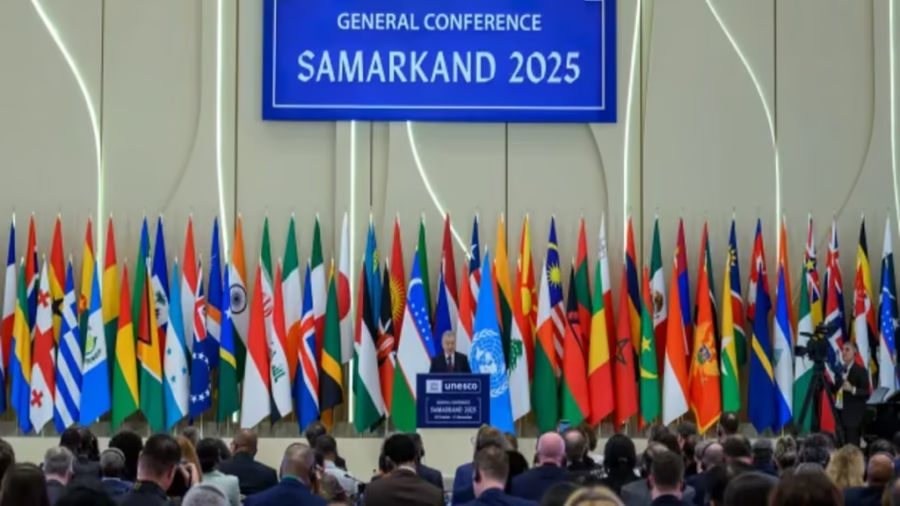
- On 7 November 2025, India was re-elected at the 43rd session of the UNESCO General Conference held at Samarkand, Uzbekistan.
How is the UNESCO Executive Board Elected?
The detailed process of electing members of the executive board is:
- Members of UNESCO’s Executive Board are not individuals. They are Member States elected by UNESCO’s General Conference, the main decision-making body.
- Each state is elected by vote, taking into account fair geographical distribution so that all world regions have a fair representation.
- The election to the UNESCO Executive Board starts when the Director-General, some months in advance of the session of the General Conference, requests Member States to declare their candidacies.
- Candidatures need to be submitted in advance; a provisional list is circulated to all Member States before the session begins.
- Seats on the Executive Board are divided by electoral groups with the aim of geographical balance among regions.
- The election is done by secret ballot in the General Conference with appointed tellers for transparency.
- Each delegation votes for the candidates of their choice, using a separate ballot paper for each group.
- Votes are counted, and candidates reaching an absolute majority take the available seats; further ballots are held until all positions are filled.
- After deliberations, the results are formally announced in a plenary meeting. The elected Member States serve for four-year terms.
The Reason for India’s Re-Election & Its Contribution to UNESCO-
India has long played an active role in heritage protection, through its 44 UNESCO World Heritage Sites, which include 36 cultural wonders like the Taj Mahal and the Ajanta and Ellora Caves, and more recently Santiniketan and Ramappa Temple. It also supports initiatives that promote traditional knowledge, literacy outreach, STEM education for girls, cultural diversity, and ethics in digital technologies.
- The Mahatma Gandhi Institute of Education for Peace and Sustainable Development, New Delhi, is a UNESCO Category-1 institute.
- UNESCO recognises Indian heritage sites like Ramappa Temple, Kumbh Mela, and Durga Puja in Kolkata.
- Supporting the United Nations’ declared International Year of Millets 2023.
- Active participation in UNESCO initiatives, including World Philosophy Day, International Mother Language Day, and International Teachers’ Day.
- Election to the Intergovernmental Committee for the Preservation of Intangible Cultural Heritage, 2006–2010 and 2014–2018.
- Advocacy for 43 World Heritage Sites in India, which includes Moidams of the Ahom Dynasty.
- The Bhagavad Gita and Natyashastra have been included in the UNESCO Memory of the World Register.
Significance of India’s Selection to the UNESCO Executive Board 2025-29-
The re-election of India to the Executive Board is significant because:
- Increases India’s global impact in education reform, cultural preservation, digital transformation, and scientific partnership.
- Increases soft power by sharing knowledge about preserving cultural diversity and supporting inclusive, human-centred development.
- Reflects international trust in India’s multilateral commitment and vision for equal access to knowledge and heritage.
- Advocates for digital equity, basic literacy, media freedom, and compatibility with the UN Sustainable Development Goals.
- Promotes South-South cooperation, cross-cultural communication, and long-term progress through UNESCO platforms.
Representation of India at UNESCO-
India is represented at UNESCO through its Permanent Delegation, located in Paris, France. The Permanent Delegate of India to UNESCO is Ambassador Vishal V. Sharma, who represents India’s engagements and diplomatic relations at UNESCO headquarters.
- It is responsible for the representation of India in sessions of UNESCO boards and working groups.
- It actively participates in discussions, program implementation, and makes necessary adjustments to ensure India’s priorities align with the global mission of UNESCO.
- For the new term (2025–29), India is likely to lead the initiatives in digital learning, climate-responsive education, preservation of intangible cultural heritage, global scientific cooperation, youth participation, and cultural exchange.
Key Focus of India-
- Digital learning and equal access to education
- Climate-responsive education and sustainable development
- Preservation of tangible and intangible cultural heritage
- Global scientific cooperation and indigenous knowledge systems
- Promotion of multilingualism and inclusive communication
- Ethical use of digital technologies and media freedom
- Youth participation and cultural exchange among member states
- South-South cooperation is aligned with the UN Sustainable Development Goals
Global Impact of India’s Re-election-
India’s contribution to the UNESCO Executive Board holds great global relevance, as it shapes international policies relating to education, culture, science, and communication:
- By serving actively, India extends its support to policy promotion for inclusive and equitable access to education, preservation of cultural and natural heritage around the world, and initiatives on sustainable development to align with the UN Sustainable Development Goals.
- India’s advocacy on digital literacy, the ethics of technology use, and preservation of intangible cultural heritage shapes international standards and practices that help countries in their contemporary challenges, such as misinformation and erosion of culture.
- Moreover, the promotion of South-South Cooperation by India enables closer relationships among developing nations, thereby facilitating collective responses to global issues in science, climate action, and cultural exchange.
- India’s representation on the Board reflects diverse voices emanating from the country with its rich heritage and technological advancement, hence contributing meaningfully to global peace and knowledge-sharing.