
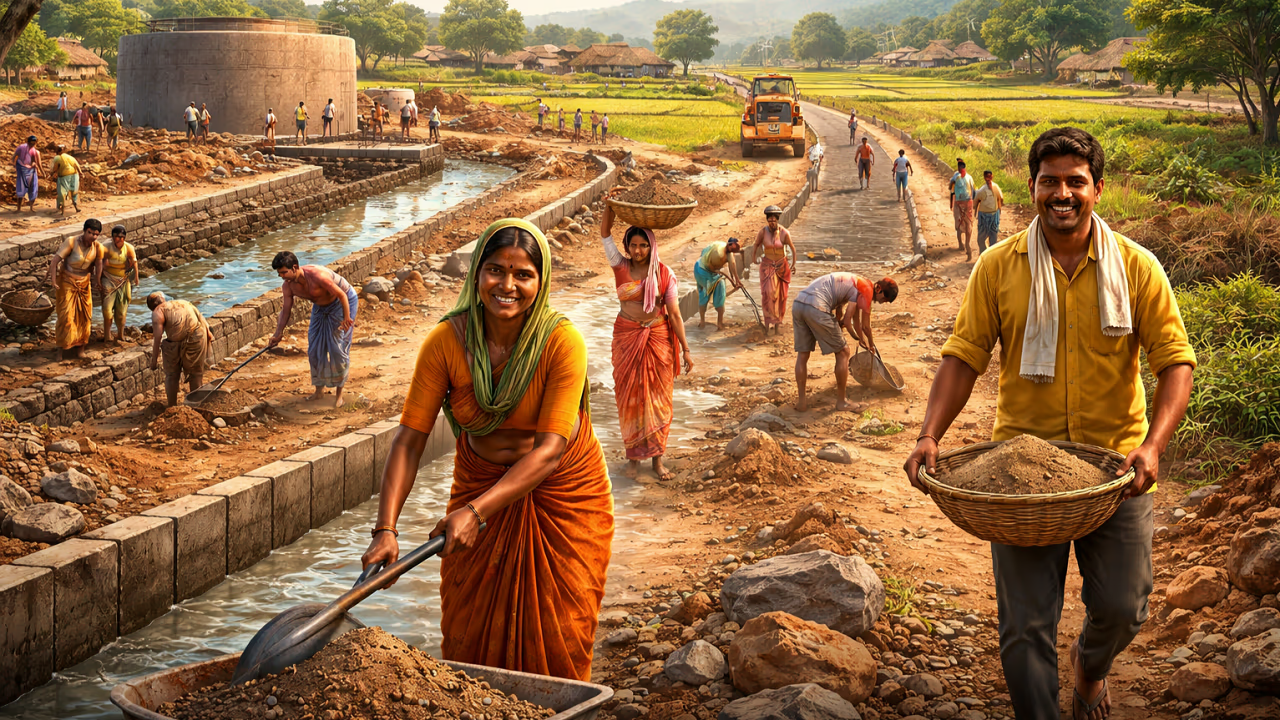
India’s rural employment regime is set to undergo its biggest transformation in two decades. The Viksit Bharat–Guarantee for Rozgar and Ajeevika Mission (Gramin) Bill, 2025, commonly termed VB-G RAM G, is suggested as a replacement for the Mahatma Gandhi National Rural Employment Guarantee Act, 2005 (MNREGA).
The new bill has witnessed a change in policy thinking from short-term wage support to infrastructure-led employment and sustainable rural livelihoods that coincide with the government’s Viksit Bharat 2047 vision.
Here you will learn what VB-G RAM G is, why the MNREGA is being replaced, key changes, benefits, challenges, and what it means for farmers, workers, and states.
ALSO READ- World Inequality Report 2026 Explained: A Brief Look at Global Disparities
Background: What Was MNREGA?
MNREGA came into existence in 2005 to provide 100 days of wage employment guaranteed in a year to rural households who were prepared to work unskilled manual work.
Some of the aims were:
- Income security for the rural poor
- Strengthen livelihood
- Promote social inclusion
- Empowerment of Panchayati Raj Institutions
Over these years, it has become one of the largest public employment programs in the world. The government, however, maintains that rural India has changed to a great extent and thus needs a different framework.
What Is VB–G RAM Bill 2025?
Viksit Bharat–Guarantee for Rozgar and Ajeevika Mission (Gramin) constitutes VB-G RAM. Under this system, the wage entitlement is 125 days a year per rural household, as opposed to the 100-day entitlement of MNREGA. But this bill has a vision far beyond working days.
The VB-G RAM G’s true avatar is to:
- Create durable and productive rural assets
- Strengthening village infrastructure
- Fostering Sustainable Livelihoods
- Creating Climate-Resilient Rural Economy
The key focus will be on planned construction of local needs and market-related infrastructure rather than random short-term works.
Why Is the Government Replacing MNREGA?
According to the government, MNREGA was designed for a different rural reality. Since 2005:
- Poverty levels have declined
- Financial inclusion has expanded
- Rural livelihoods have diversified
At the same time, MNREGA faced governance challenges such as:
- Leakages and misuse of funds
- Non-existent or low-value works
- Delays in wage payments
- Less than 8% of households completed 100 days of work
VB–G RAM G is presented as a reset, not a rollback—retaining the legal guarantee while improving planning, accountability, and outcomes.
Key Features of VB–G RAM G Bill 2025-
125 Days of Guaranteed Employment:
- Increased from 100 to 125 days per rural household
- Higher income potential for workers
- Legal guarantee of work continues
Four Priority Work Verticals:
All works are organised into four clear categories:
Water Security Works:
- Water harvesting
- Irrigation systems
- Groundwater recharge
Core Rural Infrastructure:
- Roads and connectivity
- Storage facilities
- Common utility assets
Livelihood-Related Infrastructure:
- Assets supporting agriculture and allied activities
- Support for rural enterprises
Climate and Disaster Mitigation:
- Flood control
- Soil conservation
- Extreme weather protection
This replaces MNREGA’s long and scattered list of permissible works.
Pause During Peak Agricultural Seasons:
- States can notify up to 60 days per year when scheme work is paused
- Typically, during sowing and harvesting seasons
- Ensures adequate farm labour availability
- Prevents artificial wage inflation in agriculture
Weekly Wage Payments:
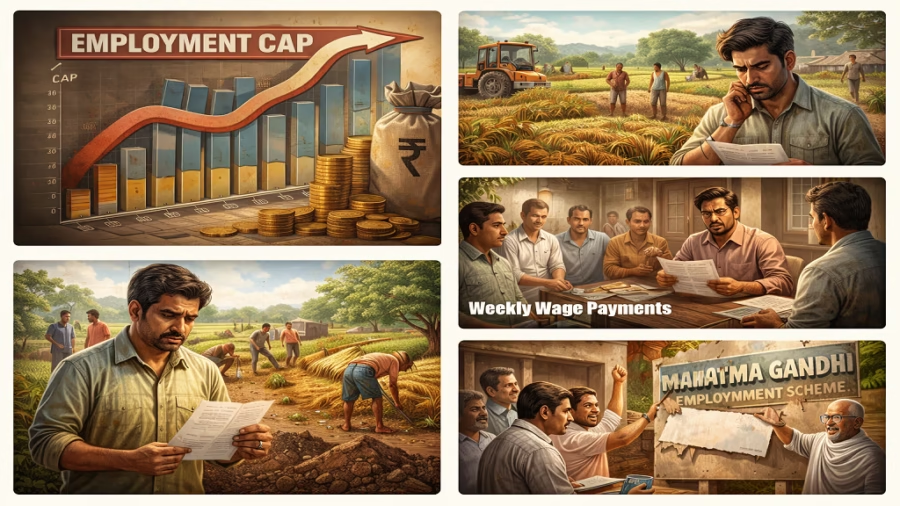
- Wages to be paid weekly, or at most within 15 days
- Faster and more predictable income for workers
- Compensation for delayed payments remains mandatory
Normative Allocation Instead of Demand-Driven Funding:
- The Centre allocates funds to states based on objective norms
- If a state exceeds its allocation, it must fund the excess itself
- Replaces MNREGA’s open-ended labour budget system
Digital Planning and Asset Mapping:
- All assets are mapped to the Viksit Bharat National Rural Infrastructure Stack
- Integration from the village to the national level
- Avoids duplication and low-value work
- Aligns with platforms like PM Gati-Shakti
Centre–State Funding Pattern:
VB–G RAM G is a centrally sponsored scheme with revised cost sharing:
- 60:40 – Most states
- 90:10 – North-Eastern and Himalayan states
- 100% Centre funding – Union Territories without legislatures
This increases state responsibility compared to MNREGA, where the Centre bore most wage costs.
ALSO READ- FDA Approves First AI Tool AIM-NASH to Advance Liver Disease Trials
What Changes for Rural Workers?
For labourers, the scheme offers:
- 125 guaranteed days of work
- More predictable work schedules
- Faster wage payments
- Mandatory unemployment allowance if work is denied
Workers also benefit indirectly from better infrastructure, such as roads, water facilities, and storage assets.
What Changes for Farmers?
They usually complained that MNREGA became a source of distortion in labour markets during peak seasons. Now, VB-G RAM G is doing the following:
- Halting all public works during the period of critical farming.
- Availability of agricultural labour.
- Stabilisation of farm wages costs and food production itself.
All the while benefiting the farmers through better irrigation, water security, and rural connectivity.
Benefits of VB–G RAM G Bill 2025-
- Greater guarantee of employment (125 days) more
- Swifter and much more guaranteed payments
- Quality and durable assets
- A robust focus on water security and climate resilience.
- Better planning and reduced fund leakages.
- Where Migration is Less Driven by Distress.
Challenges and Concerns-
Despite its ambition, the bill raises concerns:
- Higher financial burden on states
- Risk that normative allocation becomes an employment cap
- Reduced availability of work during peak farming seasons
- Implementation capacity varies across states
- Opposition criticism over the removal of Gandhi’s name
How these issues are managed will determine the scheme’s success.
Way Forward-
For VB–G RAM G to succeed:
- Centres and states must coordinate closely
- Workers must be informed about new entitlements
- Digital systems should ensure transparency
- Allocations must reflect real local demand
- Strong monitoring and audits are essential
Conclusion-
Under the new law, the Mahatma Gandhi National Rural Employment Guarantee Act represents a fundamental change in the rural employment philosophy of India: from temporary wage relief to a focus on asset-based, climate-resilient development. Higher employment, systemic planning, and improved rural infrastructure are all realisable, but the effectiveness depends solely on sufficient funding, state capacity, and genuine implementation.
If good systems are in place, VB–G RAM G could revolutionise public employment in constructing a prosperous and resilient rural Bharat.