
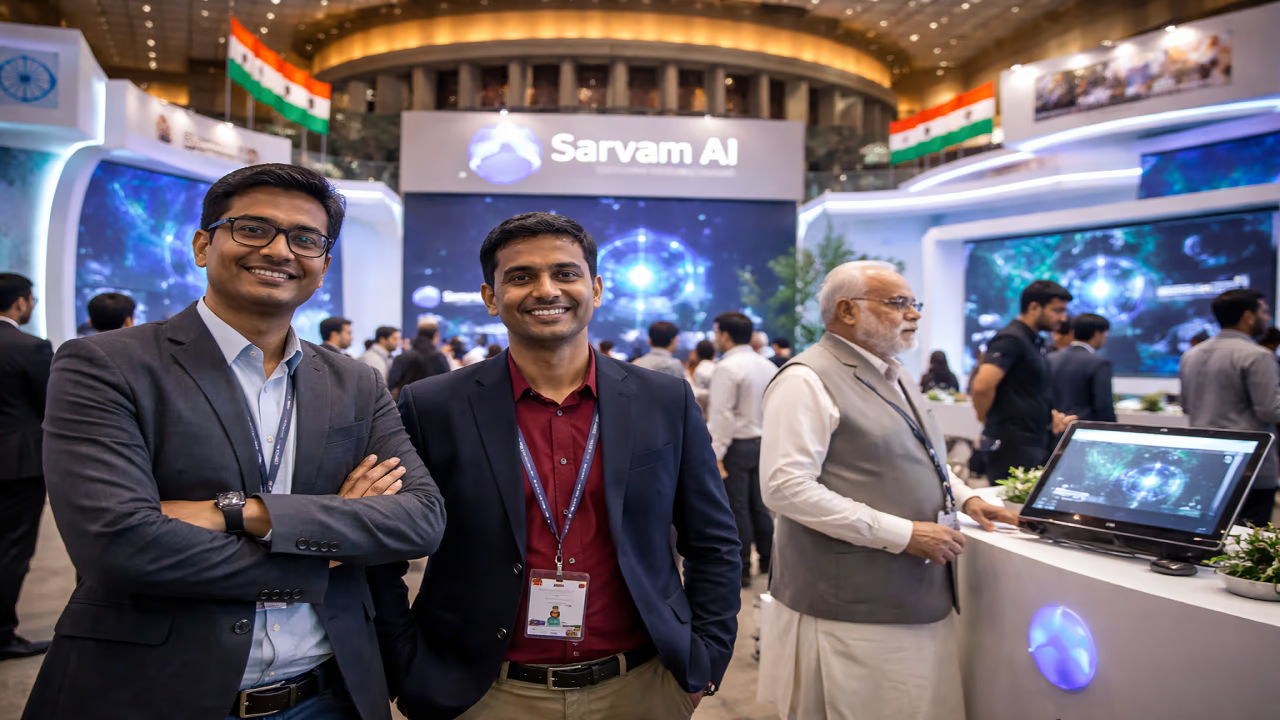
Sarvam AI has transformed from a Bengaluru startup into a major player at the India AI Impact Summit 2026 within three years. The Bharat Mandapam venue in New Delhi hosted a gathering of policymakers, researchers and industry leaders to explore artificial intelligence future developments. Sarvam AI emerged as a distinctive force among global tech giants and government initiatives through its product offerings and its mission to develop a sovereign AI model that relies on India’s linguistic heritage and public digital systems. The company’s growth represents a larger goal that aims to decrease dependence on foreign AI technology while developing systems that operate according to Indian cultural understanding.
ALSO READ- India–France Boost AI: Defence & Tech Pact 2026
The Vision: Sovereign AI Built for India-
The Indian Government selected Sarvam AI as one of its domestic companies to develop basic large language models, which they needed for the ₹10,372 crore IndiaAI Mission. The digital sovereignty efforts of the country received a major boost through this achievement.
Unlike global AI systems primarily trained on Western data, Sarvam AI focused on:
- Indian languages and code-mixed text (such as Hinglish)
- Government documents and scanned records
- Textbooks, newspapers, and regional datasets
- Speech and document recognition in non-Latin scripts
The idea was straightforward: if AI is to serve a country of 1.4 billion people, it must understand how they speak, write, and interact digitally.
The Founders: Deep Technical Roots-
Behind Sarvam AI are two engineers with long-standing ties to India’s digital transformation.
Pratyush Kumar:
Pratyush Kumar, who graduated from IIT Bombay with a degree in Electrical Engineering, completed his doctorate studies at ETH Zurich. Following his time at IBM Research and Microsoft Research, Kumar became a faculty member at IIT Madras. Through his work at AI4Bhara,t Kumar advanced Indic AI open-source research projects. He possesses specialised knowledge about large AI systems and computing systems, which serve as basic resources needed to construct Sarvam-30B and Sarvam-105B models.
Vivek Raghavan:
Vivek Raghavan, who studied at IIT Delhi, completed his Master’s and PhD degrees at Carnegie Mellon University. He chose to leave academic work by returning to India, where he worked on digital public infrastructure projects.
His contributions include:
- Serving at UIDAI during the scaling of Aadhaar
- Implementing AI-based fraud detection systems
- Advising GSTN and NPCI on digital innovations
- Contributing to language translation systems
Raghavan’s background led Sarvam AI to concentrate on creating technologies that deploy at a population scale instead of conducting research in laboratory settings.
Funding and Early Momentum-
After it began operations, Sarvam AI completed its initial work. The startup secured its first funding round by raising $41 million in December 2023 through combined seed and Series A financing efforts. The round received backing from Lightspeed Venture Partners as its primary leader, while Peak XV Partners and Khosla Ventures also joined the investment.
The funding allowed Sarvam AI to:
- Expand its research and engineering teams
- Access high-performance computing infrastructure
- Accelerate model training under the IndiaAI Mission
By 2025, the company had secured access to thousands of GPUs through government-supported compute facilities — a critical factor in training large-scale AI systems.
Sarvam 30B and 105B: The Foundational Models-
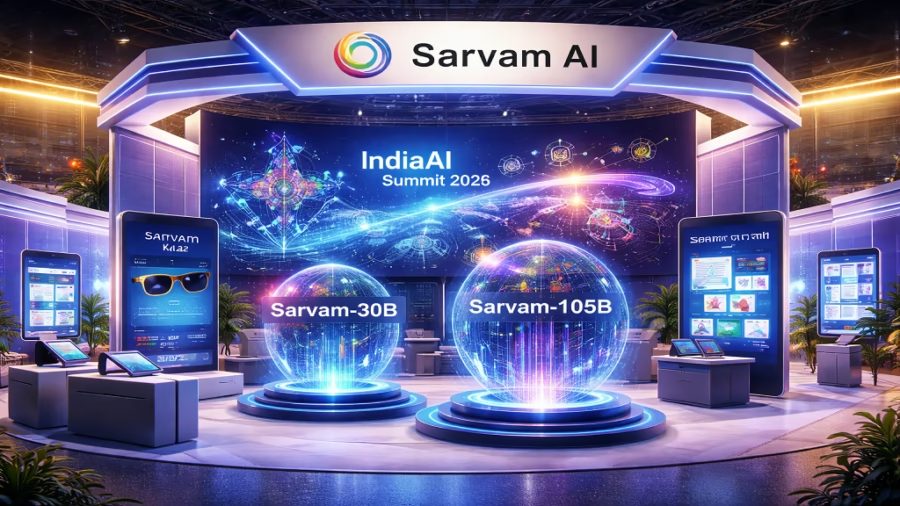
At the India AI Impact Summit 2026, Sarvam AI unveiled its two flagship models:
Sarvam-30B:
- 30-billion parameter model
- Mixture-of-Experts (MoE) architecture
- Activates approximately 1 billion parameters per token
- 32,000-token context window
Sarvam-105B (Indus):
- 105-billion parameter model
- Activates approximately 9 billion parameters per token
- 128,000-token context window
- Designed for enterprise and complex reasoning tasks
The Indus beta version of Sarvam-105B was made available to users through both web and mobile platforms.
The models learned from trillions of India-specific data tokens, which enabled them to develop multilingual skills and code-switching abilities.
Beyond Text: Speech, Vision and Hardware-
Sarvam AI’s portfolio extends beyond language models.
Speech Systems: Saaras V3:
Saaras V3 functions as a multilingual speech recognition system that can transcribe speech from various Indian languages. The system serves governance purposes, enterprise operations, and public service delivery.
Vision AI: Sarvam Vision:
Sarvam Vision specialises in document understanding and optical character recognition (OCR) technology, which supports Indian scripts. The technology serves as a crucial tool for digitising government archives and historical documents.
Sarvam Kaze Smart Glasses:
One of the most visible moments at the summit came when Prime Minister Narendra Modi wore Sarvam Kaze smart glasses.
The wearable device:
- Supports over 10 Indian languages
- Enables voice-based interaction
- Captures visual context in real time
- Operates as a multimodal AI assistant
While still awaiting broader commercial rollout, Sarvam Kaze symbolised India’s push into AI-powered hardware.
Government and Institutional Collaboration-
Sarvam AI’s credibility strengthened through a partnership.
UIDAI Partnership (2025):
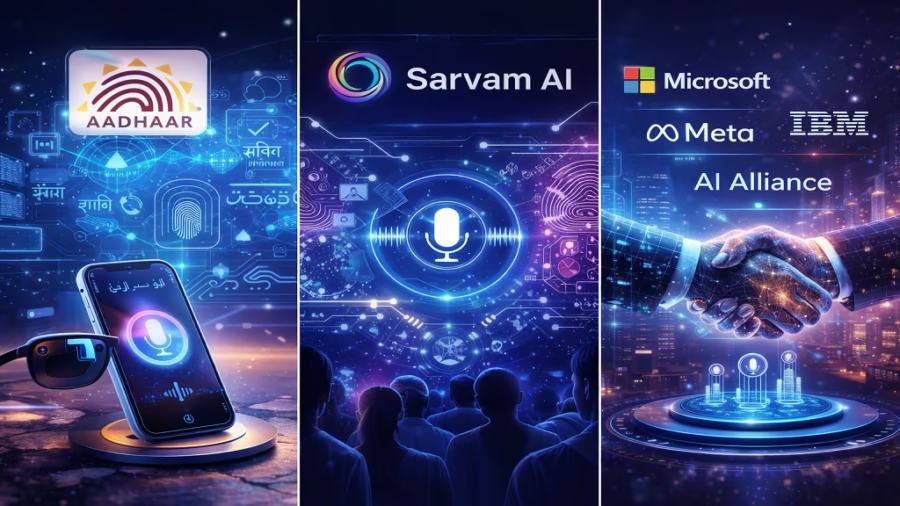
In March 2025, UIDAI partnered with Sarvam AI to combine AI-driven voice feedback systems into Aadhaar services. The goal was to elevate multilingual access.
Microsoft Collaboration (2024):
The business joined the Universe AI Alliance, which includes companies such as Meta and IBM, to support open-source AI projects. The collaboration showcases a combination framework that combines independent development with international collaboration.
AI Alliance Participation:
The firm joined the global AI Alliance, which consist companies such as Meta and IBM, to support open-source AI development. The partnerships create a hybrid system that adds domestic development with international collaboration.
Why Sarvam AI Matters-
Sarvam AI’s emergence is part of a broader shift in India’s technology strategy.
Digital Sovereignty:
The less reliant the system is on foreign AI platforms, the greater the chance it allows one to have control over infrastructure and data.
Linguistic Inclusion:
There are 22 Scheduled Languages in India, and hundreds of dialects. AI Systems would have to adopt this diversity.
Public Sector Integration:
Sarvam AI will contribute to large-scale digital governance by integrating AI into Aadhaar and other platforms.
Cost Efficiency:
Utilising domestic toolkits to train language models can save a lot of expense on costly overseas services.
ALSO READ- G4 Nations Meetup: A Push for UN Security Reform Discussed
Conclusion: A Measured Step Toward AI Independence-
The evolution of Sarvam AI from its 2023 startup phase to its 2026 India AI Impact Summit presentation demonstrates more than its rapid progress. It serves as a demonstration of India’s intent to develop an indigenous AI infrastructure.
Through its work on Indic AI models and multilingual systems and public sector integration, Sarvam AI is establishing a fundamental change in the way artificial intelligence develops and operates throughout India. The system shows sovereign AI to be an effective operational solution because it has transitioned from a theoretical concept to a practical application for local environments.