
A remarkable new height for India’s space odyssey was reached with the successful LVM3-M6 launch, propelling the BlueBird Block-2 satellite into orbit from Sriharikota. Powered by the innovative spirit of India’s youth, this mission showcases the flawless heavy-lift reliability of ISRO with an enviable success record of perfection. The LVM3 also provides a foundation for the historic human spaceflight in 2026 related to Gaganyaan, allows for an expansion of affordable commercial services, and deepens global partnerships. From telemedicine to disaster alerts, BlueBird is upping connectivity across the Asia-Pacific region. This jump in self-reliance under Atmanirbhar Bharat fascinates generations with dreams of lunar bases and more. Watch the stars get aligned for a cosmic future of India!
ALSO READ- James Webb Spots a Bizarre Lemon-Shaped Planet
Latest Update:
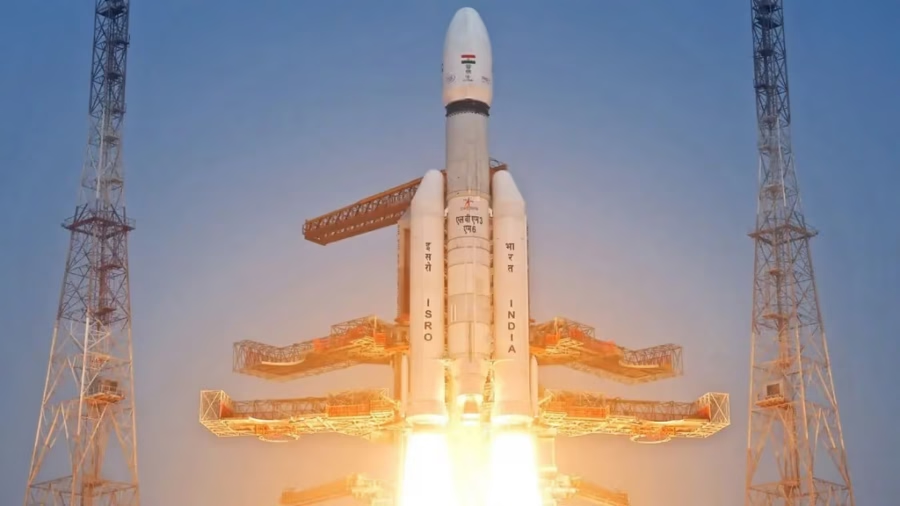
- LVM3-M6, launched from Sriharikota at 8.55 a.m. IST on December 24, 2025, marks the heaviest payload ever placed in Low Earth Orbit.
- The 2,250 kg BlueBird Block-2 communications satellite was deployed precisely into GTO after a 17-minute flight, reaching apogee of 35,786 km and perigee of 250 km for optimal geostationary manoeuvres.
- ISRO’s cryogenic CE-20 upper stage performed optimally, marking NSIL’s 6th commercial LVM3 success, serving Asia-Pacific broadband.
- Young engineers under 35 drove mission innovations, validating human-rated systems for Gaganyaan’s Q1 2026 test.
- Global partners like NASA praised the feat, boosting India’s 15% smallsat market while NGL and SSLV-D4 preparations for January launches.
Know the LVM3-M6: Reliable Heavy Lift Champion-
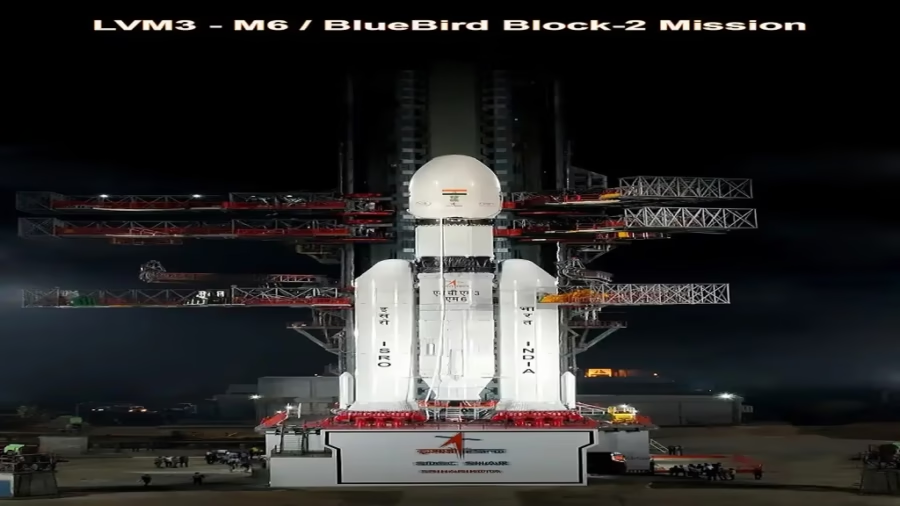
The LVM3-M6 mission refers to the sixth operational flight of India’s heavy-lift launch vehicle, Launch Vehicle Mark-3 (LVM3), also known as the “Bahubali” rocket — a name that evokes strength, capability, and national pride. In the case of LVM3-M6, the rocket had a lift-off mass of about 640 tonnes and stood approximately 43.5 metres tall — a testament to ISRO’s engineering prowess. LVM3 itself is India’s most powerful indigenous launch vehicle. It has a three-stage configuration comprising:
- Two solid strap-on boosters (S200)
- A liquid core stage (L110)
- A cryogenic upper stage (C25): Provide the thrust and precision required to place heavy payloads into orbit.
Key Specifications of LVM3-M6-
Below are the key specifications of LVM3-M6 that make it crucial for space missions:
- Vehicle Configuration: Three-stage, medium-heavy lift rocket with 2 S200 solid strap-on boosters, L110 liquid core stage, and C25 cryogenic upper stage.
- Height: 43.5 m tall, optimised for heavy payloads from Sriharikota SLP.
- Lift-off Mass: 640 tonnes total, including propellants and 6,100 kg BlueBird Block-2 payload.
- Diameter: Core body 4 meters; payload fairing 5 meters (ogive shape, 10.75m height).
- Payload Capacity (this mission): 6,100 kg to initial GTO (35,786 km apogee, 250 km perigee), heaviest LEO-class satellite from India.
- S200 Boosters: 2 x solid motors, 204.2 tonnes HTPB propellant each, 26.22m length, primary liftoff thrust generators.
- L110 Core Stage: Liquid-fueled (UH25/N2O4), 115.9 tonnes propellant, twin High Thrust Vikas Engines (HTVE) at 58.5 bar.
- C25 Upper Stage: Cryogenic CE-20 engine (LOX/LH2), 28.5 tonnes propellant, 13.5m length, precise orbit insertion with restart capability.
- Liftoff Thrust: 11,898 kN from boosters and core, enabling a rapid ascent trajectory.
Expanding Commercial Horizons through BlueBird Block-2-
At 6,100 kg, BlueBird Block-2, an innovative direct-to-cell 4G/5G communications from LEO satellite created by US-based AST SpaceMobile, is India’s largest commercial payload. It was launched using an LVM3-M6.
Objectives:
- Provide 4G and 5G connectivity straight to regular smartphones without the need for ground infrastructure, focusing on underserved and remote areas of the world.
- Bridge the digital divide across Asia-Pacific and beyond to enable mobile connectivity from space, telemedicine, and disaster alerts.
- Participate in the LEO constellation of AST SpaceMobile to enable smooth space-based cellular networks.
Features:
- Massive Phased Array Antenna: For broad coverage and fast data, this 2,400 square foot deployable array is the biggest commercial LEO antenna.
- Orbit Profile: For accurate station-keeping, it was sent to Low Earth Orbit (initial GTO: 35,786 km apogee, 250 km perigee).
- Technology: Enables interference-resistant signals for worldwide roaming, multi-beam steering, and direct-to-device 5G.
- It supports voice calls, video calls, text messaging and internet data services with 24×7 continuous coverage.
Significance of the Mission-
- Record-Breaking Payload Performance: The Indian mission marked a new record in the country’s space achievements, as the heaviest spacecraft ever launched by an Indian launcher was placed into orbit. The weight of 6,100 kg of the BlueBird Block-2 satellite, which dwarfed all previous missions, sets up a fresh benchmark to determine the potential of LVM3 launchers.
- Improved Business Credentials: Unlike other space missions, LVM3-M6 was a commercial mission taking place under an agreement between NewSpace India Limited (NSIL), the commercial arm of ISRO, and AST SpaceMobile. This goes to show that India can be a reliable partner for other countries in the competitive world of commercial space launches.
- Strategic Leap in Connectivity: The BlueBird Block-2 mission puts India and the international community at the cutting edge of efforts to close the digital divide. The mission of the satellite to provide direct mobile global broadband connectivity underlines the role that space technologies can play in the development of society, especially in underdeveloped and distant regions.
- Dominance in Heavy-Lift Launches: The LVM3 has successfully launched several major Indian missions, such as Chandrayaan-2, Chandrayaan-3, and OneWeb Commercial Launches. The successful launch of the LVM3-M6 mission further accentuates the continued excellence demonstrated by ISRO while handling heavy launchers.
ALSO READ- DPIIT Launches Digital Sponsorship Module for e-B4 Visa
How is LVM3-M6 Mission Beneficial for India?
The LVM3-M6 mission is not just a success in isolation; it represents a strategic inflexion point in India’s space journey:
- Commercial Revenue Boost: NSIL derives revenue worth $70M+ for the heaviest payload launched, which assists in funding ISRO’s future missions.
- Global Launch Market Share: Strengths the 15% small satellite market share with SpaceX at 1/3rd the cost of heavy LEO/GTO satellites.
- Technology Leadership: Indigenous CE-20 cryo engine and actuator development demonstrates 98% autonomy and less reliance on imports.
- Young Employment Surge: 70% of young engineers acquire expertise, generating over 200 space startups and 50,000 employment opportunities.
- Strategic Autonomy: Atmanirbhar Bharat shields against geopolitical risks; enables independent lunar/Mars missions.
- International Partnerships: Enhances relationships with the US (AST SpaceMobile), QUAD; increases satellite contracts from foreign companies.
- Economic Multiplier: ₹1,200 crore space revenue in 2025 fuels NGL/RLV development, MSME growth nationwide.
- Socio-Economic Impact: By supporting communication satellites like BlueBird Block-2, the mission indirectly contributes to socio-economic development goals, particularly in shrinking digital inequalities and enhancing global communications coverage.
Looking Ahead & Future Missions-
The LVM3-M6 success propels ISRO toward ambitious horizons, blending human spaceflight with planetary exploration. These missions cement global leadership while fueling Atmanirbhar Bharat:
- Gaganyaan Crewed Missions (2027): Three astronauts orbit 400 km LEO for 3-7 days post-2026 uncrewed G3/G4 with Vyommitra. Validates life support, re-entry; makes India the 4th human spacefaring nation.
- Next-Gen Launcher (NGL, 2030): 10T GTO/27T LEO capacity replaces LVM3 for heavy satellites. Enables deep space probes and crewed lunar missions at reduced costs.
- SSLV-D4 (Jan 2026): Small sat rideshares for 20+ annual launches targeting the global market. Complements LVM3 for diverse payloads from constellations.
- Bharatiya Antariksh Station (2035): Independent LEO station for 3-6 astronauts, microgravity research. Builds on Gaganyaan for sustained human presence.
- Shukrayaan-1 Venus (2026): Orbiter studies hellish atmosphere via radar, spectroscopy. India’s first planetary venture beyond the Moon/Mars.
- LUPEX Lunar South Pole (2028): JAXA-ISRO rover hunts water ice in craters. Advances in lunar economy, ISRU tech for bases.
- NISAR Earth Observer (2026): NASA-ISRO radar for disasters, agriculture monitoring. Dual-frequency data revolutionises climate tracking.
- RLV Reusables (2030): Orbital re-entry demos lead to 10x cost cuts. Two-stage system for rapid, affordable access to space.
- Mangalyaan-2 Mars (2026): Orbiter + rover for surface sampling, life detection. Builds on 2014 success with enhanced instruments.
- Private Ecosystem Boom: Skyroot/Agnikul handle 50% launches by 2030 via IN-SPACe. 200+ startups drive innovation and jobs.
FAQs-
A. ISRO’s sixth commercial LVM3 flight launched the 6,100 kg BlueBird Block-2 satellite on December 24, 2025, from Sriharikota. It marked India’s heaviest payload deployment to LEO, achieving perfect orbit insertion in 17 minutes.
A. Developed by US-based AST SpaceMobile, this 6,100 kg direct-to-cell satellite features a 2,400 sq ft phased array antenna for 4G/5G broadband to smartphones. It targets rural connectivity, telemedicine, and disaster management across the Asia-Pacific.
A. Human-rated upgrades like CE-20 cryo restart and abort systems tested successfully, paving the way for 2026 uncrewed G3 flight with Vyommitra. Confirms reliability for three-astronaut missions by 2027.
A. Liftoff at 8:55 AM IST (3:25 UTC) from Second Launch Pad, SDSC-SHAR, Sriharikota. Live-streamed on ISRO YouTube; full replay available.
A. Initial GTO: 35,786 km apogee, 250 km perigee; targets 520 km circular LEO at 53° inclination for satellite operations.