
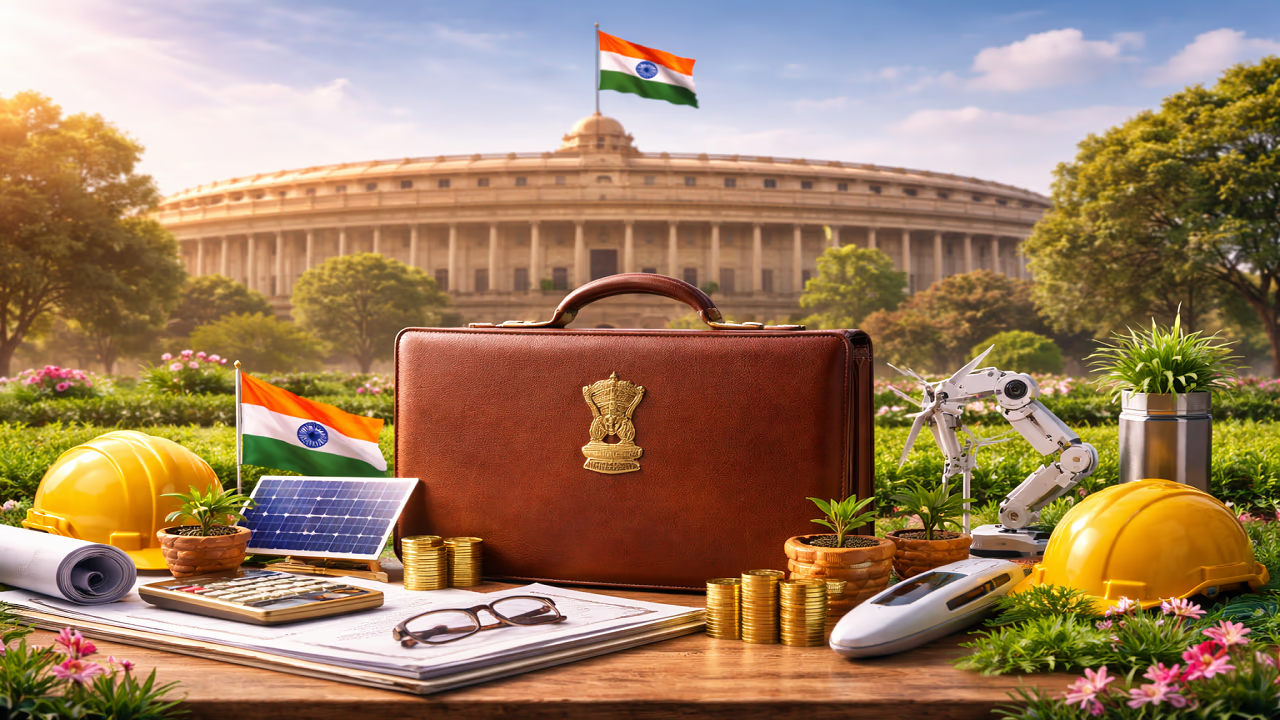
The Union Budget 2026–27 establishes a precise path for India’s economic development, which will occur through fiscal discipline and development programs that benefit all citizens. The budget presentation by Finance Minister Nirmala Sitharaman highlights youth empowerment through Yuva Shakti initiatives, while developing infrastructure tax simplification and MSME growth and preparing for future development through AI manufacturing and clean energy sectors. The budget, which originates from Kartavya Bhawan, presents its first-time budget creation process, which follows three Kartavya (duties) that include growth acceleration, aspiration fulfilment, and Sabka Sath Sabka Vikas enforcement. The policy framework to achieve Viksit Bharat derives from these two principles, which establish its foundation.
ALSO READ- Why the Scientists Set the Doomsday Clock to 85 Sec in 2026?
Union Budget 2026–27 at Prospect-
- Fiscal Deficit: 4.3% of Gross Domestic Product
- Public Capital Expenditure: ₹12.2 lakh crore
- Net Market Borrowings: ₹11.7 lakh crore
- Target Areas: Manufacturing, Infrastructure, MSMEs, Services, Agriculture, Education
- Tax Reform Highlight: New Income Tax Act effective April 2026
Three Kartavya Structure: Vital Philosophy of Budget 2026–27-
Accelerating and Sustaining Finance Development:
The government wants to boost productivity and business competitiveness while developing systems to handle global market uncertainties.
Main forces behind economic expansion:
Manufacturing in strategic and frontier sectors
- Infrastructure expansion
- Energy security
- City Economic Regions (CERs)
- MSME competitiveness
Fulfilling Aspirations and Building Capacity:
The Kartavya program emphasises development that centres on people, particularly young people, women and skilled workers.
The main goals of the program include creating educational pathways that lead to employment opportunities.
The program focuses on two important departments, consisting of healthcare and medical tourism and the rise in sports and creative industries and the formation of skill development programs throughout various sectors.
Sabka Sath, Sabka Vikas:
Inclusive development remains central, ensuring equitable allowance of resources across regions and communities.
Focus areas include:
- Farmer income growth
- Mental health and trauma care
- Divyangjan empowerment
- Development of North-East and Purvodaya states

Manufacturing Push and Industrial Growth-
Biopharma SHAKTI:
- The project requires an investment of 100 billion Indian rupees to achieve its goals.
- The country aims to establish itself as a worldwide centre for producing biologics and biosimilars.
- The organisation operates through its newly established NIPER institutions and its network of clinical trial facilities.
Textile Sector Reforms:
National Fibre Scheme:
- The Textile Expansion and Employment Scheme
- The Samarth 2.0 program provides skill development for workers
- Tex-Eco initiative for sustainable textiles
Electronics and Advanced Manufacturing:
- Semiconductor Mission 2.0
- Rare earth and critical minerals processing
- Hi-tech tool rooms and container manufacturing
ALSO READ- India–EU Free Trade Deal: Gain and Impact
MSMEs: Creating Future Champions-
MSMEs receive structured support through a three-pronged approach:
Equity Support:
- ₹10,000 crore SME Growth Fund
- Additional ₹2,000 crore for Self-Reliant India Fund
Liquidity Support:
- Mandatory use of TReDS for CPSE purchases
- Credit guarantee for invoice discounting
- GeM–TReDS integration
Professional Support:
- Corporate Mitras to assist MSMEs with compliance and governance
The removal of the ₹10 lakh cap on courier exports will help MSMEs access global markets.
Infrastructure and Connectivity Expansion-
Key infrastructure announcements include:
- Seven High-Speed Rail Corridors between major cities
- New Dedicated Freight Corridors
- Operationalisation of 20 National Waterways
- East Coast Industrial Corridor development
- Coastal Cargo Promotion Scheme
These investments focus on lowering logistics costs and promoting sustainable transport.
Energy Security and Clean Shift-
Union Budget 2026–27 powers India’s long-term energy strategy:
- ₹20,000 crore for Carbon Capture, Utilisation and Storage (CCUS)
Customs duty exemptions for:
- Lithium-ion battery manufacturing
- Critical minerals
- Solar glass inputs
Nuclear power project duty exemptions extended till 2035:
- Incentives for biogas-blended CNG
Services Sector and Digital Economy-
IT and Technology Reforms:
- Single category for IT services
- Safe harbour margin fixed at 15.5%
- Threshold increased to ₹2,000 crore
- Safe harbour validity extended to 5 years
- Fast-tracked unilateral APAs
Global Investment Boost:
- Tax holiday till 2047 for foreign cloud service providers using Indian data centres
- MAT exemption for non-residents paying presumptive tax
Education, Skills, and Youth Development:
Major initiatives include:
- Girls’ hostels in every district for STEM institutions
- Five university townships near industrial corridors
- AVGC labs in 15,000 schools and 500 colleges
- National Institute of Hospitality
- Upskilling 10,000 tourist guides
- Khelo India Mission for sports talent
Agriculture and Farming Economy-
Bharat-VISTAAR AI Platform:
- Integrates AgriStack portals with ICAR practices
- AI-driven advisory support for farmers
- Improves productivity and risk management
Additional measures:
- Duty-free fish catch in EEZ and high seas
- Support for horticulture, fisheries, and animal husbandry
- Women-led rural enterprises through SHE Marts
Tax Reforms and Simplification-
Direct Tax Highlights:
- New Income Tax Act effective April 2026
- Simplified tax forms and procedures
- Reduced TCS rates:
- Overseas tours: 2%
- Education and medical remittances: 2%
- One-time foreign asset disclosure scheme
- Decriminalisation of minor tax offences
Corporate and Financial Sector:
- Buybacks taxed as capital gains
- MAT was reduced to 14% and made the final tax
- STT increased on futures and options
Customs, Trade, and Ease of Doing Business-
Key reforms:
- The customs warehousing system will shift responsibility to warehouse operators, allowing self-declarations instead of constant physical checks. New methods help organisations handle cargo faster while maintaining responsibility for goods.
- Customs will focus inspection on only high-risk consignments using data analysis and digital tracking tools. The system enables immediate processing of low-risk consignments and helps to reduce traffic jams at ports and border controls.
- The digital single window system provides cargo clearance through its single entry point for all customs procedures. The system streamlines approval processes by allowing all government agency approvals to be completed through one online system.
- The current customs systems will be replaced by a single digital platform, which will launch in two years. The new system will transform the current fragmented systems into a unified digital customs platform, which enables businesses to handle all their filing, tracking, and compliance needs through one AI-driven system.
- Duty-free limits for international travellers will be revised to reflect modern travel patterns. The new system will make customs methods more efficient while decreasing the number of disputes that occur at airports.

Fiscal Discipline and Economic Prospect-
- Fiscal deficit: 4.3% of GDP
- Debt-to-GDP: 55.6%, declining trajectory
- Target: 50±1% by 2030
The Budget balances public investment with fiscal prudence.
Conclusion: Why the Union Budget is Important-
Union Budget 2026–27 moves beyond short-term populism and target on:
- Structural reforms
- Youth engagement
- Infrastructure-led development
- Simplified governance
- Equitable development
Combining economic ambition with fiscal responsibility, the Budget lays a strong foundation for India’s journey to a developed India.