


The world has reached a critical juncture where choices on environmental policy are set to influence the lifestyle of future generations. The Global Environment Outlook, also known as GEO 7, with analysis from UNEP, SEI, and SDG Knowledge Hub, offers a compelling set of reasons for taking immediate, tangible, and concrete actions. Ranging from climate change to nature conservation, a bright horizon of opportunities has been highlighted in sustainable food systems, energy transformation, circular economies, and governance. To help world nations in taking appropriate actions for meeting the goal of Global Environment Outlook 2025, this blog post will decode key findings of GEO 7 and other environmental outlook releases around the world.
ALSO READ- DHRUVA: Transforming Physical Addresses to DIGIPIN for Efficient E-Governance
What is GEO-7?
The Global Environment Outlook is the UN Environment Programme’s flagship assessment of the state of the planet-a science-policy process that has been running since the mid-1990s. GEO-7 builds on earlier editions to link environmental degradation with climate risks, biodiversity loss, pollution, and social inequalities by providing a roadmap for governments, businesses, and citizens.
GEO‑7 is being released at a moment when converging climate shocks, biodiversity collapse, and pollution are imperilling food security, health, and economic stability. The report is designed not to be just a diagnostic but a “future we choose” manual, signalling concrete pathways of transformation that could still keep global goals within reach.
Updates on Global Environment Outlook 2025-
- Launched December 9, 2025, during UNEA-7 in Nairobi, with summaries for policymakers.
- The emissions have been rising by 1.5% per annum since 1990, breaking records with 1.55°C warming in 2024.
- 1,000,000 of 8,000,000 known species threatened; 20-40% of world lands degraded, impacting 3,
- 9 million early deaths annually due to air and chemical pollution; plastic scraps of 8,000 million tons result in $1.5 trillion in healthcare costs.
- Indirectly, inaction would result in a 4% reduction in global GDP by 2050 and 20% by 2100, as well as a 3.4% decrease
- Present policies are not meeting environmental SDG targets, the Paris Agreement, and Kunming-Montreal.
- There are five key sectors – economy/finance, materials/waste, energy, food,
- $20 trillion in investments in 2070, 9 million lives saved, 200 million people taken out of undernourishment by 2050.
- Increased use of renewables, sustainable diets, and zero-waste approaches, drawing from indigenous knowledge and a societal response.
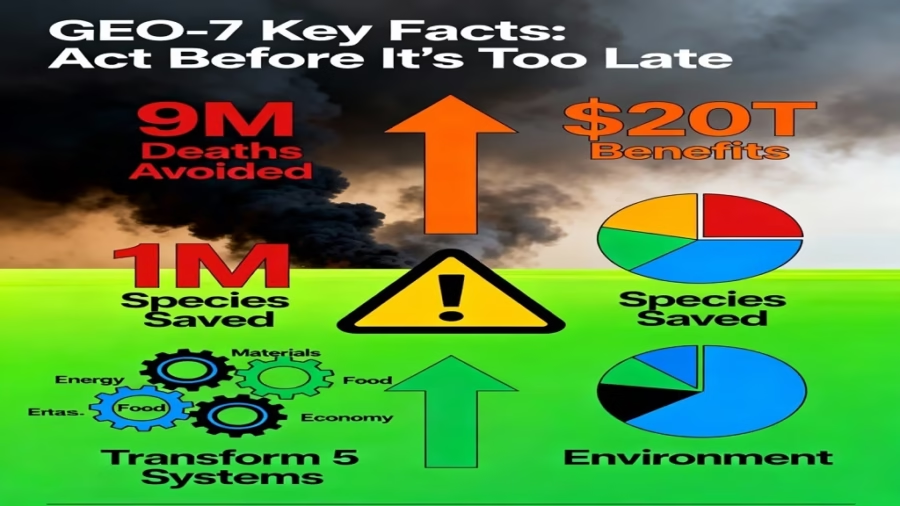
Turning Problems into Solutions-
GEO-7 moves from fragmentation in environmental issues to a systems approach, in which climate, biodiversity, pollution, and waste are seen as interconnected components of human activities.
- Identifies Root Cause Systems: Addresses three key systems that are linked and are drivers of degradation: energy, food, and waste/materials, as well as enabling economic and finance systems that support this degradation.
- Avoids Problem-Shifting: Single-issue solutions, such as increasing biofuels, result in problem-shifting, such as land use competition; this can be avoided by using systems analysis.
- Emphasises Interdependencies: Relates energy consumption to food and mineral production by highlighting how a conflict over the use of the land for renewables, food, and minerals may arise.
- Scenario-Based Pathways: Offers a business-as-usual (negative trends) outcome, as well as two target-seeking scenarios, technology-based and behaviour-based, to simulate a pathway for 2030 SDGs and 2050 goals.
- Solution Pathways for Transformation: Outlines step-by-step approaches for transforming different systems, including a transition from fossil fuels to a low-carbon economy (energy), a 2/3 reduction in food system impacts (biodiversity), and a transition to near-zero waste through circular economies (pollution).
- Holistic Integration: This combines evaluation of environmental states with policy evaluation, regional analysis, and cooperation benefits to align with SDG goals and agreements like Kunming-Montreal.
- Whole-of-Society Focus: Emphasises cooperation between various stakeholders in governments, businesses, NGOs, and indigenous peoples in order to enact different changes, using SDG interaction maps.
Integrated Pathways Transforming Future-
- Energy System Transformation
The GEO-7 calls for rapid decarbonisation through large-scale renewables, higher efficiency, and phasing down unabated fossil fuels. Investments in grids, storage, and distributed systems expand access while cutting emissions and pollution. That shift decreases climate risks, cuts air pollution-related deaths, and creates job-rich economies, proving green pathways enhance resilience over fossil dependence.
- Rethinking Food and Land Use
Unsustainable agriculture, deforestation, and overuse of chemicals undermine soil and ecosystems and connect to climate and biodiversity crises. GEO‑7 encourages regenerative farming, ecosystem protection, land restoration, reduction of food waste, and sustainable diets to achieve food security and public health.
- Materials, Waste, and Circular Economy
Linear “take-make-dispose” systems deplete natural resources and generate pollution. GEO‑7 pushes for circular designs for durability, repair, reuse, and recycling. Policies that drive this transition include producer responsibility, eco-standards, and supply chain transparency backed by innovation and changing norms of consumption.
- Health, Equity, and Economic Co-Benefits
Well-designed actions will avoid more than 9 million premature deaths every year by mid-century through cleaner air and fewer chemicals. Trillions in global benefits arise from avoided damage, health savings, productivity gains, and green jobs growth.
- Governance
Whole-of-Government and Society Fragmented approaches shut the door on progress, while GEO‑7 calls for bringing the environment into the nexus of finance, industry, transport, and social policies. “Whole-of-society” collaboration between businesses, civil society, indigenous groups, and scientists uses SDG mapping for co-benefits and trade-off management.

GEO-7 & Global South-
These findings of GEO-7 resonate in particular with developing countries under the dual pressure of growth and environmental limits.
- Dual Challenges: Balance energy access, infrastructure expansion, and jobs with climate risks, pollution, and ecosystem threats.
- Leapfrogging Opportunities: Renewables, sustainable agriculture, and circular models create an avenue for green technology adoptions without high-carbon lock-in.
- India-Specific Alignment: It will support the country’s targets related to renewable energy, emission intensity reductions, and air quality enhancement in the face of rapid urbanisation.
- Finance and Equity Needs: Appeals for fair financing, technology transfer, and capacity-building to avoid adding an undue burden on poorer countries.
- National Implementation: Faster policy execution and stronger governance of SDGs with integrated planning are deeply required in emerging economies.
ALSO READ- India Acts Swiftly to Resolve IndiGo Flight Disruptions Crisis
Conclusion-
Finally, GEO-7 is both a wake-up call and a guide to the future. On the one hand, it illustrates that a business-as-usual approach will lead to further environmental crises and inequalities, but it also highlights that other, more sustainable futures are still achievable. Instead, through a focus on transformations in energy, food and land, and in materials and waste, and by placing these transformations into a governance context that also brings in issues of equity and inclusion, several challenges, such as clean air, a stable climate, robust ecosystems, and a resilient economy, can still be met. The central message of GEO-7 is that it has yet to be determined what the future holds for our world.
FAQs-
A. GEO-7 is the seventh edition of UNEP’s flagship report, launched in December 2025, assessing the planet’s environmental state and outlining transformation pathways for energy, food, materials, and more to meet SDGs.
A. Rising GHG emissions (1.5% annually since 1990, 1.55°C warming in 2024), 1 million species at risk, 20-40% land degraded, affecting 3 billion people, 9 million annual pollution deaths, and plastic waste at 8,000 million tonnes.
A. Current policies fail to meet environmental SDGs, Paris Agreement limits, and Kunming-Montreal biodiversity targets, risking 4% GDP loss by 2050 and 20% by 2100.
A. Five key areas: economy/finance, materials/waste (circular models), energy (decarbonisation), food/land (regenerative agriculture), and environment (conservation/restoration).
A. Launched December 9, 2025, during UNEA-7 in Nairobi, with summaries for policymakers.
A. Calls for “whole-of-government” integration and “whole-of-society” collaboration, including businesses, indigenous knowledge, and SDG interaction mapping for co-benefits.
A. Aligns with renewable targets and emission cuts; offers leapfrogging to green tech but needs fair finance and tech transfer to avoid burdens.