
For the upcoming term of 2027-2031, the United Nations (UN) is set to select its next Secretary-General, which is going to be held in 2026. The UN has officially implemented the election process as the present Secretary-General, Antonio Guterres’ term is ending on 31st December 2026. The institution has begun its search for its successor with strong emphasis on transparency, inclusivity and regional diversity. The President of the UN General Assembly, Annalena Baerbock, highlighted the need for dedicated and effective leadership to uphold the UN’s core principles. This multi-phase election process is buzzing in the news where the eyes are on the preferred candidates that will reflect the global community’s commitment who embody the UN’s core pillars, such as peace, human rights, security and sustainable development. In this article, we will unravel the details about the elections and the contenders who are in the race to become the UN General Secretary 2027-31.
ALSO READ- India Back on Executive Board, Re-Elected for UNESCO 2025-29
What is the UN Secretary-General and Its Role?
A General Secretary of the United Nations serves as the chief administrator of the organisation, which is appointed by the General Assembly on the Security Council’s recommendation for a term of five years. The position was recently occupied by António Guterres (Portugal), who was elected in 2017.
Main Responsibilities:
A General Secretary is responsible for:
- Plays a key role in diplomacy, advocacy, and management.
- Oversees the UN Secretariat’s operations, including a staff of over 36,000 handling research, peacekeeping, global emergencies and mediations.
- It appoints undersecretary-generals for positions such as head of UNICEF or UNDP.
- Also, they can alert the Security Council to threats against international peace and security under Article 99.
- Acting as a mediator, it uses “Good Offices” in conflicts, peacekeeping oversight and global crises.
Election Process of the UN Secretary-General-
Here is the detailed process for how a candidate is elected for the position of Secretary-General in the United Nations:
- The process starts with a formal letter from the Presidents of the UN General Assembly and the Security Council, inviting member states to nominate candidates 12-18 months before the term expires.
- Nominees have to submit their CVs, vision statements, financial disclosures, and administrative experience through a dedicated portal.
- Nomination and Candidate Dialogues: Open nominations run for several months, emphasising gender balance, regional rotation, and transparency. The General Assembly holds public, webcast interactive dialogues in which candidates present visions and answer questions from member states to ensure accountability.
- Security Council Evaluation: The Council holds a series of private, informal straw polls using colour-coded ballots (green: encourage, yellow: no objection, red: oppose); to pass, a candidate must receive at least 9 positive votes with no vetoes from the P5. After 3-5 rounds, the Council adopts a formal resolution recommending one candidate.
- General Assembly Approval: The Assembly decides on the recommendation by simple majority or acclamation, and almost always confirms rapidly. The Secretary-General’s term starts on January 1 and is a 5-year renewable term. In 2027, nominations opened in November 2025.
Let’s Know the Candidates for Secretary-General-
Declared to be Nominated Until the Main Elections:
- David Choquehuanca (Bolivia, Latin American and Caribbean Group)
An Aymara Politician, David Choquehuanca, has been Bolivia’s Vice President since 2020. He was nominated on April 25, 2025, by indigenous groups such as Unity Pact and CIDOB. Also, David served as the former Foreign Minister, 2016-2017 and ALBA Secretary-General, 2017-2019. He represents indigenous leadership with a focus on ancestral knowledge.
- Michelle Bachelet (Chile, Latin American and Caribbean Group)
Nominated on September 23, 2025, by President Gabriel Boric, Michelle Bachelet is Chile’s first female President (2006–2010, 2014–2018). She served as UN High Commissioner for Human Rights (2018–2022) and UN Women Executive Director (2010–2013), championing gender equality, education reform, and LGBTQ+ rights.
- Rebeca Grynspan (Costa Rica, Latin American and Caribbean Group)
Rebeca Grynspan is UNCTAD Secretary-General (2021–present), focusing on trade and development. Previously, Ibero-American Secretary General (2014–2021), Costa Rica’s Second Vice President (1994–1998), and UNDP Regional Director for Latin America (2006–2010). She was nominated on October 8, 2025.
Running Candidates:
- Colombe Cahen-Salvador (France)
Colombe Cahen-Salvador is a political activist and co-founder/co-director of Atlas Movement since 2020, uniting 25,000+ members across 130+ countries to tackle climate, AI, wars, dictatorships, pandemics, and poverty through UN reform. She is the co-founder of Volt Europa and has worked at UN Human Rights and the Norwegian Refugee Council.
- Bruno Donat (Mauritius/USA)
Bruno Donat was a Mauritian-American diplomat who headed, until recently, the UN Mine Action Service Geneva office (2019-2025), specialising in demilitarisation, genocide prevention, and promotion of women candidates. He speaks out for civilians in Palestine, engaging in hunger strikes in support of voices in Gaza.
- Rafael Grossi (Argentina)
Rafael Grossi is the first Latin American head of the IAEA since 2019, excelling in nuclear non-proliferation. Chair of the Nuclear Suppliers Group (2016), leading the NPT Review Conference (2020), and head of critical Zaporizhzhia inspections during the Ukraine conflict.
Speculative Candidates:
- Jacinda Ardern (New Zealand)
Jacinda Ardern was Prime Minister of New Zealand from 2017 to 2023, leading the nationally recognised COVID-19 response of the country and implementing some of the most profound gun control laws after the Christchurch mosque attacks. She became the Special Envoy to the Christchurch Call in 2023.
- Alicia Bárcena (Mexico)
A biologist and an experienced diplomat, born in 1952. Since 2024, Alicia has been serving as Mexico’s Environment Secretary and in 2023-2024, she was Foreign Secretary. From 2008 to 2022, she was the Executive Secretary of ECLAC. Bárcena has also held top UN management roles, including UN Chef de Cabinet and Under-Secretary-General for Management.
- Maria Fernanda Espinosa (Ecuador)
Served as Foreign Minister and Defence Minister, and was President of the UN General Assembly from 2018 to 2019. Maria’s experience in serving at multiple government portfolios and in diplomatic leadership underpins her global perspective and enables cross-sector collaboration on peace, security, and human rights issues.
- Kristalina Georgieva (Bulgaria)
Kristalina has been the Managing Director of the International Monetary Fund (IMF) since 2019. She had previously held senior roles at the World Bank and European Commission, with emphasis on economic development and response to crises.
- Vuk Jeremić (Serbia)
Vuk Jeremić was the Foreign Minister of Serbia from 2007 to 2012 and President of the UN General Assembly from 2012 to 2013. His diplomatic roles range from peace negotiations to multilateral engagement in shaping the international relations of Serbia during its most turbulent regional periods.
- Amina J. Mohammed (Nigeria/UK)
From 2017, Amina J. Mohammed has served as the UN Deputy Secretary-General. She earlier served as Nigeria’s Environment Minister, leading, through her work, the sustainable development and climate action efforts globally by combining governance expertise with international diplomacy.
- Mia Mottley (Barbados)
Prime Minister of Barbados (2018), Mia is noted for climate advocacy and economic leadership for Small Island Developing States, working to elevate Caribbean needs on the global stage amid climate change challenges.
- Achim Steiner (Brazil/Germany)
Achim Steiner was appointed UN Development Programme Administrator in 2017, having previously headed the UN Environment Programme. He brings years of experience in environmental and development policy into his work on climate, sustainability, and inclusive growth.
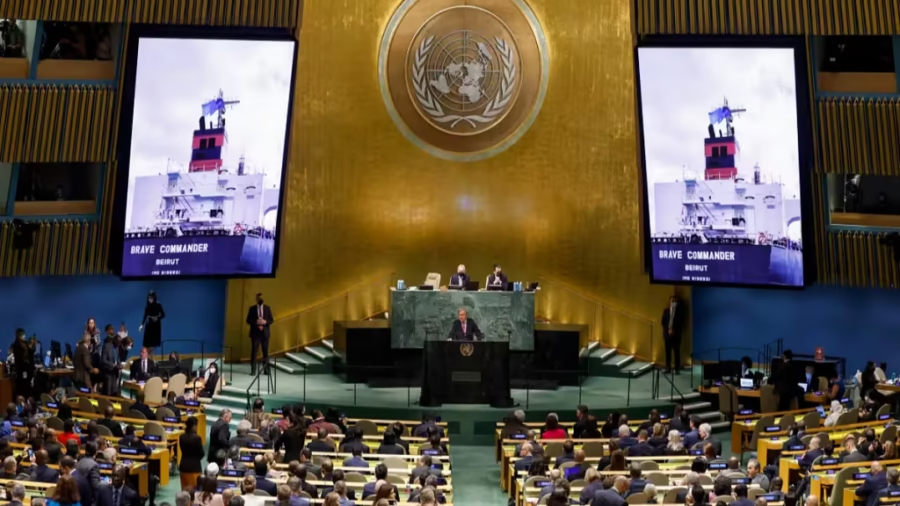
How P5 Influences Elections?
- The election process for the Secretary-General involves the five permanent members of the UN Security Council: the United States, Russia, China, France, and the United Kingdom.
- All five have a veto that can be exercised against the selection of any candidate during voting at the Security Council, thus giving them, in effect, the power to shape or block an appointment.
- To be recommended to the General Assembly for appointment, a candidate must receive at least nine affirmative votes, including the concurring votes of the five permanent members, without a veto.
- The consensus of the P5 is essential, and their political considerations heavily affect who becomes the next Secretary-General.
- This authority ensures that the leadership will be acceptable to all the major powers and maintains the geopolitical balance within the UN system.
Conclusion-
The 2026 UN Secretary-General election represents a defining moment for global multilateralism, testing transparency reforms against P5 veto power amid budget crises and geopolitical tensions. With Latin America’s strong field, African aspirations, and women’s leadership push, the winner—taking office January 2027—must tackle UN reform, humanitarian failures, and climate threats while balancing major powers. This race will shape the UN’s credibility for decades.
FAQs-
A. The election process for the next UN Secretary-General is expected to take place in mid-2026, as António Guterres’ second term ends on 31 December 2026. The new Secretary-General will assume office on 1 January 2027.
A. The UN Secretary-General is appointed by the UN General Assembly based on the recommendation of the UN Security Council. The Security Council’s decision carries the most weight, as it must agree on a single candidate before sending the name to the General Assembly.
A. The process includes:
Nomination of candidates by UN member states
Informal dialogues or “hearings” with the candidates
Security Council consultations and “straw polls”
Final recommendation by the Security Council
Formal approval by the UN General Assembly
A. Official nominations have not yet been finalised. However, many media and diplomatic circles expect candidates from Eastern Europe, as it is the only region that has never held the position. Several names are likely to emerge through government nominations in 2026.
A. The Secretary-General serves a five-year term, which can be renewed for another term based on member-state support.
A. Yes, there is no limit on the number of serving terms. The Secretary-General traditionally serves two terms. António Guterres is currently in his second term.