
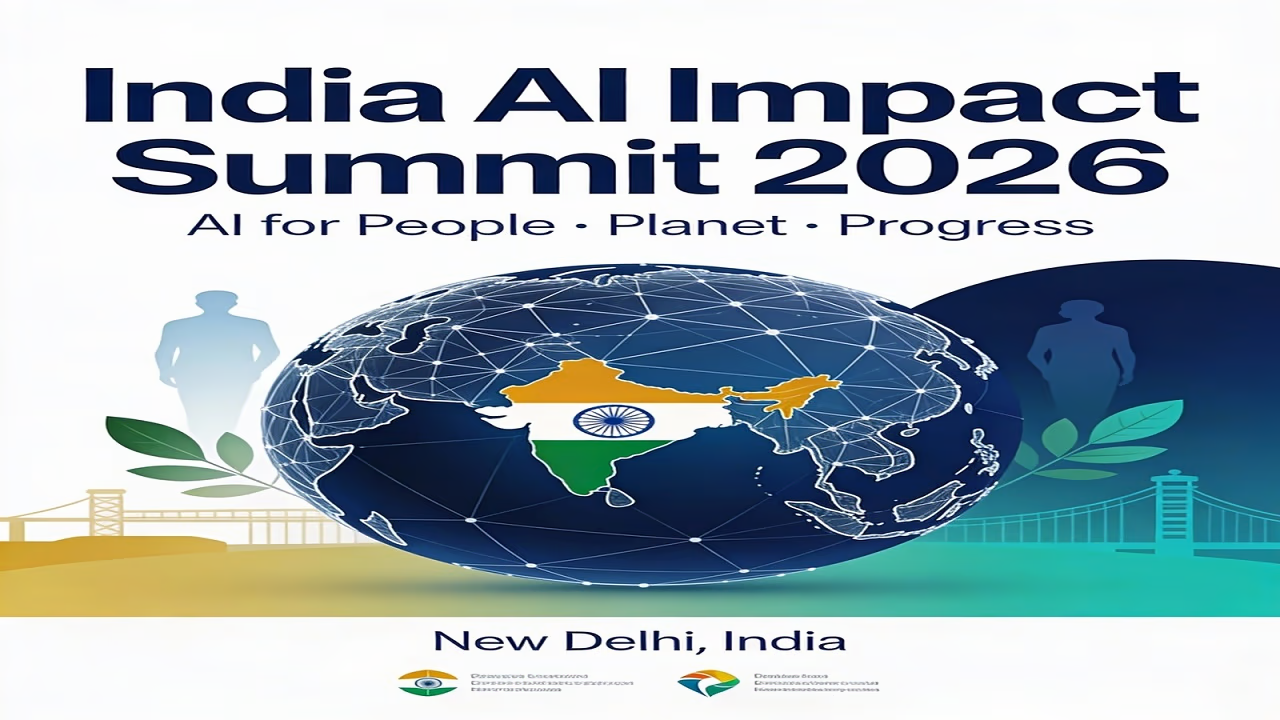
Artificial Intelligence is reshaping economies, governance, and everyday life — and the India AI Impact Summit 2026 sets the stage for meaningful global collaboration in this transformative journey. Centred on the guiding principles of People, Planet, and Progress, the summit brings together leaders, innovators, researchers, and youth to explore how AI can empower communities, strengthen digital ecosystems, and drive sustainable growth. From the Seven Chakra action themes to pre-summit dialogues and innovation showcases, the event highlights India’s pivotal role in shaping responsible and inclusive AI adoption. Read the article to know more about its vision, initiatives, and global impact.
ALSO READ- Youth Can Make India Atmanirbhar: Amit Shah at Yuva Business Maha Sammelan
What is the India AI Summit 2026?
The India AI Summit 2026 is a global flagship for AI advances, transforming rich data into an AI powerhouse. In this event, AI-based innovations are projected as a prominent tool for different sectors and enterprises. Hosted by the Government of India through the IndiaAI Mission, the division of the Ministry of Electronics and Information Technology(MeitY), focuses on leveraging artificial intelligence for equitable development, innovation and global cooperation.
- The main event is scheduled in New Delhi from 19 to 20 February 2026.
- This summit has driven its bases from global AI events, including the UK’s AI Safety Summit 2023, AI Seoul Summit 2024, and France AI Action Summit 2025.
- The main focus of the summit is to switch from safety and regulation discussions to impact-oriented outcomes that will impact real-world situations.
The Three Sutras-
The AI Summit 2026 is supported by the three sutras or the foundations—People, Planet and Progress.
People: This pillar emphasises that AI must ultimately serve human welfare and social empowerment. The innovations in the different sectors are introduced to ease, provide intelligent solutions and benefit people without delay in services. It ensures that AI solutions are human-centric, trusted and beneficial to diverse communities, particularly in developing and emerging economies.
The AI Summit underlines:
- Improved access to digital services
- Promote AI skills and jobs
- Through AI advances, it strengthens healthcare, learning, governance and citizen services.
- Reducing inequalities and bridging the AI divide
Planet: The second sutra planet reinforces the role of AI in protecting natural ecosystems and supporting climate action through sustainability in AI and resilience. With the collaborative initiatives and innovative challenges, the summit encourages AI applications that support a greener, more sustainable planet.
The key themes for this:
- Climate modelling and disaster resilience
- Sustainable agriculture and water management
- Clean energy transition
- Environmental monitoring and conservation
Progress: The third sutra, Progress, focuses on economic growth, innovation ecosystems and global cooperation. Progress here is defined not only as technological advancement, but as ethical, inclusive and future-ready development driven by AI.
This sutra of AI Summit underlines:
- Accelerate research, startups and industry partnerships
- Promote open, secure and responsible AI development
- Strengthen global collaboration frameworks
- Build shared infrastructure and datasets
Seven Chakras or Working Groups in AI Summit 2026-
The Seven Chakras are the thematic pillars — covering human capital, inclusion, trust, resilience, scientific advancement, shared resources, and social good — aligning international efforts toward outcomes that are practical and measurable. Together, they serve as a roadmap for collective action, helping countries exchange expertise, scale impactful innovations, and build a future-ready AI ecosystem grounded in ethics and equity. Here are the Seven Chakras:
- Human Capital- Emphasises a human workforce that is skilled in AI for a future-ready global AI workforce. It focuses on the following:
- Digital literacy
- Research capabilities
- Entrepreneurship
- Cross-border knowledge exchange for equitable participation.
- Inclusion for Social Empowerment- This chakra represents that AI must be accessible to the marginalised groups, rural and underserved communities. It reduces the social gap by introducing initiatives in:
- Healthcare
- Accessibilty
- Citizen services
- Inclusive digital ecosystems
- Safe & Trusted AI- It promotes AI innovations that are protected by advanced algorithms and trusted by the users. It highlights integration in the governance framework, risk mitigation, data protection and responsible innovation. This chakra displays the important qualitative features in AI systems, like ethics, accountability, transparency and security.
- Science- It aims to accelerate scientific innovation while enabling open, interoperable, and knowledge-driven AI ecosystems. It strengthens the global cooperation in:
- Frontier AI research
- Foundational models
- Computing infrastructure
- Academic collaboration.
- Resilience, Innovation & Efficiency- This working group emphasises AI to improve infrastructure through resilience, disaster preparedness, climate response, and operational efficiency. These are utilised across various sectors such as agriculture, transportation, urban development, and public services.
- Democratising AI Resources- The objective of this chakras to reduce the global AI divide and create a more balanced technology landscape. This Chakra promotes wider access to:
- Datasets
- Compute resources
- AI tools
- Open innovation platforms, especially for developing and emerging economies.
- AI for Economic Development & Social Welfare- It emphasises AI as a catalyst for economic growth, entrepreneurship, productivity, and welfare outcomes. It supports initiatives:
- Create sustainable livelihoods
- Encourage innovation-led industries,
- Deliver measurable social impact
ALSO READ- Launch of LVM3-M6: New Cosmic Era in Indian Space Odyssey
Objectives and Vision of India AI Summit 2026-
The main objective of the India AI Impact Summit is to create a shared global roadmap for deploying AI responsibly across sectors while ensuring that its benefits are inclusive and widely distributed. Summit organisers have articulated a vision where AI acts as a catalyst for advancement in key areas such as healthcare, agriculture, education, governance, and climate action.
Strategic objectives are:
- Global cooperation on AI governance principles that respect human rights, fairness, and safety.
- Showcasing India’s AI innovations and foundational models, with opportunities for collaboration.
- Bridging the Global AI Divide by elevating perspectives from the Global South.

Key Areas for AI Transformation-
The key areas for implementing the AI revolution to improve the living standard and economic growth are:
- Human-Centric & Inclusive AI: It focuses on accessibility, social empowerment, digital inclusion, and equitable technology adoption.
- Public Services & Governance: AI systems in data-driven governance, citizen-centric service delivery, and smart administration.
- Economic Growth & Industry Innovation: Startup ecosystems, productivity enhancement, enterprise, and entrepreneurship are adopting AI innovations to boost their performance.
- Research, Foundational Models & Scientific Collaboration: Frontier research partnerships, computing ecosystems, and cross-border academic cooperation.
- Safe, Secure & Trusted AI Frameworks: Ethics, accountability, risk mitigation, safety standards, and responsible AI design.
- Climate Resilience & Environmental Sustainability: Disaster management, climate modelling, resource efficiency, and sustainable development.
- Healthcare, Education & Social Welfare: AI applications designed specifically for health systems, skilling, learning, and societal welfare.
- New Talents: With innovative AI systems and global talent development programmes, new talent can be introduced to prepare future AI revolution.
- Global Collabs & Multilateral Cooperation: Global collaboration integrated with AI across governments, industry, academia, and civil society for shared results.
- Infrastructure & AI resources: Digital resources like open datasets, compute availability, digi-platforms, and infrastructure together help in reducing the digital gap for everyone.
Events for AI Breakthrough and Future Advancement-
India AI Impact Expo 2026:
- Serves as a global showcase of cutting-edge AI innovations, research breakthroughs, and real-world technology deployments from India and partner nations.
- The Expo brings together startups, research institutions, technology companies, and government initiatives to demonstrate how AI is transforming various sectors.
- It also acts as a collaborative marketplace for policy dialogue, investment partnerships, cross-border research exchange, and industry networking, enabling participants to explore scalable AI solutions with measurable societal and economic impact.
AI for All:
- A flagship initiative that highlights AI solutions designed to improve the quality of life and ensure that technological progress benefits all sections of society.
- The program encourages the development of AI applications that address challenges such as digital inclusion, accessibility, rural empowerment, public service delivery, and citizen-centric governance.
- Through innovation challenges and global participation, AI for All aims to promote equitable, people-centric, and development-focused AI adoption, especially across emerging and developing economies.
AI by Her:
- AI by Her is a dedicated platform to promote women-led innovation, leadership, and entrepreneurship in AI.
- It encourages participation of women researchers, founders, technologists, and policymakers by providing visibility, mentorship pathways, networking opportunities, and global collaboration channels.
- It underscores the commitment to building a more inclusive and gender-balanced AI ecosystem, where diverse perspectives shape technology design, deployment, and policy frameworks.
Research Symposium:
- The Research Symposium brings together leading researchers, academicians, scientists, and students from India and across the world to deliberate on frontier AI research, foundational models, safety studies, and interdisciplinary applications.
- The symposium acts as a bridge between academic research, real-world innovation, and policy thinking, fostering knowledge exchange, collaborative research networks, and deeper engagement between academia, industry, and governments.
YUVAi:
- YUVAi (Young Innovators for AI) is a youth-centric initiative that inspires students and young innovators to develop AI-driven prototypes, ideas, and solutions for real-world challenges.
- It nurtures creativity, ethical awareness, problem-solving abilities, and early exposure to responsible AI innovation among school and university students.
- Through workshops, mentoring programs, and global recognition platforms, YUVAi aims to build a future-ready generation of AI creators, researchers, and changemakers.
Pre-Summit Events-
Pre-Summit Events are officially affiliated workshops, roundtables, conferences, hackathons, and other convenings held before the main India AI Impact Summit (19–20 Feb 2026) to enrich the Summit’s agenda.
- These events are organised worldwide by governments, academic institutions, industry groups, and civil society to bring diverse voices, insights, and practical perspectives into the Summit’s deliberations.
- Events can take various formats, including panel discussions, workshops, roundtables, symposia, innovation challenges, technology showcases, and academic seminars.
- They must be in-person or hybrid and take place between August 11, 2025, and January 31, 2026, to be eligible for official affiliation.
Pre-Summit Events typically follow one or more of these formats:
- Workshops are focused on specific sectors like health, agriculture, education, or governance.
- Panel Discussions & Roundtables are expert dialogues that provide policy insights and recommendations aligned with Summit themes.
- Showcases &Tech Exhibitions of AI systems and prototypes addressing solutions for real-world problems.
- Hackathons are competitive events that encourage participants to co-create solutions, fostering practical thinking.
- Research Presentations present an overview of the projects, studies, and synopsis of work carried out through visuals.
- Upcoming Event: On 16–18 January 2026, eRaksha Hackathon (IIT Delhi) is a national-level hackathon on cybersecurity, defence AI, and digital safety, bringing together student innovators to build practical, deployable solutions.
India’s Role in Global AI Leadership-
AI Impact Summit 2026 is more than a policy forum. It is a platform for fostering India’s Digital vision to democratise AI access:
- India promotes AI as a powerful enabler for public services, welfare delivery, and digital access. Its approach ensures technology reaches citizens, rural communities, and underserved groups.
- India advocates wider access to datasets, compute, and innovation platforms for all nations. This helps bridge technological gaps and supports equitable AI participation.
- India contributes actively to global dialogues on ethics, trust, accountability, and safety in AI. Its focus is on developing frameworks that protect users and strengthen societal trust.
- With a rapidly growing startup landscape, India demonstrates AI-driven entrepreneurship and research strength. This fuels economic growth, productivity, and technology-led development.
- India brings diverse perspectives into global AI policymaking and governance discussions. It ensures the needs of emerging and developing economies are heard and addressed.
Conclusion-
The India AI Impact Summit 2026 stands as a crucial milestone at the intersection of global cooperation, responsible technology, and inclusive innovation. With its focus on measurable outcomes and broad participation, the Summit is more than a conference—it is a strategic platform for shaping a future where AI empowers people, protects society, and drives sustainable development.