
In March 2026, an amendment proposal on the Foreign Contribution (Regulation) Act 2010 was introduced in the Lok Sabha by the Union government to have control over the foreign funds and assets to streamline the contributions received by NGOs, associations, trusts and other institutions. This amendment initiates tighter control on foreign finances, including the assets, rules compliance and investments. The bill states that the government was to fully close the FCRA regime, especially in cases where the organisation is cancelled, expires, or the license is not renewed.
ALSO READ- PM Modi Ignites Civil Servants to Implement ‘Ngrik Devo Bhava’ in Karmayogi Sadhana Week
Overview of the FCRA Amendment Bill 2026-
The Foreign Contribution Regulation Amendment Act 2026 (FCRA 2026) was introduced by the Union Legislation of the Government of India.
- The objective behind it was to establish an efficient mechanism for the receipt, utilisation, and accountability of foreign contributions, which are generally provided to NGOs or associations in the form of assistance.
- The bill was introduced in 2010, and it falls under the Ministry of Home Affairs (MHA), currently headed by Shri Amit Shah Ji. On 25 March 2026, in Lok Sabha, new changes in the bill were discussed; however, the opposition lacked confidence in the bill in order to proceed with the approval of the bill again.
- The last amendments in the FCRA bill were made in 2016, 2018, and 2020.
- According to the Statement of Objects and Reasons, due to weak implementation and provisions on assets, multiple investigations, unclear timelines of funds utilisation and vagueness in registration cessation.
- The bill is a statutory mechanism for authorising, supervising, managing, and disposing of foreign funds and related assets.
Objectives:
- The main objective of the implementation of the FCRA Bill 2026 is to ensure that such inflows do not adversely affect the national interest, public order or national security.
- To prevent the use of foreign funds in the name of anti-national, political or religious conversion activities.
Latest Status of the Bill:
However, Parliament has put off detailed discussion of the FCRA Bill 2026 implementation issues due to the protests of the Opposition parties and because of the Government’s power to seize the assets of the NGOs, and so this Bill is on hold at the moment.
Key Amendments introduced in the FCRA Bill-
On Wednesday (25 March 2026), the central government introduced key amendments in the FCRA Bill 2026 to strengthen the efficient management of foreign contributions and assets:
- Authority assigned for foreign-funded assets: The amendment in the bill assigns the power to the union government to appoint a “designated authority” to enable the government to take control, manage, and supervise the contributions and assets developed from foreign receipts by non-governmental organisations. The institutions under the FCRA comprise those institutions where the registration is suspended, cancelled, or not renewed. This raises concerns over the existing legal divide. Moreover, these contributions can be transferred or sold/converted, with proceeds directed to the Consolidated Fund of India.
- Extension of “Key Functionary” Definition: According to FCRA, a key functionary is the leading authority who is responsible for the management and control of foreign contributions. The changes to the bill have extended the definition to include partners, directors, trustees, the karta of a Hindu Undivided Family, the managing authority, and office stakeholders such as trusts, trade unions, and societies.
- Omitting Section 15 Legal Gap: The new structure replaces certain aspects of Section 15 of the existing FCRA, which has been ambiguous regarding these assets. The proposed FCRA amendment seeks to establish a definite time frame for the transfer or liquidation of these assets.
- Centralised Control through Prior Investigations: The Bill has been opposed on grounds of further centralisation of powers in India, including control over investigation, penalty, and disposal of assets of foreign origin. It enhances the FCRA Bill 2026 by transparency, accountability, and legal certainty for NGOs working under regulations by the central government.
- Automatic Cessation and Timelines: The amendments propose fixed timelines defined for funds receipt and utilisation under prior permission and registration cessation upon expiry, or non-renewal and transparent rules on assets management from abroad.
- Duration of Imprisonment Reduced: The new changes in the FCRA Bill reduce the imprisonment timeframe from 5 years to 1 year for the violators and rationalise penalties.
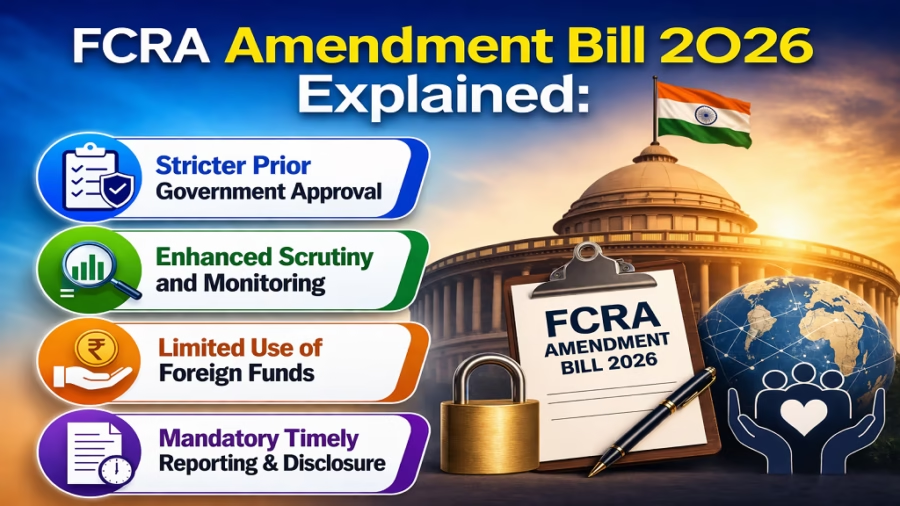
Provisions and Features in The Foreign Contribution (Regulation) Amendment Bill 2026-
Here are some provisions and features stated in the new FCRA Bill 2026 for compliance with regulations and systematic management of foreign contributions:
- Mandate Registration of NGO and institutions receiving foreign funds and assets: According to the amendments of 2026, NGOs and other institutions are not entitled to the receipt of foreign funds and assets. Until the organisation is registered or attains prior permission from the government, the funds are not accepted.
- Registration Eligibility: The following criteria are defined for organisations to register:
- The bill defines that an organisation must be registered under the Societies Registration Act, 1860 or the Indian Trusts Act, 1882 or section 25 of the Companies Act, 1956.
- The organisation must have a full-proof track of 3 years of the relevant activities.
- The organisation must uphold the minimum expenditure of up to 15 lakhs for the past 3 years.
- Designated FCRA Account for Accountability: According to the latest guidelines, the foreign contribution of the organisations must be received only in a single designated bank account opened with the State Bank of India, whose main branch is in New Delhi.
- Limitations on Funds Usage: The foreign funds and assets of the organisations cannot be transferred to any other person or organisation unless they don’t have a valid registration under FCRA.
- Validity of the FCRA Registration: An FCRA registration lasts up to 5 years of terms. The organisations and NGOs are suggested to apply for renewal of registration 6 months before the expiry date.
- Activities Prohibited under this act: the applicants applying for registrations must not represent fictitious entities, as this may violate the law under fraudulent circumstances. Additionally, these institutions should not have a historical trace of communal tensions, seditious activities or dissonance. Also, the FCRA restricts the use of foreign funds by candidates for election purposes, journalists, media persons, judicial authorities, government officials, politicians or political organisations for inappropriate utilisation.
FAQs-
A. The Foreign Contribution Regulation Amendment Act 2026 (FCRA 2026) was introduced by the Union Legislation of the Government of India for the receipt, utilisation, and accountability of foreign contributions, which are usually made available to either an NGO or an association.
A. On 25 March 2026, the Foreign Contribution (Regulation) Act 2026 amendments were introduced by the Home Minister, Shri Amit Shah, discussing the changes in the bill at the Lok Sabha.
A. The latest changes represent strong implications for controlling the inappropriate usage of foreign contributions and assets by NGO and organisations. One such amendment discussed was:
Registered institutions can receive funds.
A designated authority will keep an eye on the mobility of these funds and assets.
Imprisonment of violators was reduced from 5 years to 1 year.
Three years of proven record of relevant activities are required for registration eligibility.
A. The intervention of the opposition showed no faith in the bill, which has led to a pause in its approval.