
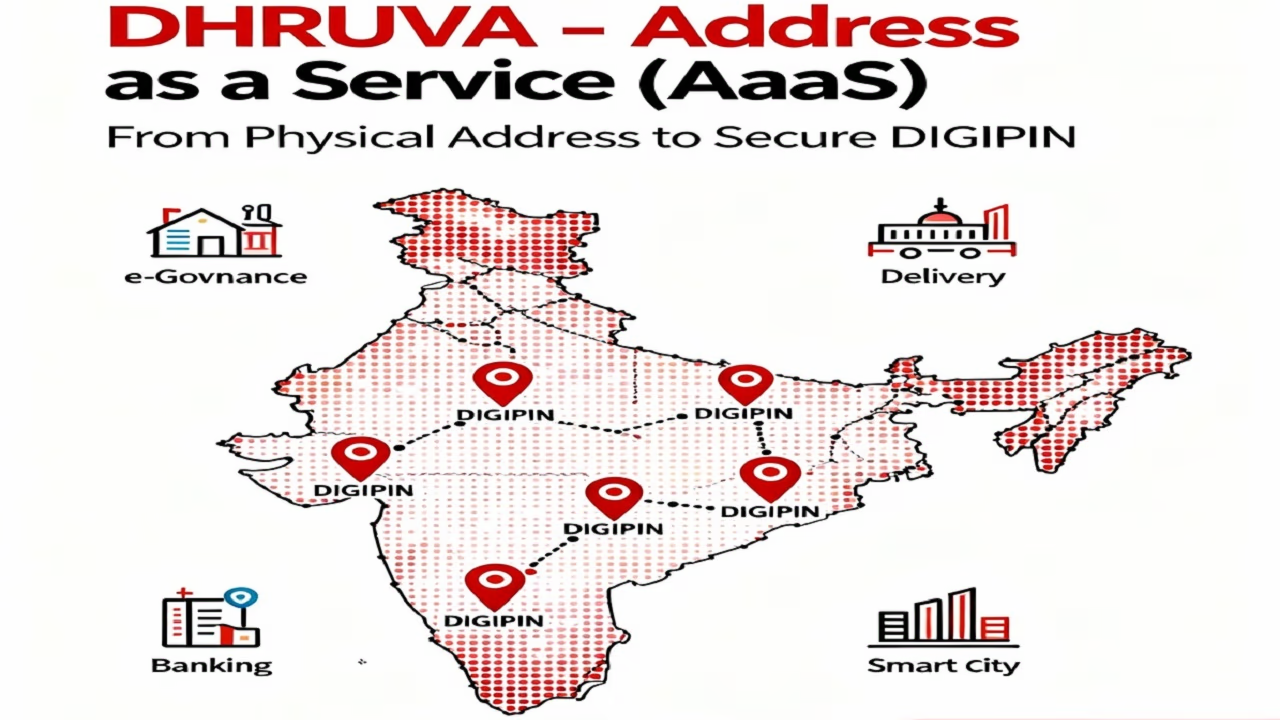
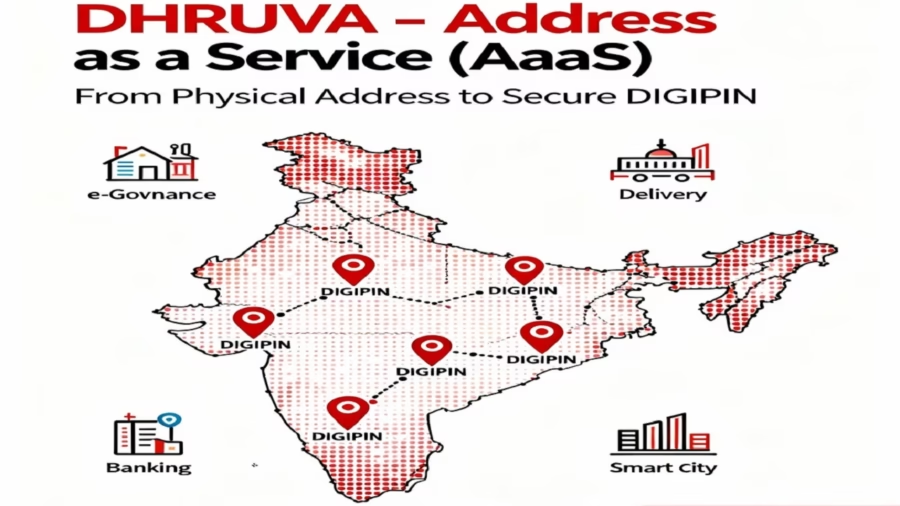
Recently, the Department of Posts has introduced important initiatives to standardise the physical address system within a digital address ecosystem, DHRUVA. Envisioning the expansion of the Digital Public Infrastructure (DPI), DHRUVA emerged from effective e-governance, efficient delivery services, and simplified address validation. The department has released a draft amendment to the Post Office Act 2023 that implements this initiative. Driven by a geocoded, consent-based system operating on lines similar to UPI, DHRUVA will enable every residence and business to generate a unique “DigiPIN,” ensuring seamless navigation, service delivery, e-commerce, and governance. As India moves towards a fully digital public infrastructure, let’s closely understand this initiative that marks a significant shift from conventional PIN codes to a smarter, secure, and standardised method.
ALSO READ- India Acts Swiftly to Resolve IndiGo Flight Disruptions Crisis
What is DHRUVA?
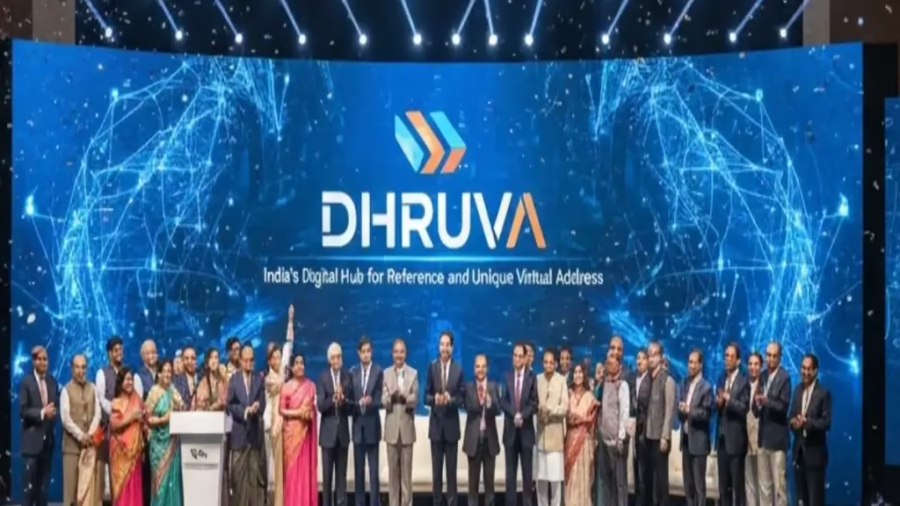
DHRUVA stands for Digital Hub for Reference and Unique Virtual Address. A national-level address management system is a framework introduced by the Department of Posts under the Ministry of Communication in collaboration with IIT Hyderabad and NRSC (ISRO).
- The draft was released on 7th December 2025, and the public comments are open till 31st December 2025 for suggestions and opinions.
- Under this, any location or place can be identified with a special digital address, like an email, called ‘DIGIPIN’ to replace primitive methods of recording the textual addresses.
- With the motive of enhancing Digital Public Infrastructure, DHRUVA is an open-source, geocoded addressing system that enables secure, verified and interoperable use of address for public and private services.
- This will be beneficial for Indian e-commerce websites like Amazon India, Myntra, Flipkart, etc., to use the addresses as labels instead of writing the full address. The end-user will verify these labels or ‘DIGIPIN’ for efficient business deliveries and ease in tracking the location.
- The Post Office Amendments will take place in the first quarter of 2026. The pilot testing will commence across different cities in early 2026.
Main Components of DHRUVA:
- DIGIPIN (Digital Postal Index Number): It is a 10-character alphanumeric code obtained from the latitude and longitude coordinates of a place. It divides India into a 4m x 4m small grid, assigns a unique DIGIPIN to every address, under the National Addressing Grid introduced by the Department of Posts.
- Digital Address Layer: It is a user-centric system built as a top layer on DIGIPIN. A person or business can create a simpler “label” like a virtual address ID linked to the DIGIPIN + descriptive address. This label can be shared instead of the full address.
How DHRUVA Transforms Physical Addresses to DIGIPIN-
- Instead of writing long, ambiguous addresses, like street name, locality, and landmark, you simply share a digital address label. The underlying DIGIPIN ensures that the exact location within a few metres is known and machine-readable.
- Users are in control because data sharing is consent-based; you decide if and when to share your address with whom. This helps with privacy, putting the power of address data in the hands of the individual.
- This will be useful across government services, private sectors, e-commerce, banks, delivery, emergency services, urban planning, and many more, where accurate location data plays an important role.
- By linking DIGIPINs to Adhaar numbers and UPI (Unified Payments Interface), it will act as a core infrastructure to streamline data sharing and services in e-commerce, medical emergencies, urban planning and e-governance.
- Users will have full access to manage, edit and share their DIGIPIN for various purposes.
- DHRUVA will also have multilingual support, mobile access and portability with identity systems like the Adhaar card.
DHRUVA as AaaS-
The core idea of the DHRUVA framework is AaaS, which means Address-as-a-Service. It is a Central Address Registry that offers a trustworthy and updated repository of verified addresses.
- A textual address is transformed into a Digital Address Identifier (DAI) that can be created, validated, updated and shared through APIs.
- AaaS creates an ecosystem of Address Service Providers and Validation Agencies that uses a single address stack, instead of firms maintaining their own fragmented databases.
- Approved public and private entities will be able to fetch, validate, or update addresses programmatically.
- Lifecycle management of DHRUVA, where addresses can be created, corrected, geo-verified, or retired in a managed way for demolished or merged properties.
- This will make address data reusable across government departments, utilities, banks, and logistics providers, and citizen-facing apps, reducing duplication and errors massively.
How Existing National IDs Can Be Linked With DHRUVA?
DHRUVA integrates with national ID systems, like Aadhaar, using complementary non-linked APIs to map verified identities to geocoded addresses without ever merging databases, preserving privacy. The key integration methods are:
- Aadhaar-linked address verification: During KYC or service enrollment, Aadhaar authenticates the identity, while the location linked to DIGIPIN is validated by DHRUVA—two-factor checks decrease fraud without data fusion.
- UPI-style consent flows: Citizens share DIGIPIN (address handle) along with a Virtual Payment Address through apps; service providers poll both stacks for comprehensive resident-location mapping.
- DigiLocker document sync: Property/utility docs in DigiLocker auto-populate DHRUVA addresses; Aadhaar e-sign verifies changes and creates tamper-proof address histories.
- ABHA/Health ID linkage: Ayushman Bharat Digital Mission has used DIGIPIN for geo-aware health camps, Aadhaar for verifying beneficiaries, and DHRUVA for ensuring accurate doorstep delivery. MOSIP interoperability: DHRUVA joins Aadhaar/ UPI as India’s 4th DPI pillar. Standard APIs enable seamless queries across identity, payment, and address layers.
Benefits of Digitalising Addresses as DIGIPIN-
- Accurate location and deliveries
Each address comes with a digital code, geo-tagged, greatly lessening wrong or failed deliveries and helping ambulances, police, and services reach the exact spot.
- Cleaner, unified address records
Different departments and companies can link to the same verified digital address, thereby reducing duplicates, fake entries, and inconsistent spellings across databases.
- Better targeting of government schemes
It can help map welfare benefits, subsidies, and services to real habitations and households, improving inclusion while reducing leakages or ghost beneficiaries.
- Lower business and logistics costs
E-commerce, couriers, and banks save time and money on account of reliable address verification, fewer return-to-origin parcels, and more efficient route planning.
- Secure, consent-based, address sharing
Instead, a virtual address identifier may be used by citizens instead of full text, enhancing privacy without losing the ease of digital use across platforms.

Future of DHRUVA for Better E-Governance-
DHRUVA is not merely an addressing reform but a fundamental building block of India’s next-generation digital state, where finally, geography and governance speak the same precise language and do so interoperably.
- Real-time dynamic addressing: Addresses auto-update for property splits, migration, or urban changes via APIs, allowing live governance dashboards for urban planning and disaster response.
- AI-enabled spatial analytics: Overlay DIGIPIN data with Aadhaar/UPI information to achieve predictive service mapping—identifying underserved areas, optimising school/health placements, and reducing welfare leakages.
- Global DPI export model: DHRUVA becomes India’s 4th stack layer – after Aadhaar/ UPI, licensed to more than 20 countries via MOSIP/ NPCI, setting address standards in developing markets.
- Drone/Autonomous Delivery Infrastructure: 4×4 m grid precision enables scaled drone logistics, reducing last-mile costs by 25% and transforming rural e-commerce/governance reach.
- Unified citizen services platform: Single DIGIPIN links property tax, utilities, DBT, and emergency services, thus streamlining 80% of location-based government interactions into one interoperable layer.
ALSO READ- 100 Days Child Marriage Free Bharat Campaign: India’s Bold Move Against Child Abuse
Conclusion-
DHRUVA represents India’s bold leap toward a unified, geo-precise addressing ecosystem that will establish a digital revolution in e-governance, commerce, and citizen services. It establishes Address-as-a-Service as the third pillar of Digital Public Infrastructure, alongside Aadhaar and UPI, reducing failure rates in last-mile delivery, welfare leakages, and data silos while ensuring the privacy of citizen data through consent-based sharing. Smarter cities and rural inclusion, among other things, are guaranteed as this framework scales up, reiterating that precise addresses lead to precise governance.
FAQs-
A. DHRUVA is the Digital Hub for Reference and Unique Virtual Address that creates geo-coded digital addresses for every location in India, standardising the addressing system, much like the UPI for payments.
A. Address-as-a-Service means verified addresses, delivered via APIs for government, businesses, and citizens to re-use across services without duplication.
A. DIGIPIN is a unique alphanumeric code connected to GPS coordinates and address text, easily shareable like a UPI ID for precise location without revealing full details.
A. No, Dhruva will not replace the Adhaar card. DHRUVA addresses where you stay, whereas Aadhaar defines your identity. They integrate via APIs for complete resident-location verification.
A. India Post acts as the nodal authority, while Address Service Providers and Validation Agencies, along with line ministries, ensure accuracy and updates.
A. Dhruva will be implemented after pilot testing across different cities in 2026, following amendments to the Post Office Act and integration with stakeholders in the first quarter of the year.