


Cicada COVID Variant BA.3.2 has rapidly spread across 20+ nations, which include 30 states in the U.S.A., some parts of Europe and Asia. This has raised a major concern about whether India is at risk or not from this variant. Earlier, the COVID-19 pandemic created havoc with breathing disorders and deaths that led to worldwide lockdown and the imposition of strict protocols to control the situation. Though it may appear like a chapter in history that we have moved past, with new variants arising, it is a timely reminder that the coronavirus continues to mutate. A subvariant of this virus, dubbed the “Cicada” variant (BA.3.2), has drawn worldwide attention to its impact on health. In this case, an interesting question arises: Is India at risk once again?
ALSO READ- India’s Six Sigma Push: Strengthening ECMS Quality
Overview of Cicada COVID Variant BA.3.2.-
The “Cicada” variant, also known as BA.3.2, is from the sub-lineage of the Omicron family and has established itself as a major “Variant Under Monitoring” (VUM) by the World Health Organisation (WHO) on 25 December 2025. The experts are monitoring this because:
- Immune escape from previous vaccination or infection
- To check vaccine effectiveness
- Transmissibility
The new strain is a subvariant of the older Omicron BA.3 variant and was given its name because of its “cicada-like” behaviour, evading detection for nearly a year after its discovery in South Africa in 2024 before resurfacing worldwide. With 75 mutations, including over 50 spike protein changes, the new variant is highly adept at immune escape, giving it the power to infect those who are immune. The informal name for this variant was SARS-CoV-2 lineages, which has been given the scientific designation ‘BA.3.2.’
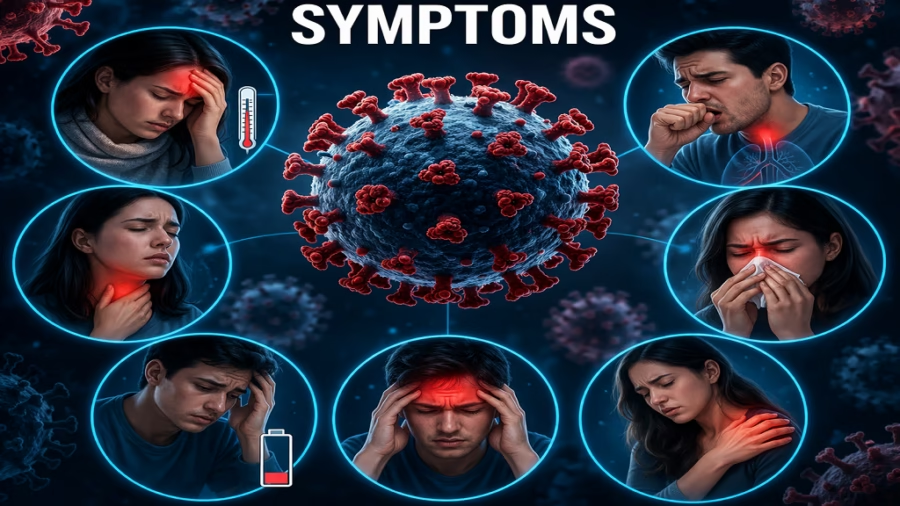
Symptoms of COVID-19 Cicada Variant-
According to current findings, the new Cicada BA.3.2 possesses symptoms similar to the Omicron sub-variants. These variants majorly affect the upper and lower respiratory systems, causing symptoms. However, vaccinated individuals are less prone to catching the symptoms, whereas vulnerable groups like older individuals and people with underlying conditions must be careful and look out for these symptoms:
- Fever and fatigue
- Sore throat
- Cough
- Running nose
- Chest congestion
- Body pain
- Smell and taste senses are lost
Severe symptoms of this variant include:
- Bluish lips
- Difficulty in breathing
- Chest pain
- Diarrhea
What is the Cause of the cicada variant spread?
The spread of the Cicada COVID BA.3.2 can be credited to carelessness and not taking early actions before the variant cases were detected in the region. The spread of the Cicada variant (BA.3.2) is fueled by a combination of biological changes in the virus, human movement and interaction in the physical world. The spread of the virus is not fueled by a single factor but is a combination of all factors.
- Heavy Mutation in its Spike Protein: This suggests the COVID-19 variant BA.3.2 carries around 70-75 mutations in its spike protein, which means it is the part of the cell virus that attaches to the human body. Also, it is different from other variants as it is unrecognisable by the earlier vaccines and our body to counter it. This makes it partially invade the human immune system.
- Mobility and Ability to Transit: Due to no restrictions in crowding, local gatherings have accelerated their speed of expansion across 23 states in the US and other places like Europe and Asia. As this variant is the evolved version of the previous Omicron family, many people’s immunity is not ready to fight this.
- Global Travelling and Movement: The variant BA.3.2 has earlier been found in South Africa (2024). After that, it has been found among the travellers, wastewater, and samples in various countries. The virus has spread across various countries due to travel from one country to another. Human meetups and interactions have caused the transmission of Cicada faster.
- No Prevention: The major cause of the spread of the Cicada virus is that the foreign government authorities did not managed its control by imposing restrictions, and people stopped adhering to the precautions. Secondly, the government did not introduce guidelines on the safety measures to be followed by the citizens against the Cicada COVID-19 Variant BA.3.2. For instance, the citizens did not wear masks, wash their hands, or maintain distance.
India’s Update on the Cicada COVID-19 Variant BA.3.2: Is India at Risk or Not?
The biggest question in relation to the Cicada variant BA.3.2: Is India in a state of risk? Whether similar conditions, such as the COVID-19 pandemic in 2019, will emerge due to continuous negligence in stopping the BA.3.2 variant from spreading? What are the Indian authorities doing, and what advice do experts offer?
Unlike the U.S.A. and Europe, the conditions in India are not as alarming, says the Indian Health Experts in relation to the new Cicada variant.
The wave-like early pandemic is unlikely to arise, but the impact may be mild.
- The conditions are not as severe as Delta or early Omicron waves like NB.1.8.1 and XFG; however, the immunity-invasion traits may raise new concerns for the “summer surge.”
- Cases reported globally tend to show symptoms similar to previous COVID-19 waves, but no immediate hospitalisation is needed so far.
Also, experts claim that the variant is not likely to spread as:
- Most of the people in India were vaccinated during the previous pandemic wave, which signals that Indians have strong immunity to fight the BA.3.2.
- India’s advanced medical testing infrastructure and variant tracking system are responsible for supervising the spread of the Cicada variant.
- Also, no growth of the virus is found in Indians, despite heavy mutation spikes in the protein.
- However, due to India’s population density, there are chances of widespread transmission of the variant, making it a major concern.
- At last, the health experts suggest there is no need to panic about the variant as the situation is under continuous vigilance, and those individuals who are at risk will get immunity boosters.
- Citizens of India are to follow similar precautionary protocols like the COVID-19 coronavirus pandemic; however, it is not mandatory, but for public safety, it will be a crucial help.

Fight Against BA.3.2: Precautions to be Taken-
As India is not in the danger zone, we can still step up to minimise the spread of the Cicada COVID-19 Variant BA.3.2 by just adopting healthy habits and taking precautions:
- Hand hygiene is a must to avoid contact with viruses. By washing them and using sanitisers before eating food or touching areas that seem unhygienic.
- You must wear a mask such as FFP2, KN95 or N95, which are best for air filtration in public places, to avoid air spread.
- Take updated vaccinations and immunity boosters.
- Eat immunity booster food to strengthen your immune system.
- Ensure clean air in homes and offices, and use air filters.
- Check out for symptoms and consult doctors for help. Do not panic. Isolate yourself if you have symptoms like a cold and cough.
- Keep yourself informed with the latest news and health department instructions.
FAQs-
A. The latest variant, which has been spread across the U.S.A., Europe and Asia, is from the Omicron family, Cicada COVID-19 Variant BA.3.2, which has heavier mutation than other coronavirus variants.
A. Right now, India is not at risk of this variant like the previous pandemic in 2019. Health centres and authorities are continuously monitoring the situation; however, carelessness and not taking precautions can lead to severe consequences.
A. The evolved variant triggers the immunity quicker with its 70-75 mutation spikes. The other major reasons include crowding, not maintaining the distance, hygiene issues, weak immunity, and not taking precautionary measures.
A. To prevent yourself from the Cicada virus, follow these precautions:
Wear a mask in public
Wash your hands and use sanitiser.
Eat healthy to strengthen immunity.
Take immunity boosters.
Consult a doctor if symptoms are detected.